913A Armament Systems Maintenance Warrant Officer
When a tank turret stops traversing in the middle of a gunnery rotation, or a field artillery system throws fault codes no one in the unit can decode, one person fixes it. The 913A Armament Systems Maintenance Warrant Officer is the Army’s resident expert on every crew-served weapon, armament platform, and fire control system in the inventory. This is not a supervisor role tacked onto a senior NCO. You own the technical answer when the commander has none.
Most soldiers spend a career maintaining equipment. A 913A warrant officer spends a career knowing it better than anyone in the Army.
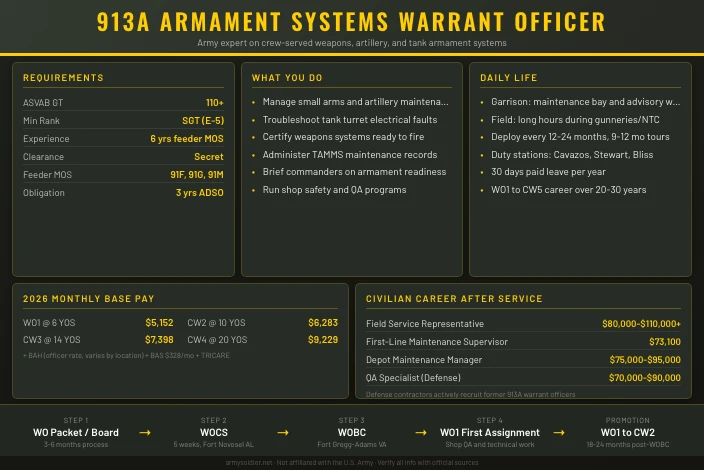
Job Role and Responsibilities
The 913A Armament Systems Maintenance Warrant Officer manages maintenance and repair operations for small arms, field artillery, tank turret systems, and armament platforms at field and sustainment levels. This warrant officer directs troubleshooting of complex electrical, hydraulic, and fire control malfunctions, oversees quality assurance programs, administers The Army Maintenance Management System (TAMMS), and serves as the senior ground armament technical advisor at brigade and higher echelons.
Technical Expertise and Scope
The 913A operates at the intersection of mechanical precision, electrical systems, and weapons technology. Crew-served weapons like the M240 and M2 machine gun, large-caliber cannon systems on Bradley and Abrams platforms, field artillery tube systems, and associated fire control instruments all fall inside this warrant’s lane. Where an enlisted armorer knows his assigned weapons, a 913A knows the entire armament family across the brigade – and knows what a failed part actually means for combat readiness.
The distinction from enlisted 91F armament repairers is authority and scope. Senior NCOs execute repairs. The 913A determines whether a repair is correct, signs off on technical certifications, sets shop safety standards, and tells the commander when a system is or is not ready to fight.
Related MOS Codes and Designators
| Code | Title | Notes |
|---|---|---|
| 913A | Armament Systems Maintenance Warrant Officer | Primary MOS; field and sustainment maintenance |
| 91F | Small Arms/Artillery Repairer | Primary enlisted feeder MOS |
| 91G | Fire Control Repairer | Feeder MOS with armament overlap |
| 91M | Bradley Fighting Vehicle Systems Maintainer | Feeder MOS; turret and weapons systems experience |
| A8 | Master Gunner (ASI) | Adds armament technical depth; strengthens 913A packet |
| K8 | Armor Master Gunner (ASI) | Armor-specific armament expertise |
Mission Contribution
The Army fields lethal systems. Lethal systems need people who can keep them that way. A 913A warrant officer maintains the materiel readiness reporting that commanders rely on for operational planning. When a brigade prepares for a National Training Center rotation, it’s the 913A who assesses armament system readiness across every battalion, identifies parts shortfalls, and briefs the S4 on what will and won’t be ready.
At higher echelons – division and corps – a senior 913A serves as the branch technical advisor, shaping maintenance policy, reviewing modification work orders, and mentoring junior warrant officers in the career field.
Systems and Equipment
Primary systems this warrant officer maintains at the expert level include:
- Tank armament: M256 120mm smoothbore cannon (Abrams), M240 coaxial machine gun, fire control systems and thermal sights
- Infantry fighting vehicle armament: M242 25mm Bushmaster chain gun (Bradley), associated elevation and traverse drives
- Field artillery: M777 towed howitzer, M109 Paladin self-propelled howitzer, associated fire control instruments
- Small arms and crew-served: M2HB .50 caliber, M240 series, M249 SAW, Mk19 grenade launcher
- Diagnostic tools: Armament Electronic Fault Locator (AEFL), technical manuals, TAMMS, MRMS maintenance reporting systems
Salary and Benefits
Base Pay at Realistic Career Points
Most 913A candidates come from the enlisted ranks as E-5 or above, meaning their years of service (YOS) count already accumulates before they ever pin on WO1. The pay figures below reflect realistic entry and progression points for a prior-service warrant officer.
| Rank | Typical YOS | Monthly Base Pay (2026) |
|---|---|---|
| WO1 | 6 YOS | $5,152 |
| WO1 | 8 YOS | $5,584 |
| CW2 | 10 YOS | $6,283 |
| CW2 | 12 YOS | $6,509 |
| CW3 | 14 YOS | $7,398 |
| CW3 | 18 YOS | $8,150 |
| CW4 | 20 YOS | $9,229 |
| CW4 | 24 YOS | $10,032 |
| CW5 | 26 YOS | $11,495 |
Pay figures are from DFAS 2026 military pay tables. Warrant officers receive officer-rate Basic Allowance for Housing (BAH), which varies by duty location and dependency status. At Fort Cavazos, Texas, a CW3 with dependents receives roughly $2,268 monthly in BAH. Basic Allowance for Subsistence (BAS) is $328.48 per month for officers.
Special Pay and Bonuses
The 913A MOS does not carry aviation bonus pays or flight pay. Soldiers who qualify for Hazardous Duty Incentive Pay (HDIP) earn additional compensation for specific hazardous duty assignments. Army Reserve and National Guard components have periodically offered accession and affiliation bonuses for 913A warrant officers; verify current bonus availability through your warrant officer recruiter at HRC, as bonus programs change with each fiscal year.
Retirement and Long-Term Benefits
Warrant officers entering service now fall under the Blended Retirement System (BRS). BRS combines a 20-year pension at 2.0% per year of service – so 40% of the high-36 average base pay at 20 years – with Thrift Savings Plan (TSP) government matching up to 5% of base pay. TSP matching begins in the third year of service and is worth capturing from day one.
Many 913A warrant officers serve 25 to 30 years. At CW5 with 26 YOS, base pay is $11,495 per month. A 30-year pension calculated on high-36 from that pay level is a substantial annuity.
Work-Life Balance
Garrison life for a 913A generally runs standard duty hours with readiness events and gunneries added. Field exercises and deployments change the calculus significantly – maintenance operations run extended hours when systems need to be ready before first light. The warrant officer path offers more predictability than a rifle platoon leader, but armament readiness does not stop at 1700 on a Friday before a major exercise.
Warrant officers accrue 30 days of paid leave annually and carry the same 11 federal holidays as all service members. The relative absence of staff officer career competition gives many 913A warrant officers more time for family and personal life than their commissioned officer peers.
Qualifications and Eligibility
Appointment Paths
The 913A has one standard path: enlisted-to-warrant. This MOS does not offer a direct civilian or street-to-seat appointment. You must first serve in a qualifying feeder MOS.
The standard requirement, per Army recruiting guidance, is SGT (E-5) or above with six years of field experience in a qualifying feeder MOS. Waivers exist for some requirements but not for the E-4-and-below grade restriction.
Requirements Table
| Requirement | Standard |
|---|---|
| Appointment path | Enlisted-to-warrant only |
| Minimum rank | SGT (E-5) |
| Feeder MOS | 91F (primary), 91G, 91M, 91P; 15J also eligible |
| Field experience | 6 years hands-on in feeder MOS |
| ASVAB GT score | 110 minimum (Army-wide warrant officer standard) |
| Education | High school diploma or GED required; ALC graduate from feeder MOS required |
| Age limit | Maximum 46 years at time of appointment (waiverable) |
| Security clearance | Secret (required) |
| Physical | Must pass Army physical exam; no flight physical required |
Applicants who come from 91F with an A8 (Master Gunner) or K8 (Armor Master Gunner) ASI have a distinct packet advantage. The letter of recommendation from a CW3 or above in MOS 913A is required, not optional. If you don’t know a 913A warrant officer, attend an armament course, contact HRC, or reach out through your unit chain.
Warrant Officer Candidate School (WOCS)
All warrant officer candidates attend Warrant Officer Candidate School at Fort Novosel, Alabama. WOCS runs approximately five weeks and covers Army doctrine, warrant officer roles and responsibilities, leadership under stress, and the unique position warrant officers hold in the Army structure.
WOCS is leadership development, not technical training. Candidates complete land navigation, physical training, and assessed leadership tasks. The technical MOS training comes afterward in WOBC. Selection for WOCS is board-driven – you submit a warrant officer packet, it goes before a branch selection board, and the board determines whether you are qualified.
Test Requirements
All Army warrant officer applicants must achieve a minimum GT score of 110 on the ASVAB. GT is calculated from Verbal Expression (VE) plus Arithmetic Reasoning (AR). This is a non-waiverable threshold. Applicants whose GT score falls below 110 must retest before their packet can be submitted.
The SIFT (Selection Instrument for Flight Training) is not required for 913A. That test applies only to aviation warrant officer MOS (153A, 153D, 153M, and related).
Upon Appointment
New 913A warrant officers enter at WO1 and hold a federal warrant of appointment issued by the Secretary of the Army. Upon promotion to CW2 – typically 18 to 24 months after appointment – they receive a commission and become commissioned warrant officers. The standard Active Duty Service Obligation (ADSO) for non-aviation warrant officers is three years from appointment, though individual cases may vary based on training agreements.
Work Environment
Daily Setting
A 913A warrant officer in garrison typically works from a Direct Support or General Support maintenance facility. The shop environment combines technical manual review, parts ordering, quality assurance inspections, and hands-on troubleshooting of weapons systems brought in by unit armorers who ran out of answers. As the MOS progresses from WO1 to CW3, more time shifts toward advising commanders and training junior soldiers, with less time personally turning wrenches.
At brigade level and above, the 913A occupies a staff position – attending readiness briefings, tracking armament serviceability rates across the formation, and engaging with Army Materiel Command on parts availability and modification work order status.
Position in the Unit
Warrant officers sit outside both the NCO support channel and the traditional commissioned officer command chain. The 913A reports to the maintenance officer or battalion S4, advises the commander directly on armament matters, and maintains a lateral relationship with the senior armament NCO. That NCO runs the shop floor. The 913A sets the technical standard the shop floor operates to.
Junior 91F soldiers come to the 913A when a repair is beyond their skill level or when they need a technical signature. The commander comes to the 913A when he needs to know whether a weapon system is safe to fire. That dual relationship – technical expert and command advisor – defines the warrant officer position.
Technical vs. Staff Balance
Early career (WO1/CW2) leans toward hands-on technical work and shop-level quality assurance. Mid-career (CW3) balances direct technical work with staff advisory duties at battalion and brigade. Senior warrant officers (CW4/CW5) spend most of their time in staff roles at brigade, division, and corps, mentoring subordinate warrant officers and shaping policy rather than repairing systems personally.
Retention
Ordnance warrant officers have historically had reasonable retention. The technical career specialization appeals to soldiers who want depth over breadth, and the 913A population is relatively small – which means experienced warrant officers are in demand. The primary drivers of early separation are civilian pay gaps in the defense contractor world, which often exceeds military compensation at the CW3 and CW4 level.
Training and Skill Development
Warrant Officer Basic Course (WOBC)
After completing WOCS, new 913A warrant officers attend the Armament Systems Maintenance Warrant Officer Basic Course at the U.S. Army Ordnance School, Fort Gregg-Adams, Virginia (formerly Fort Lee). WOBC provides the MOS-specific technical foundation that WOCS does not cover.
| Phase | Location | Focus |
|---|---|---|
| WOCS | Fort Novosel, AL | Leadership, Army doctrine, warrant officer roles |
| WOBC | Fort Gregg-Adams, VA | Armament systems, TAMMS, QA procedures, shop management |
WOBC differs from enlisted AIT and from officer BOLC. AIT trains soldiers to perform tasks at their skill level. BOLC trains officers to lead platoons. WOBC trains the warrant officer to be the technical authority – understanding not just how to repair systems but how to assess an entire armament program, identify systemic failure patterns, and advise leaders on readiness risk.
Warrant Officer Advanced Course (WOAC)
CW2s and CW3s attend the Warrant Officer Advanced Course, also conducted at Fort Gregg-Adams. WOAC shifts focus toward armament management at higher echelons – division and corps maintenance programs, integration with Army Materiel Command, and advanced troubleshooting of complex multi-system failures. Attendance is typically required before promotion to CW3.
Warrant Officer Intermediate Level Education (WOILE)
CW3s approaching the senior portion of their career attend WOILE, a five-week resident course at the Warrant Officer Career College, Fort Novosel, Alabama. WOILE is MOS-immaterial – all warrant officers attend the same course regardless of specialty. It develops warrant officers for service at higher echelons, with focus on joint operations, Army organizational design, and the advisory role of senior technical experts in combined arms environments.
Warrant Officer Senior Service Education (WOSSE)
Senior CW4s and CW5s complete WOSSE, a two-phase program combining distance learning with a resident phase at Fort Novosel. WOSSE prepares warrant officers for service at corps, Army, and joint level. Very few soldiers reach this point in their career, and completion is required for consideration for CW5.
Additional Training and Certifications
The Army funds training at specialized armament courses, modification work order schools, and platform-specific technical training. Warrant officers with the right assignment history can also attend:
- Airborne School (Fort Moore, Georgia) – airborne-qualified positions at SOCOM-supporting units
- Armor or infantry weapons master gunner courses
- Maintenance management and logistics executive courses
Through Army Tuition Assistance, 913A warrant officers can earn up to $4,500 per year toward a college degree. Many pursue bachelor’s degrees in mechanical engineering technology, industrial technology, or business management, which directly strengthen a warrant officer evaluation record and support post-service transition.
Career Progression and Advancement
Career Timeline
| Rank | Time in Grade | Typical Total YOS | Key Assignments |
|---|---|---|---|
| WO1 | 18-24 months | 6-9 | WOBC graduate; shop-level QA and technical work |
| CW2 | 4-6 years | 9-14 | Armament platoon or section technical lead; battalion advisor |
| CW3 | 4-6 years | 14-20 | Brigade armament officer; WOAC graduate; WOILE |
| CW4 | 4-8 years | 20-28 | Division/corps armament advisor; senior staff roles |
| CW5 | Until retirement | 28-35+ | Army-level technical authority; force modernization advisory |
Promotion System
WO1 to CW2 promotion is time-based following WOBC graduation – no board required. Starting with CW3, promotion requires selection by a centralized DA board. Board selection depends on OER content, assignment history, education, and demonstrated technical expertise validated by senior raters.
CW5 is the most selective rank in the warrant officer structure. A small number of positions exist across the Army, and competition is intense. Candidates who reach CW5 typically have 28 or more total years of service, significant joint or multi-echelon assignments, and a graduate degree or its equivalent in professional military education.
Building a Competitive Record
A strong 913A career file includes: consistent “Most Qualified” OERs from senior raters who are themselves branch-qualified, broadening assignments at joint or Army Materiel Command organizations, completion of all resident PME courses on time or early, and a pattern of increasing advisory responsibility at each grade. Senior warrant officers who stay only in shop-level billets rarely compete well for CW4 and above.
CW5 as Senior Technical Advisor
A CW5 in the 913A career field advises at Army Materiel Command, Training and Doctrine Command, or major Army command (MACOM) level. This means shaping armament systems policy, participating in requirements definition for future systems, and mentoring the entire 913A warrant officer cohort. The role is consultative, not operational – a CW5 does not run a shop. He or she ensures the Army’s armament maintenance enterprise functions at scale.
Physical Demands and Medical Evaluations
Army Fitness Test
All soldiers, including warrant officers, take the Army Fitness Test (AFT), which replaced the ACFT on June 1, 2025. The AFT has five events scored 0-100 each, with a maximum of 500 points. The general passing standard is 300 total points (60 per event), sex- and age-normed.
| Event | Abbreviation | Description |
|---|---|---|
| 3 Rep Max Deadlift | MDL | Maximum weight lifted for three repetitions |
| Hand Release Push-Up | HRP | Push-ups with full arm extension at bottom |
| Sprint-Drag-Carry | SDC | 250-meter timed shuttle with drag and carry |
| Plank | PLK | Timed plank hold |
| Two-Mile Run | 2MR | Timed two-mile run |
Minimum passing score per event is 60 points. The 913A is not among the 21 designated combat specialty MOSs, so the 350-point sex-neutral standard does not apply. Warrant officers use the same standard as the general Army population.
MOS-Specific Physical Demands
The 913A involves lifting, maneuvering, and inspecting heavy armament components. Gun tubes, breech assemblies, and turret drive components can exceed 50 pounds. No formal OPAT category applies to this MOS, but physical capability matters in the shop environment. No flight physical or aviation medical exam is required.
No MOS-specific vision or hearing standards beyond the standard enlistment physical apply to 913A. Annual Periodic Health Assessments (PHA) are required for all soldiers.
Deployment and Duty Stations
Deployment Tempo
The 913A deploys with the units it supports. Combat brigades and Division Sustainment Brigades both carry armament warrant officer requirements. Historical deployment patterns for maintenance warrant officers have run 9 to 12 months deployed, with 12 to 24 months between deployments, though tempo varies significantly by unit type and OPTEMPO.
During deployment, the 913A is a critical part of the maintenance cell keeping weapons systems operational. In a combat environment, armament readiness directly affects the brigade’s ability to fight. Warrant officers deploy as technical advisors and shop managers, not as infantry platoon leaders, though they carry weapons and operate in the same threat environment.
Duty Station Options
The 913A fills positions at installations wherever armored, mechanized, or field artillery units are stationed. Common duty locations include:
- Fort Cavazos, Texas – III Corps, heavy brigade combat teams
- Fort Stewart, Georgia – 3rd Infantry Division
- Fort Campbell, Kentucky – 101st Airborne (Air Assault)
- Fort Wainwright, Alaska – 1st Stryker Brigade (armament positions exist)
- Fort Bliss, Texas – 1st Armored Division
- Fort Gregg-Adams, Virginia – Ordnance School staff and instructor positions
- Germany (USAREUR) – V Corps and rotational BCT support
Assignment preferences go through HRC. Warrant officers have input into preferences but do not control assignments. Senior warrant officers with specific expertise sometimes receive negotiated assignments based on unit need.
Risk, Safety, and Legal Considerations
Job Hazards
Working around loaded and semi-functional weapons systems carries real risk. A 913A warrant officer handles armament components that can be under tension, charged with hydraulic pressure, or carrying residual electrical charge in fire control systems. Mishaps in armament maintenance facilities, while not common, can be serious.
Garrison shop environments carry standard industrial hazards: noise, chemical solvents, cutting tools, and heavy lifting. The warrant officer owns the shop safety program and is responsible for ensuring procedures are followed.
Safety Protocols
The 913A applies the Army’s Composite Risk Management (CRM) framework to maintenance operations. Shop safety SOPs, technical manual compliance, and before-operations checks are the daily tools. At the command level, the 913A briefs commanders on safety risk during armament operations and has the authority to halt a maintenance operation that violates safety standards.
Authority and Responsibility
Warrant officers hold authority commensurate with their grade. The 913A does not typically hold command authority in the sense of commanding a company or platoon, but the technical certification authority – the right to sign off that a weapons system is safe and ready to fire – is a significant legal responsibility. That signature goes into TAMMS and follows the warrant officer’s record.
Impact on Family and Personal Life
Family Considerations
The 913A career pattern includes PCS moves every two to three years, consistent with most Army careers. Warrant officers generally experience fewer PCS moves than company-grade commissioned officers who rotate through developmental assignments on a tighter timeline. That relative stability is real but should not be overstated – a 20-year career still means eight to ten moves.
Army Community Service (ACS) and Family Readiness Groups (FRG) provide support during deployments and field exercises. Military family housing is available at most major installations, and BAH covers equivalent off-post housing in most markets.
Dual-Military and Family Planning
Dual-military couples where one partner is a 913A can request join-spouse assignments through HRC, though approval depends on available positions for both soldiers at the same installation. The Army has improved join-spouse matching, but gaps remain. Families with school-age children benefit from the interstate compact that smooths school transitions during PCS moves.
Warrant officers generally face less frequent TDY travel than their commissioned officer counterparts, who rotate through developmental schools and staff assignments more frequently. But a gunnery or NTC rotation can still pull a 913A away for four to six weeks at a stretch.
Reserve and National Guard
Component Availability
MOS 913A exists in both the Army Reserve and the Army National Guard. Reserve 913A positions are found in General Support Maintenance Companies and Direct Support Maintenance Companies at Reserve centers across the country. National Guard positions vary by state based on what systems the Guard’s maneuver units field.
Appointment in Reserve Components
Reserve and Guard soldiers follow the same packet process as active-duty candidates. A drilling soldier in a feeder MOS (91F, 91G, 91M) with the required experience and rank submits through their unit chain to the component warrant officer recruiter. Active-duty 913A warrant officers separating from active service can affiliate with a Reserve or Guard unit, sometimes qualifying for an affiliation bonus.
Guard states also run state-level warrant officer programs. Contact your state G1 or Army National Guard warrant officer recruiter for state-specific paths and bonus eligibility, as these vary significantly by state.
Drill and Training Commitment
The standard Reserve and Guard commitment is one weekend per month plus two weeks of annual training. A typical drill weekend equals four Unit Training Assemblies (UTAs). For 913A warrant officers, additional training days may be required for system-specific certifications, readiness inspections prior to deployments, or mobilization preparation.
Reserve and Guard Pay
| Component | Monthly Pay | Rate Basis |
|---|---|---|
| CW2 at 10 YOS (per drill weekend) | ~$837 | 4 drills × daily rate |
| CW3 at 14 YOS (per drill weekend) | ~$986 | 4 drills × daily rate |
| Active duty CW2 at 10 YOS | $6,283/month | Full-time base pay |
Active drill pay is calculated as monthly base pay divided by 30 multiplied by the number of drills performed. A standard weekend = 4 drills. Annual training pays full daily active-duty rates for the two-week period.
Benefits Comparison
| Benefit | Active Duty | Army Reserve | Army National Guard |
|---|---|---|---|
| Commitment | Full-time | 1 weekend/mo + 2 wks AT | 1 weekend/mo + 2 wks AT |
| Healthcare | TRICARE Prime ($0 premium) | TRICARE Reserve Select ($57.88 member-only/mo) | TRICARE Reserve Select ($57.88 member-only/mo) |
| Education | Full Tuition Assistance ($4,500/yr) | Federal TA ($4,500/yr) | Federal TA + state tuition waivers (varies by state) |
| Housing allowance | BAH (officer rate) | None (non-mobilized) | None (non-mobilized) |
| Deployment tempo | Unit-driven; 9-12 mo cycles | Periodic mobilization | State + federal missions |
| Retirement | 20-year pension + BRS | Points-based; collect at 60 | Points-based; collect at 60; state bonuses vary |
| Promotion | Board-selected; annual cycle | Board-selected; slower cycle | Board-selected; slower cycle |
Civilian Career Integration
The 913A MOS pairs exceptionally well with defense industry careers. Contractors supporting Abrams upgrades, Bradley product improvements, and artillery modernization programs actively recruit former 913A warrant officers for field service representative, system engineering technician, and depot maintenance management roles. A CW3 or CW4 who retires and joins a defense contractor often earns more than their final active-duty all-in compensation within two years.
USERRA protections require civilian employers to rehire drilling Reserve and Guard members and cannot penalize service members for military duty. Employers in the defense sector often actively encourage Reserve service because the clearances and system familiarity that come with it benefit the company directly.
Post-Service Opportunities
Transition to Civilian Life
A 913A warrant officer retiring at CW4 or CW5 carries two decades of weapons systems expertise, quality assurance certification authority, maintenance management experience, and a network inside Army Materiel Command and the major defense primes. That combination is not easy to replicate from the civilian side, and employers know it.
The Army’s Soldier for Life – Transition Assistance Program (SFL-TAP) provides career transition support including resume writing, interview preparation, and federal hiring preference briefings. The Hiring Our Heroes program connects transitioning service members with corporate fellowship placements, and the Army Career Alumni Program (ACAP) maintains job boards with defense contractor openings.
Civilian Career Prospects
| Civilian Role | Median Annual Salary | Job Outlook |
|---|---|---|
| First-Line Supervisor, Mechanics & Repairers | ~$73,100 | Steady demand |
| Industrial Machinery Mechanic | ~$63,510 | +13% projected growth 2024-2034 |
| Weapons Systems Field Service Representative | $80,000-$110,000+ | Defense contractor driven; strong demand |
| Depot Maintenance Manager | $75,000-$95,000 | Stable with modernization programs |
| Quality Assurance Specialist (Defense) | $70,000-$90,000 | Growing with Army recapitalization |
Industrial machinery mechanic salary data is from BLS Occupational Outlook Handbook (May 2024). Field service representative and depot maintenance manager ranges reflect defense contractor compensation and are not BLS-standardized. Individual salaries vary by contractor, clearance level, and location.
Certifications and Credentials
Army COOL (Credentialing Opportunities On-Line) maps the 913A MOS to relevant civilian credentials and identifies certifications the Army will fund. Relevant pathways include:
- Certified Maintenance and Reliability Professional (CMRP) – Society for Maintenance and Reliability Professionals
- Certified Quality Technician (CQT) or Certified Quality Inspector (CQI) – American Society for Quality
- CompTIA A+ – for warrant officers with electronics troubleshooting depth
The Post-9/11 GI Bill covers 36 months of education benefits. For full-time study at a public in-state school, the GI Bill covers full tuition and mandatory fees, a monthly housing allowance at the E-5 with dependents BAH rate for the school’s ZIP code, and up to $1,000 annually in book stipend. Private schools are covered up to $29,920.95 for academic year 2025-2026.
Is This a Good Job for You? The Right (and Wrong) Fit
Ideal Candidate Profile
The best 913A candidates are already the person other armorers call when something breaks. If you’re a 91F who has gone beyond your own systems, read tech manuals for adjacent platforms, and found yourself explaining gun tube erosion to a new lieutenant, you’re in the right lane. The traits that predict success are technical obsession, attention to procedural detail, comfort with authority and accountability, and the ability to communicate a complex technical problem in plain language to a non-expert commander.
Soldiers who thrive in this MOS tend to have a few things in common: they want to be the subject matter expert, not the manager of generalists; they prefer a finite technical domain mastered deeply over broad operational experience accumulated quickly; and they are comfortable with the warrant officer identity – neither fully NCO nor fully officer.
Potential Challenges
The 913A is a specialized career with a relatively small peer community. There are fewer 913A warrant officers in the Army than, say, 915A automotive warrant officers, which means fewer mentors to seek out early in the career and a narrower professional network inside the Army. Promotion competition, particularly to CW4 and CW5, means the selection pool includes only highly experienced warrants – and one weak OER in the file can matter more than it would in a larger branch.
Soldiers who want command authority should look at commissioned officer paths. Warrant officers advise and certify, but they do not command companies or battalions. That distinction matters to some people and is completely fine with others – it helps to know which category you’re in before committing.
Career and Lifestyle Alignment
If your goal is a full 20-to-30-year career focused on a single technical domain, retiring with a pension, and transitioning into defense industry work at a premium salary, the 913A path lines up well. If you want to command a unit, make rank quickly, or build a broad operational resume, commissioned officer routes are a better fit. If you want the salary and flexibility of civilian life sooner, the feeder enlisted time as a 91F is itself marketable – you don’t have to go warrant to have a good career.
The Reserve and Guard option gives soldiers with strong civilian careers the chance to maintain the technical identity and benefits of Army service without sacrificing full-time civilian employment. Many 913A warrant officers find that balance sustainable for decades.
More Information
Talk to a warrant officer recruiter at HRC to get current packet requirements, board dates, and bonus availability for the 913A MOS. The Army Warrant Officer Recruiting page has the official eligibility checklist and contact information for the Ordnance branch personnel developer. If your GT score needs work before you submit a packet, an ASVAB prep course can help you close the gap on the AR and VE subtests that determine your GT composite.
This site is not affiliated with the U.S. Army or any government agency. Verify all information with official Army sources before making enlistment or career decisions.
Explore more Army Warrant Officer careers such as the 914A Allied Trades Warrant Officer and the 915A Automotive Maintenance Warrant Officer.