914A Allied Trades Warrant Officer
Most Army maintenance shops have a senior NCO who knows the equipment cold. The 914A Allied Trades Warrant Officer is the person that sergeant calls when a CNC machine breaks down, when a fabricated part needs to be reverse-engineered from a blueprint, or when the unit’s metal shop has to produce a battle-damage repair component that does not exist in the supply system. This is a small, technical community where deep hands-on expertise is the job, not a footnote to it.
Warrant officer candidates need a GT score of at least 110 — our ASVAB study guide covers what drives that number.
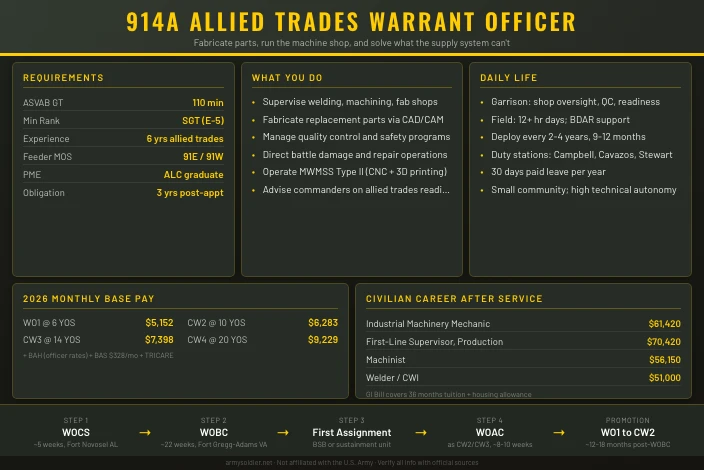
Job Role and Responsibilities
The 914A Allied Trades Warrant Officer serves as the Army’s senior technical expert in metalworking, welding, fabrication, machining, and allied trades operations. This warrant officer plans, directs, and supervises maintenance shops that include machine tools, welding equipment, automotive body and hull repair, painting, glass, radiator, canvas, and woodworking facilities. At higher echelons, the 914A functions as the technical advisor on all allied trades and precision manufacturing matters for the supported commander.
Technical Expertise and Scope
The 914A owns everything that involves fabricating, repairing, or reconditioning metal and structural components at the field and sustainment levels. Where an enlisted 91E (Allied Trades Specialist) operates individual machines and performs specific trade tasks, the warrant officer manages the entire shop ecosystem: equipment readiness, quality control programs, safety compliance, personnel training, and production priorities across multiple trade functions simultaneously.
This role sits between the enlisted technician and the commissioned officer in a specific and deliberate way. The commissioned Ordnance officer sets priorities and manages the broader maintenance mission. The 914A provides the technical depth to execute it, solving fabrication problems that generalist officers are not trained for and validating work that junior NCOs cannot certify on their own.
MOS Codes and Designations
| Code | Title | Notes |
|---|---|---|
| 914A | Allied Trades Warrant Officer | Primary MOS |
| 91E | Allied Trades Specialist | Primary enlisted feeder MOS |
| 91X | Formerly Mechanical Maintenance | Historical feeder; replaced by 91E |
There are no standard Additional Skill Identifiers (ASI) unique to 914A in current DA Pam 611-21 guidance, though individual warrant officers may hold skill identifiers related to additive manufacturing, quality assurance, or instructor duties based on additional schooling.
Mission Contribution
A unit’s combat power depends partly on equipment that works. When a vehicle hull takes battle damage or a critical mechanism fails in a theater where resupply is slow, the 914A’s shop can fabricate a replacement part rather than wait weeks for it to arrive. That capability directly affects readiness rates that commanders brief every day.
At brigade and sustainment levels, the 914A also manages quality assurance, ensuring shop output meets Army standards before parts go back into service. Faulty fabricated components in a combat system are not a paperwork problem; they are a safety hazard. The 914A is the person who signs off.
Technology, Equipment, and Systems
The 914A’s primary system is the Metal Working and Machining Shop Set (MWMSS) Type II, which integrates both subtractive CNC machining and additive manufacturing (3D printing) into a single field-deployable unit. Warrant officers must be proficient in Computer Aided Drawing (CAD) and Computer Aided Manufacturing (CAM) software to design parts from blueprints or through reverse engineering. Traditional equipment includes lathes, milling machines, welding rigs, grinders, press brakes, and sheet metal fabrication tools.
The additive manufacturing capability added to both the Warrant Officer Basic Course and the Warrant Officer Advanced Course lets 914As print polymer components for battle damage assessment and repair at the tactical level. Metal additive technology is in development and may expand the warrant officer’s fabrication toolkit in coming years.
Salary and Benefits
Warrant officers use the same basic pay table as commissioned officers at equivalent grade levels, and BAH is calculated at officer rates. Most 914A candidates enter as E-5 or E-6 with six or more years of service, so their pay at W-1 reflects those accrued years of service rather than a brand-new servicemember’s rate.
Base Pay at Realistic Career Points
| Rank | Typical YOS at Appointment | Monthly Base Pay (2026) |
|---|---|---|
| WO1 | 6 YOS | $5,152 |
| WO1 | 8 YOS | $5,584 |
| CW2 | 10 YOS | $6,283 |
| CW3 | 14 YOS | $7,398 |
| CW4 | 20 YOS | $9,229 |
| CW5 | 26 YOS | $11,495 |
DFAS 2026 Military Pay Chart. 2026 rates reflect a 3.8% across-the-board increase per the FY2026 NDAA.
Base pay is only part of total compensation. Add BAH at officer rates (varies by duty location and dependency status), BAS of $328.48/month for officers, and TRICARE Prime at no cost for active duty members and their families. A CW3 at 14 years of service stationed at a major CONUS installation typically earns well over $90,000 in combined pay and allowances annually.
Special Pays and Bonuses
The 914A is not an aviation or cyber MOS, so flight pay and aviation continuation pay do not apply. Warrant officers in this MOS may be eligible for accession or retention bonuses through HRC. In 2026, the Army introduced a competitive bid system where warrant officers can bid for retention bonus amounts tied to critical skills shortages. Whether 914A is designated a critical skill in a given fiscal year determines bonus availability. Check HRC warrant officer bonus guidance for current eligibility.
Retirement and Long-Term Benefits
The Blended Retirement System (BRS) applies to service members who entered after January 1, 2018 or opted in. BRS combines a 20-year pension at 2.0% per year of service (40% of high-36 average base pay at 20 years) with TSP matching. The government automatically contributes 1% of basic pay to TSP starting after 60 days of service and matches up to an additional 4% once the member reaches three years of service. Contributing 5% of base pay captures the full government match of 5%.
Continuation pay kicks in at the 7-to-12-year window for Army active component warrant officers and provides a 2.5x or higher monthly pay multiplier in exchange for three additional years of service.
Warrant officers who reach 20 years typically serve 25-30 years total, given the late start relative to commissioned officers. A CW4 or CW5 retiring at 24-26 years of service draws a pension based on significantly higher average pay than a 20-year retiree.
Work-Life Balance
Leave accrues at 2.5 days per month (30 days per year), with a maximum carryover of 60 days. Garrison life for a 914A follows standard duty hours with some overtime during maintenance surges or pre-deployment preparation. Field exercises increase the tempo, and deployment shifts work to 12-hour or longer days. Compared to commissioned officers, warrant officers spend less time in staff meetings and more time in the shop solving technical problems, which most 914As consider a feature rather than a drawback.
Qualifications and Eligibility
Appointment Paths
The 914A has one appointment path: enlisted-to-warrant. There is no direct civilian appointment and no street-to-seat option. Candidates must already be active duty, Reserve, or National Guard soldiers with hands-on experience in allied trades or mechanical maintenance work.
| Requirement | Standard | Waiver Available? |
|---|---|---|
| Minimum rank | SGT (E-5) | No waiver for E-4 and below |
| Feeder MOS | 91E (Allied Trades Specialist); 91W (Mechanical Maintenance, historical); comparable civilian/ARNG/USAR experience considered | Yes, with documentation |
| Field experience | 6 years in a comparable allied trades field | Waiver with documentation |
| Professional military education | Advanced Leader Course (ALC) graduate from a feeder MOS | Waiver required if not complete |
| NCOER record | Up to 10 most recent NCOERs showing supervisory proficiency in the MOS | No waiver |
| Letter of recommendation | From a CW3 or above in 914A | Required |
| GT score | 110 minimum (non-waiverable for all warrant officer MOS) | No |
| Age limit | Under 46 at time of appointment | Waiver possible |
| Citizenship | U.S. citizen | No |
| Physical | Must pass Army physical examination; no flight physical required | Medical case by case |
Recruiter, Drill Sergeant, and other non-technical duty assignments do not count toward the six-year experience requirement. The Army looks for NCOERs that show the candidate actually doing the trade work, not just supervising administrative functions.
Warrant Officer Candidate School (WOCS)
All warrant officer candidates attend WOCS at Fort Novosel, Alabama (home of the U.S. Army Warrant Officer Career College). The course is approximately five weeks and focuses on Army leadership doctrine, warrant officer roles and responsibilities, customs and courtesies, and the transition from NCO to warrant officer. WOCS is not MOS-specific; it is the gate every candidate passes through regardless of specialty.
The application process requires a complete warrant officer packet submitted through your unit chain of command to Army Recruiting Command (WORC). Packet contents include:
- DA Form 61 (Application for Appointment)
- Official transcripts and copy of diploma
- All NCOERs (up to the most recent 10)
- Letters of recommendation
- Physical examination results
- Security clearance documentation
- MOS-specific prerequisites checklist
Boards meet on a published schedule at HRC. Selection rates vary by MOS and year-group. The 914A is a small community, so competition is primarily based on NCOER quality, the strength of the senior warrant officer recommendation, and demonstrated technical expertise rather than raw volume of applicants.
Test Requirements
All warrant officer applicants require a minimum GT score of 110. The GT score is a composite of Verbal Expression (VE) and Arithmetic Reasoning (AR) from the ASVAB. Most 91E candidates who have earned E-5 already have a qualifying GT score, but if yours is below 110, you must retest before applying. There is no waiver for this requirement.
The SIFT (Selection Instrument for Flight Training) is not required for 914A. That test applies only to aviation warrant officer candidates (153A, 153D, 153M, and related codes).
Upon Appointment
New warrant officers enter at WO1 and hold a federal warrant of appointment issued by the Secretary of the Army. The standard Active Duty Service Obligation (ADSO) for non-aviation technical warrant officers is three years from the date of appointment. Upon completion of WOBC and promotion to CW2, the warrant officer receives a commission and becomes a commissioned warrant officer (CW2 through CW5).
See our ASVAB study guide for a study plan focused on the GT composite.
Work Environment
Setting and Schedule
The 914A works primarily in maintenance facilities: shops equipped with machine tools, welding equipment, and fabrication machinery at brigade support battalions, division support commands, and sustainment brigades. At higher-level assignments, the warrant officer may work in a headquarters environment as a technical staff advisor rather than directly supervising a shop floor.
Garrison days follow a standard structure: PT formation, shop operations, quality control reviews, personnel management, and equipment readiness reporting. During pre-deployment or major training exercises, the schedule compresses and work extends into evenings. Deployed, the shop runs on a mission-driven schedule and the 914A is available whenever the unit needs fabricated parts or technical guidance.
Position in the Unit
The 914A is not in the NCO support channel and does not hold a traditional command position. The warrant officer advises the supporting unit’s maintenance officer (usually a commissioned Ordnance officer) on technical matters, quality standards, and shop capabilities. At the same time, the 914A often has direct supervision over a section of enlisted soldiers and NCOs who run the actual fabrication equipment.
This dual position can feel unusual at first. You are a peer-level technical advisor to officers and a supervisor of enlisted, but you do not fit cleanly into either lane. The relationship works well when the commissioned officer understands the warrant’s technical authority and defers on fabrication questions, and when the enlisted section trusts the warrant’s judgment built from years of doing the same work they do.
Technical vs. Staff Roles
A WO1 or CW2 spends most of the day in the shop: hands-on technical oversight, training junior soldiers, solving fabrication problems, managing machine maintenance, and ensuring quality control. As experience grows and rank increases, the 914A takes on more staff advisory roles. A CW4 at a sustainment brigade may spend the majority of time in the headquarters, briefing readiness data, coordinating with supported units, and writing technical policy rather than turning wrenches.
This shift is normal and expected. The depth of hands-on experience in the junior grades is what makes the senior warrant’s staff advice credible.
Job Satisfaction and Retention
The 914A community is small and technically tight-knit. Warrant officers who stay in the field typically cite the autonomy, the technical focus, and the absence of the generalist officer career management treadmill as reasons to stay. Those who leave early often do so because civilian manufacturing and industrial management positions offer higher compensation for comparable or lesser responsibility. The civilian pay gap is real in this MOS.
Training and Skill Development
Warrant Officer Basic Course (WOBC)
After WOCS, candidates attend the 914A WOBC at the U.S. Army Ordnance School, Fort Gregg-Adams, Virginia (formerly Fort Lee, renamed 2023). The WOBC is approximately 22 weeks and covers the full range of allied trades technical competencies the warrant officer will need at their first assignment.
| Phase | Location | Length | Focus |
|---|---|---|---|
| WOCS | Fort Novosel, AL | ~5 weeks | Leadership, WO roles, Army doctrine |
| WOBC (Phase 1) | Fort Gregg-Adams, VA | ~5 weeks | Shop management, safety, quality control |
| WOBC (Phase 2) | Fort Gregg-Adams, VA | ~17 weeks | Machining, welding, fabrication, CNC operations, additive manufacturing |
WOBC covers the practical skills gap between the 91E enlisted AIT and the technical management responsibilities of a warrant officer. Students learn CAD/CAM software, advanced CNC programming, welding certification standards, shop administration, and now additive manufacturing using the MWMSS Type II system. The course also covers Army logistics systems, maintenance management, and readiness reporting.
Warrant Officer Advanced Course (WOAC)
WOAC is attended as a CW2 or CW3, typically after the first operational assignment. It is conducted at Fort Gregg-Adams and runs approximately 8-10 weeks. The advanced course builds on WOBC with deeper instruction in additive manufacturing (88 hours of AM training were added to the WOAC curriculum), advanced shop management, sustainment operations at brigade and higher, and Army modernization priorities for allied trades capabilities.
Warrant Officer Intermediate Level Education (WOILE)
WOILE is a 5-week, MOS-immaterial resident course attended as a CW3 or CW4. It is held at Fort Novosel and prepares warrant officers for technical advisor roles at division, corps, and higher echelons. The course covers warrant officer leadership at scale, joint operations concepts, and how technical specialists contribute to the commander’s planning process. WOILE is not 914A-specific, which makes it valuable for building peer relationships with warrant officers from other MOS communities.
Warrant Officer Senior Service Education (WOSSE)
WOSSE is for senior CW4s and CW5s. It runs in two phases: a distance learning phase followed by a resident phase at Fort Novosel. The course focuses on senior technical leadership, Army enterprise management, and the warrant officer’s role at the highest organizational levels. Completion is generally required for CW5 consideration.
Additional Training and Certifications
The Army funds several training opportunities relevant to 914A:
- Army Continuing Education System (ACES): Tuition Assistance covers up to $4,500 per year for college coursework
- Army COOL (Credentialing Opportunities On-Line): Funds civilian certifications that map to military training and experience. The Army COOL page for 914A lists relevant certifications including welding, machining, and manufacturing credentials
- Relevant civilian certifications: AWS Certified Welder (American Welding Society), NIMS Machining Level I and II (National Institute for Metalworking Skills), CWI (Certified Welding Inspector), and Lean Six Sigma credentials are all achievable through COOL funding
The GI Bill (Post-9/11, Chapter 33) provides 36 months of education benefits after service. For private schools the annual cap is $29,920.95 for academic year 2025-2026. Public in-state tuition is fully covered with no dollar cap.
A qualifying GT score comes first — our ASVAB study guide covers the subtests that drive GT.
Career Progression and Advancement
Career Timeline
| Rank | Typical TIG | Total YOS (including enlisted) | Key Assignment |
|---|---|---|---|
| WO1 | 12-18 months | 6-8 | WOCS, WOBC; first platoon/section assignment at BSB |
| CW2 | 3-5 years | 9-13 | Shop OIC, WOAC, first sustainment-level assignment |
| CW3 | 5-7 years | 14-20 | Technical advisor at BCT or sustainment brigade; WOILE |
| CW4 | 5-7 years | 19-26 | Senior technical advisor at division or corps; WOSSE eligibility |
| CW5 | Until retirement | 24-30+ | Senior staff advisor at division, corps, or Army level |
W-1 to CW2 promotion is time-based after WOBC completion. CW3 and above require selection board approval.
Promotion System
The promotion from WO1 to CW2 happens after completing WOBC and a minimum time-in-grade, typically around 12-18 months. From CW3 onward, promotion is board-selected and competitive. Warrant officers receive Officer Evaluation Reports (OERs) using the DA Form 67-10 series, with DA Pam 623-3, Appendix B covering warrant-officer-specific guidance.
Board selection at CW4 and CW5 is less about volume of assignments and more about the quality and impact of technical work performed. A strong file for a 914A includes:
- Demonstrated technical solutions that increased readiness rates
- Successful quality assurance program management
- Additive manufacturing integration accomplishments
- Mentorship of junior warrant officers and enlisted soldiers
- Broadening assignments: instructor positions at Fort Gregg-Adams, joint billets, or interagency details
CW5 as Senior Technical Advisor
A CW5 Allied Trades Warrant Officer is rare by design. There are very few at any given time, and they serve at division, corps, or Army Materiel Command staff. The CW5 is not managing a shop anymore; they are shaping policy, advising on equipment procurement, influencing how the Army integrates additive manufacturing into the field maintenance system, and mentoring the next generation of 914A warrants. The role is advisory and strategic, with decades of hands-on credibility behind every recommendation.
Physical Demands and Medical Evaluations
Army Fitness Test Standards
Warrant officers take the same Army Fitness Test (AFT) as all soldiers. The AFT replaced the ACFT on June 1, 2025 and has five events scored 0-100 points each for a maximum of 500 points. Minimum passing score is 60 points per event (300 total), sex- and age-normed.
| Event | Abbreviation | Minimum Score (17-21, Male) | Minimum Score (17-21, Female) |
|---|---|---|---|
| 3-Rep Max Deadlift | MDL | 60 pts | 60 pts |
| Hand Release Push-Up | HRP | 60 pts | 60 pts |
| Sprint-Drag-Carry | SDC | 60 pts | 60 pts |
| Plank | PLK | 60 pts | 60 pts |
| Two-Mile Run | 2MR | 60 pts | 60 pts |
| Total minimum | 300 | 300 |
army.mil/aft. Standards are sex- and age-normed. The 914A is not among the 21 designated combat MOSs requiring the 350-point sex-neutral standard.
The AFT minimum applies to all soldiers regardless of MOS. A warrant officer scoring near the minimum will not stand out positively on OERs, and most senior warrant officers score well above the floor throughout their careers.
MOS-Specific Physical Demands
The 914A does not require a flight physical, special vision standards, or hearing thresholds beyond standard Army medical fitness requirements. The work itself is physically demanding: operating heavy machine tools, lifting shop equipment, and working in environments with heat, noise, and metal particulates. Soldiers with pre-existing back injuries, upper extremity conditions, or respiratory sensitivities should understand these working conditions before pursuing this MOS.
No additional periodic medical evaluations specific to 914A are required beyond the standard Army medical readiness requirements.
Deployment and Duty Stations
Deployment Details
The 914A does not have a defined high-frequency deployment cycle the way infantry or aviation units do. Deployment tempo depends entirely on the unit. A 914A assigned to a Brigade Support Battalion (BSB) in a deployment-heavy division will deploy more often than one assigned to a training or institutional command. Typical deployment lengths for support units run 9 to 12 months on a 2-to-4-year cycle.
Deployed, the 914A’s shop supports the entire supported force: fabricating replacement parts, repairing battle-damaged vehicles, and maintaining readiness on equipment that cannot wait for theater-level sustainment. The work is operationally essential and recognized as such by supported commanders.
Warrant officer deployments differ from enlisted deployments in one practical way: the 914A is accountable for shop output and cannot be pulled for general labor or force protection tasking the way enlisted soldiers sometimes are. The technical function has to continue.
Duty Station Options
914A positions exist at installations with significant ground force presence and active maintenance operations. Common duty stations include:
- Fort Campbell, KY (101st Airborne Division)
- Fort Cavazos, TX (1st Cavalry Division, III Corps)
- Fort Bragg (Fort Liberty), NC (XVIII Airborne Corps)
- Fort Stewart, GA (3rd Infantry Division)
- Fort Hood-area sustainment commands
- Fort Gregg-Adams, VA (Ordnance School, instructor billets)
- Korea and Germany (OCONUS rotational assignments)
HRC manages warrant officer assignments. Preference is taken into account when vacancies exist, but the needs of the Army are the determining factor. The 914A community is small enough that warrant officers who are flexible often get good assignments; the pool of candidates for any given position is limited.
Risk, Safety, and Legal Considerations
Job Hazards
Allied trades work carries inherent industrial hazards: metal shavings, arc flash from welding operations, rotating machinery, chemical solvents used in cleaning and surface preparation, and high-noise environments. The 914A is responsible for managing these hazards at the shop level, not just personally avoiding them. A safety failure in the shop is the warrant officer’s problem professionally and legally.
Deployed, the risk profile adds potential indirect fire, vehicle movement hazards, and the accelerated operational tempo that compresses the time available for deliberate safety planning.
Safety Protocols
The 914A implements Composite Risk Management (CRM) across all shop operations, conducts periodic safety inspections, maintains Material Safety Data Sheet (MSDS/SDS) compliance, and enforces personal protective equipment standards. Quality assurance and safety are inseparable in this MOS: a fabricated part that fails in service because safety standards were skipped is both a safety incident and a maintenance failure.
Authority and Responsibility
The 914A does not hold command authority the way an aviation warrant officer commanding a small aircraft does. Authority comes through technical expertise and position: the warrant certifies that shop output meets Army standards, and that certification carries legal weight. Signing off on a substandard fabricated component that then causes a casualty has UCMJ implications. The warrant officer’s technical signature matters.
Impact on Family and Personal Life
Family Considerations
The 914A lifestyle is more predictable than aviation or special operations warrant officer fields, but still military. PCS moves happen every 2-4 years, driven by HRC assignment cycles. Most duty stations are major CONUS installations with full Army Community Service (ACS), Family Readiness Groups (FRG), and spouse employment programs. The Army’s installation infrastructure is generally stronger at large posts where 914A billets cluster.
Deployments create the most significant family stress. Nine-to-twelve months deployed, followed by preparation for the next rotation, compresses the time available for family life. The Army’s deployment support systems, including the Family Readiness Officer network and ACS programs, exist specifically to support families during these periods.
PCS Stability
Technical warrant officers in small MOS communities like 914A tend to have slightly more assignment stability than commissioned officers who must be moved through a development pipeline. A 914A who performs well at an assignment may stay longer than the standard 2-3 years when no vacancy exists elsewhere. That longer dwell time can benefit families with school-age children.
The Army’s Joint Spouse Program attempts to co-locate dual-military couples, though it cannot guarantee it. Warrant officers in niche MOS codes have fewer available positions, which can make joint-spouse assignments more difficult to arrange than for larger MOS communities.
Reserve and National Guard
Component Availability
The 914A is available in both the Army Reserve and the Army National Guard. Positions exist in maintenance companies and sustainment battalions in most states, though the total number of 914A billets in the Reserve component is smaller than active duty. Specific unit availability varies by state and region.
Appointment Path for Reserve and Guard
Reserve and Guard soldiers follow the same enlisted-to-warrant path: E-5 or above in a feeder MOS (91E or comparable), ALC complete, six years of hands-on field experience, and a warrant officer packet submitted through the unit chain of command. Selection boards for Reserve and Guard may be conducted at the state level for ARNG soldiers or through USARC channels for Army Reserve soldiers. The same 914A WOBC at Fort Gregg-Adams applies to all components.
Active duty 914As who transition to the Reserve or Guard keep their rank and accumulated experience. The transition process requires coordination with HRC and the gaining Reserve or Guard unit.
Drill and Training Commitment
Standard Reserve and Guard commitment is one weekend per month (four drill periods) plus two weeks of annual training. The 914A may require additional training days to maintain currency on specialized equipment and quality assurance certifications. Aviation warrants have the most demanding currency requirements; technical maintenance warrants like 914A have fewer recurring certification requirements but should expect occasional additional training beyond the minimum schedule.
Reserve and Guard Pay
Drill pay is calculated as (monthly base pay / 30) x number of drill periods. A standard weekend equals four drill periods.
- WO1 at less than 2 YOS: approximately $541 per weekend
- CW2 at 2 YOS: approximately $675 per weekend
Reserve and Guard soldiers do not receive BAH or BAS for drill weekends unless ordered to duty beyond a specified threshold.
Component Comparison
| Factor | Active Duty | Army Reserve | Army National Guard |
|---|---|---|---|
| Commitment | Full-time | 1 wkd/mo + 2 wks AT | 1 wkd/mo + 2 wks AT |
| Monthly pay (CW3 @ 14 YOS) | $7,398 | ~$986/mo drill equivalent | ~$986/mo drill equivalent |
| Healthcare | TRICARE Prime ($0 premium) | TRICARE Reserve Select ($57.88/mo individual) | TRICARE Reserve Select ($57.88/mo individual) |
| Education (tuition) | TA: $4,500/yr + GI Bill (post-separation) | TA + MGIB-SR ($493/mo) | TA + state tuition waivers (varies) |
| Deployment tempo | Moderate (unit-dependent) | Lower; mobilization-based | Lower; state + federal missions |
| Career progression to CW5 | Full track available | CW4/CW5 possible; slower pace | CW4/CW5 possible; fewer billets |
| Retirement | BRS pension at 20 years active | Points-based; collect at age 60 | Points-based; collect at age 60 (or earlier with active service) |
TRICARE Reserve Select rates: $57.88/month individual, $286.66/month for member and family (2026). Rates per tricare.mil.
Civilian Career Integration
The 914A Reserve or Guard slot pairs naturally with civilian careers in manufacturing, precision machining, industrial maintenance, and quality control. A machining supervisor who drills one weekend a month as a 914A CW3 brings direct military technical credibility to their civilian role. USERRA protects against job loss or benefit denial due to military service obligations. Many manufacturing employers actively support Reserve and Guard service because the leadership, safety, and quality management skills transfer directly.
Post-Service Opportunities
Transition to Civilian Life
A 914A transitioning after 10-20+ years of service brings a combination that civilian employers pay for: hands-on fabrication and machining expertise, shop management experience, quality assurance credentials, and Army leadership. The Soldier for Life Transition Assistance Program (SFL-TAP) and programs like Hiring Our Heroes help bridge the gap between military experience and civilian job titles.
The hardest translation is usually the title. “Allied Trades Warrant Officer” does not map directly to a civilian job posting. The work maps well: CNC machinist, welding supervisor, manufacturing engineer, quality manager, industrial maintenance superintendent. Veterans who reframe their experience in civilian terms typically find strong demand.
Civilian Career Prospects
| Civilian Career | Median Annual Wage | Job Outlook |
|---|---|---|
| Machinist | $56,150 | +5% (faster than average) |
| Welder / Cutting / Brazing | $51,000 | +3% (as fast as average) |
| Industrial Machinery Mechanic | $61,420 | +11% (much faster than average) |
| CNC Tool Operator | $49,970 | +4% (as fast as average) |
| Quality Control Inspector | $44,670 | -4% (some automation pressure) |
| First-Line Supervisor, Production | $70,420 | +3% (as fast as average) |
Bureau of Labor Statistics, Occupational Employment and Wage Statistics, May 2024. Job outlook figures from OOH, projected 2023-2033.
Senior 914A warrant officers with 15-20 years of experience and quality management credentials can move into manufacturing engineering or plant management roles that pay substantially above these medians. Defense contractors who need professionals with both technical fabrication skills and security clearance eligibility specifically recruit from this community.
Certifications and Credentials
Army COOL covers exam fees and preparation costs for certifications that align with 914A military experience and training. Relevant credentials include:
- AWS Certified Welder (American Welding Society)
- CWI – Certified Welding Inspector (AWS)
- NIMS Machining Level I and II (National Institute for Metalworking Skills)
- MSSC Certified Production Technician (CPT) (Manufacturing Skill Standards Council)
- Lean Six Sigma (Green Belt or Black Belt through various providers)
- PMP (Project Management Professional) for senior warrant officers transitioning to program management
The GI Bill can fund a technical degree (manufacturing engineering technology, industrial technology, welding engineering) at a community college or university after separation. A 914A with an associate’s or bachelor’s degree in a manufacturing-related field combined with military experience commands significantly more in the civilian market than someone with experience alone.
Is This a Good Job for You? The Right (and Wrong) Fit
Ideal Candidate Profile
The 914A is a strong fit for NCOs who genuinely like the allied trades work, not just the rank that comes with a warrant officer appointment. If you are an E-5 or E-6 in 91E who still looks forward to getting on the machines, likes solving fabrication problems, and can see yourself as the person others call when something cannot be fixed by standard means, this path is worth pursuing.
The technical autonomy is the main draw. You are the expert in the room on allied trades matters, and the Army treats you as such. You are not rotating through a generalist officer career that takes you away from your specialty every two years. The warrant officer path rewards depth over breadth, which is the opposite of how commissioned officer careers work.
Candidates who also have a strong interest in additive manufacturing and CNC technology will find the 914A field evolving in a direction that rewards that curiosity. The Army is integrating these capabilities actively, and early adopters in the warrant officer community are shaping how they get used at the tactical level.
Potential Challenges
The 914A community is small. There are not many of your peers at any given installation, which can feel isolating compared to larger MOS communities. Promotion to CW5 is competitive and rare; most 914A warrant officers will retire as CW4. The civilian pay gap is real for experienced manufacturing professionals, and some warrant officers leave at the 10-to-12-year mark when civilian opportunities emerge.
This is not the right MOS for someone who wants command authority, frequent high-visibility leadership opportunities, or a fast track to senior staff positions. The warrant officer path in this field is narrow and technical by design.
Career and Lifestyle Alignment
For an E-5 or E-6 91E who wants to stay connected to the technical work, move into a leadership role without leaving the shop floor entirely, and build toward a manufacturing or quality management career on the back end, the 914A is a sound long-term decision. The three-year initial obligation is short enough to evaluate whether the path suits you before committing to a full career.
If your goal is to command soldiers, compete for general officer potential, or work in joint environments divorced from the technical specialty, the warrant officer path is the wrong choice. Apply for OCS instead.
More Information
Talk to your unit’s career counselor or contact the Army Warrant Officer Recruiting Command directly at recruiting.army.mil/ISO/AWOR to get current board dates, packet requirements, and any updates to 914A-specific prerequisites. GT score is the first thing to verify – if yours is below 110, schedule a retest before building the rest of your packet. The U.S. Army Ordnance Corps warrant officer page has direct contact information for the 914A personnel developer at the Ordnance proponent.
- Prepare for the ASVAB with our study guide to meet the GT 110 requirement
This site is not affiliated with the U.S. Army or any government agency. Verify all information with official Army sources before making enlistment or career decisions.
Explore more Army warrant officer careers such as the 915A Automotive Maintenance Warrant Officer and the 919A Engineer Equipment Maintenance Warrant Officer.