915A Automotive Maintenance Warrant Officer
Every time a combat vehicle rolls out the gate mission-ready, a 915A warrant officer made that happen. When a battalion has 400 wheeled vehicles and a commander needs to know which 380 are capable of moving tonight, one technical expert owns that answer. That’s the 915A Automotive Maintenance Warrant Officer: the Army’s resident specialist for wheeled vehicle fleet management, from HMMWVs and MRAPs to 10-ton cargo trucks. This isn’t a management job where you stopped turning wrenches. It’s where the best maintainers in the Army go when they’re ready to run the whole operation.
Warrant officer candidates need a GT score of at least 110 — our ASVAB study guide covers what drives that number.
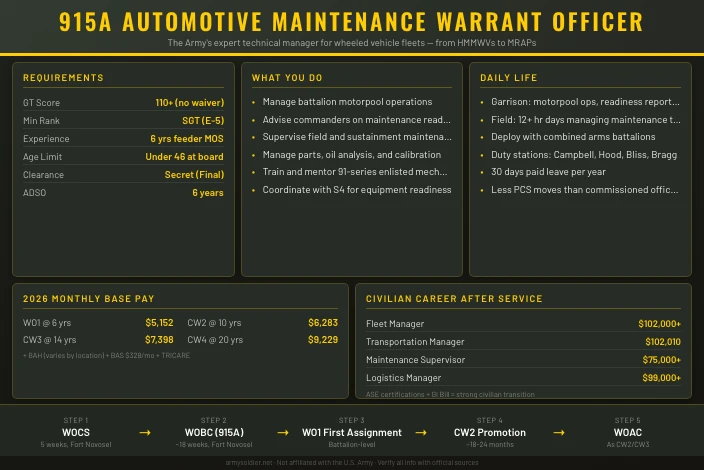
Job Role and Responsibilities
The 915A Automotive Maintenance Warrant Officer plans, organizes, and executes maintenance operations for wheeled vehicle fleets at battalion and brigade level. As the commander’s primary technical advisor on ground vehicle readiness, the 915A manages field and sustainment-level maintenance, allocates repair resources, and supervises the 91-series enlisted mechanics who keep combat formations moving. This warrant officer MOS sits within the Army’s Ordnance Corps and covers all light and heavy wheeled vehicles in the Army inventory.
Technical Expertise and Scope
The 915A’s technical domain covers everything that rolls on wheels and does not fly: HMMWVs, MRAPs, M1083 series medium tactical vehicles, MATVs, LMTVs, and other wheeled platforms across the brigade combat team. Where a 91B wheeled vehicle mechanic works on individual systems and components, the 915A manages maintenance at scale, tracking vehicle readiness rates, managing shop workloads, and making the resource decisions that determine how many vehicles are ready on any given day.
The difference between a senior 91-series NCO and a 915A warrant officer is scope and technical authority. An NCO leads a shop. The warrant officer advises the battalion S4 and commander, interprets technical manuals at the systems level, and makes technical calls that NCOs escalate to them. A 915A who disagrees with a technical decision from a commissioned officer can and does push back. That technical authority is the whole point.
Related Warrant Officer MOS
| MOS | Title | Primary Platform |
|---|---|---|
| 915A | Automotive Maintenance WO | Wheeled vehicles |
| 915E | Senior Automotive Maintenance WO | Wheeled vehicles (senior) |
| 915S | Stryker Maintenance WO | Stryker vehicle family |
| 915T | Track Maintenance WO | Tracked vehicles (non-Stryker) |
| 919A | Engineer Equipment Maintenance WO | Engineer vehicles and equipment |
Mission Contribution
A battalion’s readiness rate lives and dies on what the 915A reports. Commanders at company level get their vehicles from the battalion pool. The 915A tracks what’s deadline, what’s in maintenance, and what timeline realistic repairs will take. Staff officers plan logistics based on that data. When a unit deploys, the 915A is part of the pre-deployment readiness push and the in-theater maintenance structure.
The warrant officer bridges the gap between a company commander who needs 12 vehicles tomorrow morning and a shop that has three mechanics available. That requires technical knowledge on one side and leadership communication on the other. Neither a junior NCO nor a staff officer can do both.
Equipment and Tools
Day-to-day tools include the Army’s Global Combat Support System-Army (GCSS-Army), the enterprise resource planning system that tracks equipment status, parts requisitions, and maintenance work orders. Beyond software, the 915A works directly on the shop floor, reviewing diagnostic results, signing off on maintenance before vehicles return to units, and managing calibration programs and oil analysis schedules.
Salary and Benefits
Warrant officers collect base pay, BAH, and BAS. Most 915A candidates come from the enlisted ranks as E-5 or above, so their pay grade at appointment reflects years of service already served. A new WO1 with six years in the Army earns significantly more than the minimum W-1 rate.
Base Pay at Realistic Career Points
| Rank | Typical YOS | Monthly Base Pay |
|---|---|---|
| WO1 | 6 years | $5,152 |
| WO1 | 8 years | $5,584 |
| CW2 | 10 years | $6,283 |
| CW2 | 12 years | $6,509 |
| CW3 | 14 years | $7,398 |
| CW3 | 18 years | $8,150 |
| CW4 | 20 years | $9,229 |
| CW4 | 24 years | $10,032 |
| CW5 | 26 years | $11,495 |
2026 pay rates per DFAS. YOS = total years of service including enlisted time.
Allowances and Special Pays
BAH is calculated at officer rates for warrant officers and varies by duty station and dependent status. At most major Army installations, a single W-2 draws between $1,400 and $2,200 per month in BAH. Officers (including warrants) receive BAS at $328.48 per month.
The 915A does not qualify for flight pay or hazardous duty pay in garrison unless assigned to a special duty position. Warrant officers who serve in combat zones receive the same tax exclusions and combat zone pay as enlisted soldiers.
Additional Benefits
Active duty warrant officers receive TRICARE Prime at no cost: zero enrollment fees, zero copays, zero deductibles for the service member and family. Dental and vision are included.
Retirement under the Blended Retirement System (BRS) pays 2% per year of service on the high-36 average base pay at 20 years, plus TSP matching up to 5% of base pay. A CW3 or CW4 retiring at 20 years with a high-36 around $8,000 to $9,000 monthly walks away with a pension of $3,200 to $3,600 per month at age 40-something, before TSP draws. Many 915As serve 25 to 30 years, reaching CW4 or CW5 and significantly higher pension amounts.
Annual leave accrues at 2.5 days per month (30 days per year), with up to 60 days carryover. Federal Tuition Assistance covers up to $4,500 per year and $250 per semester hour for degree completion while on active duty.
Work-Life Balance
Warrant officers in maintenance positions work a garrison schedule tied to unit OPTEMPO. A heavy maintenance week before a major field exercise looks nothing like a slow week in between training cycles. Deployments compress the schedule further. But compared to commissioned officers who rotate through staff jobs with unpredictable hours, warrant officers generally have more predictable daily routines because their work is tied to physical assets with measurable workloads.
Qualifications and Eligibility
The 915A is an enlisted-to-warrant pathway. There is no direct appointment or street-to-seat option for this MOS.
Appointment Path
Candidates must be a Sergeant (E-5) or above with at least six years of hands-on experience in a qualifying feeder MOS. That experience must show in NCOERs. Boards look for documented technical proficiency in a supervisory role, not just time on the clock.
Qualifying feeder MOS for 915A:
- 91A (M1 Abrams Tank System Maintainer)
- 91B (Wheeled Vehicle Mechanic)
- 91D (Power Generation Equipment Repairer)
- 91H (Track Vehicle Repairer)
- 91L (Construction Equipment Repairer)
- 91M (Bradley Fighting Vehicle System Maintainer)
- 91P (Artillery Mechanic)
- 91S (Stryker Systems Maintainer)
- 91X (any non-MOS qualified 91-series position)
Requirements Table
| Requirement | Standard | Waiverable? |
|---|---|---|
| Feeder MOS | 91-series (see list above) | No |
| Minimum rank | SGT (E-5) | No |
| Experience | 6 years in feeder MOS | No |
| GT score | 110 minimum | No |
| Age | Under 46 at board date | No |
| Citizenship | U.S. citizen | No |
| Education | High school diploma or GED | No |
| ALC completion | Required | No |
| Security clearance | Final Secret | No |
| Enlistment remaining | 12 months minimum | Yes |
| College credit | 30 hours preferred | Yes |
Test Requirements
All warrant officer applicants must score 110 or higher on the GT (General Technical) score. The GT score is derived from the Verbal Expression (VE) and Arithmetic Reasoning (AR) subtests of the ASVAB. This threshold is not waiverable for 915A or any non-aviation warrant officer MOS. Candidates who fall below 110 must retest.
Warrant Officer Candidate School (WOCS)
WOCS runs five weeks at Fort Novosel, Alabama (the U.S. Army Warrant Officer Career College). The course develops leadership, Army doctrine, and warrant officer roles and responsibilities. It is the same five-week course for all non-aviation warrant officer candidates. Aviation candidates complete a longer 6-week version before flight training begins.
The application packet (called the DA 61 packet) includes letters of recommendation (required from a CW3 or above in the 915A MOS or related field), NCOER copies showing technical proficiency, academic transcripts, physical exam documentation, and a security clearance eligibility determination. State adjutant generals and HRC both process packets depending on component.
Packet and Board Process
Selection boards meet periodically throughout the year. Competitive packets show:
- NCOERs that document technical leadership in motor officer or motor sergeant-adjacent roles
- ALC graduation from a 91-series feeder MOS
- ASE certification (preferred but not required)
- 30 or more college credit hours
- A letter of recommendation from a 915A CW3 or higher
Warrant officer selection rates vary by MOS and component. The 915A has open positions across active duty, the Army Reserve, and the National Guard. Units with maintenance shortfalls actively recruit eligible NCOs.
Upon Appointment
New 915A warrant officers enter at WO1 with a warrant of appointment issued by the Secretary of the Army. The standard Active Duty Service Obligation (ADSO) for the 915A is six years from the date of appointment. Upon promotion to CW2, warrant officers receive a commission and become commissioned warrant officers.
See our ASVAB study guide for a study plan focused on the GT composite.
Work Environment
Setting and Schedule
The 915A works primarily in and around the motorpool and maintenance shops. Garrison days run from first formation through vehicle maintenance time in the afternoon. Field exercises change that rhythm significantly. The warrant officer may be in the motor pool until midnight getting vehicles deadline-cleared before a morning movement. During deployments, the 915A works from a Forward Operating Base maintenance area, often under compressed timelines and with a reduced parts pipeline.
Position in the Unit
The 915A fills the role of battalion maintenance officer or is the primary maintenance warrant in a support company or forward support company. They advise the battalion S4 (logistics officer) and the battalion commander on vehicle readiness. They are not in the NCO support channel and do not work for the battalion sergeant major the way senior NCOs do. Their authority flows from their technical expertise and their warrant appointment.
The relationship with the Motor Sergeant (typically an E-7 or E-8) is the most important working relationship a 915A manages. The Motor Sergeant runs day-to-day shop operations and leads the enlisted maintainers. The 915A handles the technical calls the Motor Sergeant escalates, manages the paperwork and parts pipeline that the Motor Sergeant can’t resolve, and represents the maintenance function to commissioned officers and staff. When it works well, it’s a strong team. When either person doesn’t respect the other’s lane, the motorpool suffers.
Technical vs. Staff Roles
At WO1 and CW2, most of the work is hands-on and shop-floor. A new 915A is learning the battalion’s equipment, building relationships with the Motor Sergeant and company maintenance sections, and establishing credibility through technical competence.
By CW3, more time shifts to staff advisory work at brigade or higher. Brigade maintenance warrants attend planning meetings, brief commanders, and track readiness across multiple subordinate battalions. By CW4 and CW5, many 915As serve in division or corps sustainment brigades as senior technical advisors with little direct shop involvement. The career arc moves from wrench-adjacent to advisor, but technical knowledge underpins every advisory role.
Job Satisfaction and Retention
Maintenance warrant officers typically cite three reasons they stay: the technical work is genuinely interesting, the autonomy compared to commissioned staff positions is real, and the pay-to-effort ratio improves significantly at CW3 and above. The most common reason to leave before 20 years is civilian fleet management compensation. A credentialed 915A with a decade of experience can earn comparable or higher total compensation in the private sector. Those who stay tend to value the pension math and the continued technical challenge at senior grades.
Training and Skill Development
Warrant Officer Basic Course (WOBC)
The 915A WOBC is conducted at the Ordnance School at Fort Novosel, Alabama.
| Phase | Location | Length | Focus |
|---|---|---|---|
| WOCS | Fort Novosel, AL | 5 weeks | Leadership, Army doctrine, WO roles |
| WOBC Phase 1 (RC Distance) | Correspondence | Variable | Foundation (for RC candidates) |
| WOBC Resident | Fort Novosel, AL | ~18 weeks | Automotive systems, GCSS-Army, maintenance management |
The resident WOBC covers wheeled vehicle systems in technical depth, maintenance management doctrine, GCSS-Army operations, property accountability, and the maintenance officer role in unit operations. Unlike AIT, which trains soldiers to perform maintenance tasks, WOBC trains warrant officers to manage, diagnose at the systems level, and advise commanders. Graduates leave Fort Novosel with the tools to run a battalion maintenance operation on day one.
Warrant Officer Advanced Course (WOAC)
WOAC is typically attended as a CW2 or early CW3, usually around the 10 to 12-year mark. The course goes deeper into advanced maintenance management, sustainment operations, and the warrant officer’s role at higher echelons. WOAC is conducted at Fort Novosel for most Ordnance warrant officers. Completion is required for promotion to CW3.
Warrant Officer Intermediate Level Education (WOILE)
WOILE is a five-week, MOS-immaterial resident course at Fort Novosel. Attended as a CW3 or CW4, it develops warrant officers for advisory roles at division and corps level. The course is not MOS-specific. The 915A attends alongside aviation, intelligence, and cyber warrants. The focus shifts from technical expertise to institutional knowledge, joint operations, and strategic advisory skills.
Warrant Officer Senior Service Education (WOSSE)
WOSSE prepares senior CW4 and CW5 warrant officers for the most senior advisory roles. It runs as a two-phase course: distance learning followed by a resident phase. Content covers strategic-level operations, senior advisory responsibilities, and interagency and joint environments. Not all warrant officers reach this level, but those who do typically serve at division, corps, or Army command staff.
Additional Schools and Certifications
- Airborne School: Available at Fort Moore; adds airborne-qualified units to your assignment options
- Air Assault School: Fort Campbell; useful for light infantry-division assignments
- Equal Opportunity Advisor Training: Available at multiple locations
- ASE Certifications: The Army funds ASE certification preparation through Army COOL, which covers exam fees for credentialing that maps directly to 915A duties
- Certified Automotive Fleet Manager (CAFM): Available through NPTC; recognized by commercial fleet employers
- Tuition Assistance: $4,500 annually for degree completion toward a bachelor’s or master’s in logistics management, business administration, or engineering
Warrant officers in maintenance branches pair well with engineering and business degrees for both promotion competitiveness and civilian transition. The Ordnance proponent recommends at least 30 college credit hours before the board and a bachelor’s before CW3 promotion.
A qualifying GT score comes first — our ASVAB study guide covers the subtests that drive GT.
Career Progression and Advancement
Career Timeline
| Rank | Typical Total YOS | Time in Grade | Key Role |
|---|---|---|---|
| WO1 | 6-8 | 18-24 months | Battalion maintenance warrant, junior advisor |
| CW2 | 8-12 | 4-6 years | Battalion maintenance officer, section OIC |
| CW3 | 14-18 | 4-6 years | Brigade or division maintenance advisor |
| CW4 | 18-24 | 4-6 years | Division/corps senior technical advisor |
| CW5 | 24-30+ | Terminal grade | Army, MACOM, or joint-level technical authority |
YOS includes enlisted time. Most 915As enter at 6+ years of service.
Promotion System
WO1 to CW2 is time-based after completing WOBC, typically 18 to 24 months. CW3 and above requires board selection. Boards review OERs (DA Form 67-10 series, with warrant-officer-specific guidance in DA Pam 623-3 Appendix B), education records, assignments, and demonstrated technical expertise.
Promotion to CW4 is competitive and requires a complete file: senior rater characterization in the top block, broadening assignments, advanced civil schooling or a degree, and at least one tour at a higher echelon. CW5 is the most selective grade in the warrant officer corps. Only a small percentage of CW4s are selected, and most CW5s in the maintenance field serve at division level or above.
Building a Competitive Record
A strong 915A career file includes:
- Top-block OERs from senior raters who take the time to differentiate
- Assignments in at least two different unit types (light, heavy, BCT, sustainment)
- One broadening assignment (joint duty, training officer, TRADOC instructor)
- A bachelor’s degree by CW3, master’s preferred by CW4
- Command and staff college equivalency or resident PME completion
CW5 as Senior Technical Advisor
A CW5 in the 915A specialty typically serves at a division sustainment brigade, a corps support command, or an Army Materiel Command organization. At this level, the CW5 is not managing a motorpool. They’re advising general officers on fleet-level readiness policy, equipment fielding, and maintenance doctrine. They may testify to program managers about fielding challenges with new platforms or help write Army-level maintenance regulations.
Physical Demands and Medical Evaluations
Army Fitness Test Standards
Warrant officers take the Army Fitness Test (AFT), which replaced the ACFT on June 1, 2025. The AFT has five events scored 0-100 each, for a maximum of 500 points. The general standard requires a minimum of 60 points per event and 300 total. The 915A is not among the 21 designated combat MOSs requiring the 350-point combat specialty standard.
| Event | Abbreviation | Minimum Score (60 pts) |
|---|---|---|
| 3 Rep Max Deadlift | MDL | Age/sex normed |
| Hand Release Push-Up | HRP | Age/sex normed |
| Sprint-Drag-Carry | SDC | Age/sex normed |
| Plank | PLK | Age/sex normed |
| Two-Mile Run | 2MR | Age/sex normed |
Specific raw performance thresholds for each minimum score vary by age group and sex. Current scoring tables are published at army.mil/aft.
MOS-Specific Physical Demands
The 915A job involves physical work in and around vehicles and maintenance facilities. Lifting components, climbing in and out of vehicle hulls, and working in both heat and cold are part of the role at all grades, though progressively less so as rank increases. No special medical evaluations beyond the standard Army physical are required for appointment. No flight physical. No special vision or hearing standards beyond the standard Army medical fitness criteria.
Deployment and Duty Stations
Deployment Considerations
Wheeled vehicles deploy everywhere the Army deploys, which means the 915A deploys with their units. Typical deployments run nine to twelve months for active duty. Deployment tempo tracks with the parent unit’s OPTEMPO. A warrant assigned to an infantry brigade combat team will deploy more frequently than one assigned to a training base or depot-level maintenance unit.
During combat deployments, the 915A operates from a base maintenance area, coordinating with the theater sustainment command for parts and evacuating vehicles that exceed field-level repair capability. Deployed maintenance operations often run 24-hour schedules during high-intensity operations.
Primary Duty Stations
The 915A has positions across most major Army installations where combined arms units are stationed.
| Installation | Location | Major Units |
|---|---|---|
| Fort Campbell | Kentucky | 101st Airborne Division |
| Fort Cavazos | Texas | III Corps, 1st Cavalry Division |
| Fort Liberty | North Carolina | XVIII Airborne Corps, 82nd Airborne |
| Fort Bliss | Texas | 1st Armored Division |
| Fort Drum | New York | 10th Mountain Division |
| Fort Stewart | Georgia | 3rd Infantry Division |
| OCONUS | Germany, Korea, Japan | USAREUR-AF, USARPAC |
Assignment preferences are submitted through HRC, but unit vacancies and Army needs drive final assignments. Warrant officers generally have more assignment stability than commissioned officers, with fewer mandatory PCS moves and more time between them.
Risk, Safety, and Legal Considerations
Job Hazards
Maintenance work carries physical risks: hydraulic systems under pressure, heavy lifting, vehicle fires, and working around fuel and lubricants. At the organizational level, the 915A also owns responsibility for maintenance safety. If a vehicle leaves the shop with a deficient brake system and injures a soldier, the technical authority who signed it off bears professional consequences.
Deployed maintenance carries additional risk. Operating on FOBs and in austere environments means the 915A works near hostile fire risk while simultaneously managing complex maintenance operations.
Safety Protocols
The 915A applies Composite Risk Management (CRM) to maintenance operations, managing safety inspections, hazardous material handling, and tool accountability. They enforce maintenance safety standards under Army Technical Manual procedures and DA Pam 750-8 (the Field Maintenance Manual). Violations of maintenance safety standards can result in UCMJ action for both the warrant officer and subordinate soldiers.
Authority and Responsibility
The 915A does not hold command authority in the traditional sense. They are not a commander of a unit. Their authority is technical and advisory. They can and do issue direct guidance to enlisted soldiers on technical matters. When a 915A’s technical determination conflicts with what a commissioned officer wants, the warrant officer is expected to document the technical call and escalate through proper channels, not simply comply with an order that violates a technical standard.
Impact on Family and Personal Life
Family Considerations
Maintenance positions at battalion level usually mean a 7 a.m. to 5 p.m. garrison schedule with predictable exceptions. Field exercises and pre-deployment readiness periods are intense. Families experience the same deployment separations as any other Army family, typically one deployment per three to four years on active duty.
The Army provides Army Community Service (ACS) and Family Readiness Groups (FRGs) at every major installation. Spouse employment programs, on-post childcare, and installation schools are available at all primary 915A duty stations.
PCS Tempo and Stability
Warrant officers generally PCS less often than commissioned officers. A commissioned lieutenant might PCS every two to three years as they rotate through battalion, brigade, and school assignments. A CW2 or CW3 in a stable maintenance billet may go four to five years between moves. That stability matters for spouses with careers, children in school, and families that have built community roots.
Dual-military couples with one 915A warrant can request join-spouse assignments through HRC. The program works best when both spouses are in MOSs with broad installation footprints. Maintenance warrants have enough duty station options that join-spouse is manageable, though not guaranteed.
Reserve and National Guard
Component Availability
The 915A is available in both the Army Reserve and the Army National Guard. Maintenance warrant officer positions are among the most common in both components because every combat and support unit needs vehicle readiness expertise.
Appointment Paths in Reserve Components
Reserve and Guard candidates follow the same feeder MOS, rank, and GT score requirements as active duty. The WOCS and WOBC courses are the same at Fort Novosel. Most Reserve and Guard 915As are active duty veterans who transitioned to their component, though NCOs who served only in the Reserve or Guard can also apply if they meet all requirements with qualifying experience.
National Guard candidates apply through their state’s Warrant Officer Strength Manager. State-level programs vary in how aggressively they recruit maintenance warrants, but positions are generally available.
Drill and Training Commitment
The standard Reserve and Guard commitment is one weekend per month (Battle Assembly, four drill periods) plus two weeks of Annual Training per year. The 915A may have additional currency requirements tied to GCSS-Army system access and safety certifications. Aviation warrants have significant additional requirements (flight hours), but the 915A does not.
Part-Time Pay
Reserve and Guard drill pay is based on the same base pay table as active duty, divided by 30 days per month.
| Rank/YOS | Per Weekend (4 Drills) | Annualized (48 drills + AT) |
|---|---|---|
| WO1 < 2 yrs | $541 | ~$12,400 |
| WO1 @ 2 yrs | $599 | ~$13,700 |
| CW2 < 2 yrs | $616 | ~$14,100 |
| CW2 @ 2 yrs | $675 | ~$15,500 |
Annual Training adds approximately 14 days of additional base pay. Figures based on 2026 pay tables.
Benefits Comparison
| Category | Active Duty | Army Reserve | Army National Guard |
|---|---|---|---|
| Monthly pay model | Full base pay | Drill pay only | Drill pay only |
| Healthcare | TRICARE Prime ($0) | TRICARE Reserve Select ($58/mo individual) | TRICARE Reserve Select ($58/mo individual) |
| Education | TA up to $4,500/yr | TA up to $4,500/yr | TA + possible state tuition waiver |
| Retirement | 20-yr pension + TSP | Points-based, collect at 60 | Points-based, collect at 60 |
| Deployment tempo | High | Moderate (mobilization-driven) | Moderate (state + federal) |
| Advancement to CW4/CW5 | Yes | Yes (slower timeline) | Yes (slower timeline) |
| PME (WOAC, WOILE) | Required on schedule | Available, less enforced | Available, less enforced |
TRICARE Reserve Select costs $57.88 per month for individual and $286.66 for member-plus-family in 2026. This is substantially cheaper than civilian employer plans but requires a monthly premium, unlike active duty coverage.
Reserve retirement is points-based under BRS. A 20-year qualifying career in the Reserve or Guard typically generates fewer points than an active duty career because drill periods and AT generate fewer points than continuous active duty days. The pension is collected starting at age 60 (reduced by 90 days for each qualifying deployment), and will be smaller than an equivalent active duty pension.
Civilian Career Integration
The 915A pairs directly with fleet management careers in the private sector. A Reserve or Guard 915A who also manages a commercial vehicle fleet or works in logistics operations builds a resume that’s compelling to both the military and civilian employers. USERRA protections under 38 USC 4301-4335 require employers to reinstate Reserve and Guard members after deployments and prohibit discrimination based on military service.
Post-Service Opportunities
Civilian Transition
A 915A CW3 or CW4 retiring after 20 years brings with them a verified record of managing multi-million dollar equipment fleets, running complex maintenance operations under pressure, and developing technical teams. Those skills translate directly to civilian fleet management, logistics operations, and maintenance supervision roles.
The Army’s Soldier for Life-Transition Assistance Program (SFL-TAP) and Hiring Our Heroes corporate fellowships connect transitioning warrant officers with employers actively recruiting veterans. The Army Credentialing Assistance (ArmyCA) program funds certifications while on active duty.
Civilian Career Prospects
| Civilian Role | Median Salary | Job Outlook (2024-2034) |
|---|---|---|
| Transportation/Distribution Manager | $102,010/yr | +6% (faster than avg) |
| Fleet Manager | $98,000-$122,000/yr | Stable demand |
| First-Line Supervisor, Mechanics | $75,000-$95,000/yr | +4% |
| Logistician | $99,240/yr | +18% (much faster than avg) |
| Maintenance Manager | $80,000-$105,000/yr | Stable |
Salary data from Bureau of Labor Statistics Occupational Outlook Handbook, 2024-2025 data. Fleet manager salary ranges from Salary.com 2026 data.
Certifications and Credentials
The Army COOL program covers exam fees for certifications that align with 915A duties. The most valuable for post-service transition:
- ASE Certifications (Automotive Service Excellence): Multiple credentials in brakes, electrical, drivetrain, and service management. Employers recognize ASE credentials immediately.
- Certified Automotive Fleet Manager (CAFM): National Private Truck Council credential recognized by major fleet employers.
- Project Management Professional (PMP): For 915As moving into logistics management or maintenance operations leadership roles.
- Logistics certifications (APICS CSCP, CLTD): Useful for supply chain and distribution management roles.
The Post-9/11 GI Bill covers up to 36 months of tuition at a public institution (full in-state) or up to $29,920.95 annually at private institutions for the 2025-2026 academic year. Many 915As use this benefit for a bachelor’s in business administration, logistics, or engineering if they didn’t complete a degree on active duty.
Is This a Good Job for You? The Right (and Wrong) Fit
Ideal Candidate Profile
The best 915A candidates are senior 91-series NCOs who are already functioning like maintenance warrant officers before they apply. They’re the Staff Sergeant who the company commander calls when the Motor Sergeant doesn’t know the answer. They think beyond their own shop to how decisions affect readiness across the battalion. They’re comfortable challenging a lieutenant’s decision with technical facts.
Strong personality traits for this role:
- Systematic problem-solving, comfortable managing many variables at once
- Patience for administrative and technical documentation alongside hands-on work
- Enough people skills to work in an advisory relationship with commissioned officers
- Drive to remain technically current as vehicle systems evolve
Potential Challenges
Candidates who want command authority and a defined leadership hierarchy may find the warrant officer path frustrating. The 915A advises and influences rather than commands. A newly appointed WO1 coming from a Staff Sergeant position may feel a loss of direct authority over soldiers, even though the technical authority increases.
Promotion to CW5 is genuinely competitive and not everyone who wants it will get it. Most 915As max out at CW4. For those who stay 20-plus years expecting CW5, the career needs to be built with that goal in mind from CW2 onward.
The peer community is also small. There are far fewer 915As than 91B mechanics, which means fewer peers to compare notes with, fewer mentors available at each installation, and sometimes less institutional support than larger MOS communities receive.
Career and Lifestyle Alignment
This MOS fits well for an experienced 91-series NCO who wants to stay in the technical lane for a full career rather than moving into senior NCO administrative roles. It’s also right for someone who wants to build a civilian fleet management career, where the military experience and Army COOL certifications create a direct path.
It fits less well for someone who wants frequent recognition through visible leadership, wants rapid promotion, or prefers theoretical work over physical environments. The motorpool is not glamorous. But for the right person, it is deeply satisfying: complex problems, measurable outcomes, and the knowledge that a unit deployed mission-ready because of what you did.
More Information
Talk to a warrant officer recruiter before submitting a packet. The Army’s Warrant Officer Recruiting page lists current MOS requirements, board schedules, and recruiter contact information by state. If your GT score is below 110, work with a recruiter on a retest plan before applying. The ASVAB Verbal Expression and Arithmetic Reasoning subtests drive the GT composite, so focused prep in those areas pays off. Current 915As and 915A boards can be reached through the Ordnance proponent at 804-765-7370.
- Prepare for the ASVAB with our study guide to meet the GT 110 requirement
This site is not affiliated with the U.S. Army or any government agency. Verify all information with official Army sources before making enlistment or career decisions.
Explore more Army warrant officer careers such as the 915T Track Maintenance Warrant Officer and the 919A Engineer Equipment Maintenance Warrant Officer.