915T Track Maintenance Warrant Officer
The Bradley Fighting Vehicle can absorb a 14.5mm round, cross a river, carry a squad of infantry into a contested objective, and fire an anti-tank missile at night. None of that happens without a 915T. When a crew chief reports a transmission fault at 0200 before a brigade movement, the commander doesn’t call an NCO or a commissioned officer first. The call goes to the warrant officer.
The 915T Track Maintenance Warrant Officer is the Army’s deepest technical expert on tracked armored platforms: M2/M3 Bradley Infantry and Cavalry Fighting Vehicles, M113 series carriers, and the full family of tracked support vehicles. Unlike a maintenance platoon sergeant managing people and paperwork, or a company commander signing maintenance readiness reports, the 915T is the one who knows exactly what is wrong, why it is wrong, and how to fix it permanently. That combination of hands-on depth and advisory authority makes this one of the more consequential technical roles in any heavy Brigade Combat Team.
Warrant officer candidates need a GT score of at least 110 — our ASVAB study guide covers what drives that number.
Job Role and Responsibilities
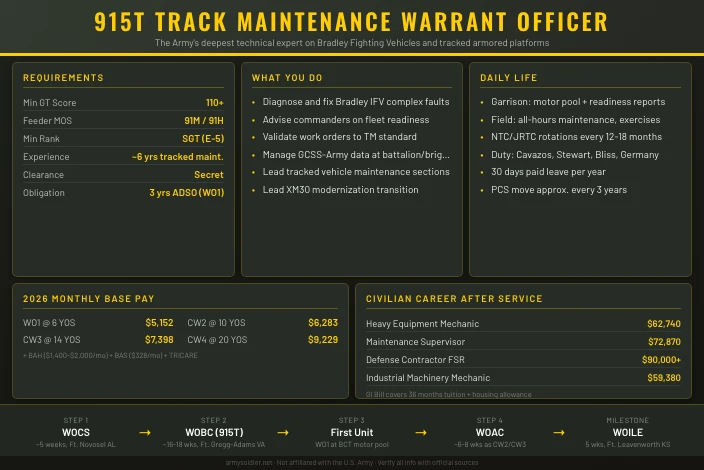
The 915T Track Maintenance Warrant Officer is the Army’s senior technical expert for tracked armored vehicle maintenance, responsible for supervising, managing, and directing all maintenance operations on tracked platforms including the M2/M3 Bradley Fighting Vehicle, M113 Armored Personnel Carrier, and associated systems. A 915T serves as the principal technical advisor to battalion and brigade commanders on fleet readiness, maintenance resource planning, and systems integration for tracked combat vehicles across the combined arms formation.
Technical Expertise and Scope
The 915T’s technical domain spans powerpack systems (engine and transmission), automotive drive train components, final drives, track and suspension systems, hydraulic systems, electrical systems, and the integrated fire control and armament interfaces that make tracked platforms combat-effective. At the WO1 and CW2 level, this means working directly at the organizational and direct support level, running fault diagnostics, supervising complex repairs, and validating that systems meet Technical Manual standards before a vehicle returns to service.
By CW3 and above, the 915T is embedded as a staff advisor at battalion, brigade, and sometimes division level, where the work shifts to maintenance management: analyzing fleet readiness data, identifying systemic failure trends, advising commanders on replacement parts sourcing, and managing maintenance allocation decisions across multiple subordinate units. The role differs from both the enlisted specialist who turns wrenches and the commander who signs readiness reports. The 915T is the person who translates raw technical complexity into decisions the commander can act on.
Related MOS Codes and Designations
| MOS Code | Title | Relationship |
|---|---|---|
| 915T | Track Maintenance Warrant Officer | Primary MOS this article covers |
| 915A | Automotive Maintenance Warrant Officer | Wheeled vehicle counterpart |
| 915S | Stryker Systems Maintenance Warrant Officer | Stryker-specific platform variant |
| 915E | Senior Ordnance Logistics Warrant Officer | Senior WO5 position across the 915 family |
| 91M | Bradley Fighting Vehicle System Maintainer | Primary enlisted feeder MOS |
| 91H | Track Vehicle Repairer | Secondary enlisted feeder MOS |
Skill Identifiers and Additional Skill Identifiers for the 915T include qualifications tied to specific platform variants, master gunner qualifications, and instructor certifications earned during the career.
Mission Contribution
Every heavy and armored BCT lives or dies by its maintenance readiness rate. A Bradley that cannot move is a Bradley that cannot support the infantry it carries, and a brigade with degraded tracked fleet readiness loses maneuver options the enemy gains. The 915T is the technical backstop ensuring those vehicles stay in the fight.
The warrant officer role as a bridge between enlisted expertise and officer decision-making is real in this MOS. An E7 maintenance platoon sergeant understands how to manage people and prioritize the work queue. A maintenance officer understands resource allocation and reporting chains. The 915T understands the system itself at a depth neither of those positions requires. A CW3 who can read fault codes, walk a senior NCO through a transmission-in-place procedure, and then brief the battalion S4 on parts requirements in the same morning is providing something no other rank combination delivers.
Technology, Equipment, and Systems
The 915T’s primary platforms are the M2A3 and M3A3 Bradley Fighting Vehicle series, along with the older M113A3 Armored Personnel Carrier family still in service in support roles. Track maintenance warrant officers also maintain ancillary tracked vehicles in the formation: M88A2 HERCULES recovery vehicles, M992 Field Artillery Ammunition Support Vehicles, and other specialty tracked platforms assigned to heavy BCTs.
Diagnostic tools include the Standard Automotive Tool Set (SATS), Combat Repair Team Vehicle diagnostic equipment, and the Army Maintenance Management System (GCSS-Army). At the brigade level, 915T warrant officers use GCSS-Army extensively to track parts status, manage work orders, and produce readiness reports for commanders.
The XM30 Mechanized Infantry Combat Vehicle is the Army’s planned successor to the Bradley. Two competing prototypes, from General Dynamics Land Systems and American Rheinmetall Vehicles, are in fabrication with fielding possible in the early 2030s. The XM30 features a hybrid-electric powertrain, 50mm cannon, and fully digital open-architecture systems that are fundamentally different from Bradley’s analog-era maintenance environment. The 915T warrant officer community will absorb this transition first. NCOs and commissioned officers will follow their technical lead.
Salary and Benefits
Base Pay
Most 915T warrant officers come from the enlisted ranks as E5 through E7, which means their years of service (YOS) for pay purposes are already significant when they pin WO1. The figures below reflect realistic entry points.
| Rank | Typical YOS | Monthly Base Pay (2026) |
|---|---|---|
| WO1 | 6 YOS | $5,152 |
| WO1 | 8 YOS | $5,584 |
| CW2 | 10 YOS | $6,283 |
| CW2 | 12 YOS | $6,509 |
| CW3 | 14 YOS | $7,398 |
| CW3 | 16 YOS | $7,666 |
| CW4 | 20 YOS | $9,229 |
| CW4 | 24 YOS | $10,032 |
| CW5 | 24 YOS | $11,070 |
| CW5 | 26 YOS | $11,495 |
Pay figures sourced from DFAS 2026 military pay tables. The 3.8% across-the-board increase took effect January 1, 2026.
Special Pays and Allowances
Warrant officers draw officer-rate BAH for their duty location and dependency status. At most installations with significant tracked armor presence, BAH for a CW2 without dependents ranges from roughly $1,400 to $2,000 per month depending on local housing costs. BAS for officers is $328.48 per month (2026 flat national rate).
Maintenance warrant officers are not flight officers, so aviation career incentive pay does not apply. Hazardous duty pay may apply for specific assignments involving ammunition handling or other designated hazardous conditions. The Army’s new Warrant Officer Retention Bonus Auction program, launched in early 2026, allows eligible CW3 and CW4 warrant officers in critical MOS fields to bid on retention bonuses in exchange for a 6-year active duty service obligation. Check current HRC MILPER messages for whether 915T is designated as a critical MOS under the current auction cycle.
Benefits
Healthcare through TRICARE Prime covers the soldier and family members at zero premium and zero copay for active-duty personnel. Dental and vision are included. The retirement system for soldiers who entered after January 1, 2018 is the Blended Retirement System (BRS), which combines a pension worth 40% of high-36 average pay at 20 years with TSP matching of up to 5% of basic pay beginning in the third year of service. Continuation pay, available at the 7-12 year mark, can provide a lump-sum bonus of 2.5x to 13x monthly basic pay in exchange for three additional years.
Warrant officers accrue 30 days of paid leave annually. Many 915T warrant officers serve 25 to 30 years given the depth of expertise they build, which pushes the pension base significantly above the 40% minimum.
Work-Life Balance
Garrison life for a 915T tracks closely with a standard Army schedule: PT at 0630, work call by 0900, evening release at 1700 on most days. The reality in a heavy BCT is that maintenance never fully stops. Field exercises, NTC and JRTC rotations, and equipment modernization pushes mean long days and some weekends. The warrant officer lifestyle does differ from commissioned officers in one meaningful way: there is less staff grind, fewer briefings that require your chair, and fewer PowerPoint products to build. The work is technical. When you are not needed at the command level, you’re at the motor pool.
Qualifications and Eligibility
Appointment Path
The 915T does not have a direct civilian or street-to-seat pathway. All candidates come from the enlisted ranks. To qualify, you must be a Sergeant (E-5) or above in a qualifying feeder MOS with documented hands-on maintenance experience.
The primary feeder MOS is 91M (Bradley Fighting Vehicle System Maintainer). The secondary feeder is 91H (Track Vehicle Repairer). Other 91-series MOS holders with documented tracked vehicle experience may be considered with a waiver. The standard experience threshold is approximately six years in a qualifying MOS, with that experience validated by NCOERs reflecting supervisory proficiency at the organizational and direct support maintenance level.
Recruiter and drill sergeant tours do not count toward the six-year threshold. Only time in positions performing or directly supervising tracked vehicle maintenance counts. ARNG, USAR, and relevant civilian experience can be credited if properly documented.
A completed Advanced Leader Course (ALC) from a feeder MOS is required before submitting your packet.
Qualification Requirements Table
| Requirement | Standard |
|---|---|
| Appointment path | Enlisted-to-warrant (no street-to-seat option) |
| Feeder MOS | 91M (primary), 91H (secondary), other 91-series with waiver |
| Minimum rank | Sergeant (E-5) or above |
| Experience | ~6 years in qualifying feeder MOS, supervisory level |
| Professional development | ALC graduate in feeder MOS |
| Minimum GT score | 110 (non-waiverable) |
| Education | High school diploma or GED required; college credit strengthens packet |
| Age limit | Generally under 46 at time of appointment (verify current DA Circular) |
| Physical standard | PULHES 222222 |
| Security clearance | Secret (required prior to appointment) |
| Citizenship | U.S. citizen |
Age limits and specific feeder MOS lists are published in DA Circular 601-6 (Warrant Officer Procurement Program), which is updated periodically. Verify current limits with your warrant officer recruiter at recruiting.army.mil/ISO/AWOR/915T/.
GT Score
The minimum GT score of 110 applies to all Army warrant officer candidates and is non-waiverable. GT score is the Verbal Expression + Arithmetic Reasoning composite from the ASVAB. If your GT score is below 110, you must retest before submitting a packet. Contact an Army recruiter or career counselor to arrange a retest.
Warrant Officer Candidate School
All non-aviation warrant officer candidates attend Warrant Officer Candidate School (WOCS) at Fort Novosel, Alabama (formerly Fort Rucker). The course runs approximately 5 weeks for the resident program. It covers Army leadership doctrine, the warrant officer role and responsibilities, land navigation, Army writing, and the specific ethical and legal framework that defines how warrant officers operate within the command structure.
WOCS is mentally demanding. The school uses a progressive leadership model that places candidates in peer leadership positions under deliberate stress. The physical standards are not extreme by combat arms standards, but the intellectual pace is relentless. Candidates who come in thinking WOCS is a formality leave with a different perspective.
Warrant Officer Packet
The selection packet includes DA Form 61 (application for appointment), copies of your last 10 NCOERs, a letter of recommendation from a CW3 or above, transcripts, a physical, and official GT score documentation. Senior warrant officer recommendations carry significant weight on the board. A packet from a candidate with strong NCOERs reflecting supervisory maintenance proficiency, a letter from a respected CW4 or CW5 in the 915 family, and documented civilian certifications (ASE, OSHA 10) will stand out.
Selection rates for maintenance warrant officer boards are competitive but not as restrictive as aviation or cyber. The Army consistently needs technically proficient maintenance warrant officers in heavy BCTs. A clean record, strong NCOERs, and documented depth in tracked systems are the baseline for a competitive packet.
Upon appointment, new warrant officers enter at WO1 with a standard 3-year Active Duty Service Obligation (ADSO).
See our ASVAB study guide for a study plan focused on the GT composite.
Work Environment
Daily Setting
A WO1 or CW2 in this MOS spends most of the workday at the unit motor pool or maintenance facility. The morning starts with a readiness report review, followed by hands-on work: diagnosing faults with NCOs, supervising complex technical procedures, and validating completed work orders. Unlike an enlisted specialist who may spend an entire day on a single vehicle, the warrant officer moves between vehicles and systems as needed, consulting on the harder problems.
In garrison, the schedule is structured and predictable. During field exercises, NTC or JRTC rotations, or deployment, the pace compresses significantly. Track vehicles break in the field. The 915T goes wherever the vehicles go.
At CW3 and above, the balance shifts toward staff advisory work. Time at brigade S4 or battalion maintenance sections reviewing GCSS-Army readiness reports, briefing commanders on fleet health, and coordinating with supporting maintenance companies becomes the primary daily activity. Hands-on work still happens, but it is now selective: the CW3 steps in on complex faults or training situations, not routine repairs.
Unit Position
The 915T occupies a specific position in the unit structure that is distinct from both the NCO support channel and the officer command chain. At the battalion level, a 915T typically works for the battalion maintenance officer (a commissioned officer, usually a 91A or 915A) but advises the battalion executive officer and commander directly on technical matters. At brigade, a senior CW3 or CW4 serves as the Brigade Maintenance Warrant Officer, advising the Brigade S4 and Brigade Commander.
Warrant officers are not in the NCO support channel. They do not replace platoon sergeants or first sergeants. The relationship with the senior maintenance NCO in a unit is collegial and complementary: the NCO manages the maintenance section, the warrant officer provides technical depth the NCO cannot be expected to have at the same level.
The warrant officer-NCO-officer dynamic in a maintenance context works well when roles are clear. The 915T who tries to manage people the way an NCO does, or command resources the way a commissioned officer does, creates friction. The 915T who focuses on technical expertise and advisory authority earns trust quickly from both sides of that boundary.
Technical vs. Staff Roles Over Time
- WO1: Almost entirely hands-on at the organizational maintenance level. Learning fleet specifics, building trust with NCOs and commanders, establishing technical credibility.
- CW2: Combination of hands-on and advisory. Beginning to fill staff roles at battalion level.
- CW3: Primarily staff advisory at battalion or brigade. Hands-on work is selective and mentorship-focused.
- CW4: Brigade-level staff, multi-unit advisory. May fill joint or interagency broadening assignments.
- CW5: Division or corps staff. Senior technical advisor for entire tracked vehicle fleets across multiple brigades.
Job Satisfaction and Retention
Warrant officers in the 915 family report high job satisfaction relative to other Army career tracks, largely because the role is defined by technical depth rather than administrative grind. The main friction points are consistent: GCSS-Army’s complexity, the bureaucratic overhead of Army maintenance management, and the gap between the technical work that drew people to this field and the staff work that grows with rank.
Retention is solid but not exceptional. Experienced CW3s who can command premium salaries in defense contracting or heavy equipment industries do leave before reaching CW4 or CW5.
Training and Skill Development
Training Pipeline Overview
| Phase | Program | Location | Length | Focus |
|---|---|---|---|---|
| WOCS | Warrant Officer Candidate School | Fort Novosel, AL | ~5 weeks | Leadership, Army doctrine, WO roles |
| WOBC | Warrant Officer Basic Course (915T) | Fort Gregg-Adams, VA | ~16-18 weeks | Tracked vehicle systems, maintenance management |
| WOAC | Warrant Officer Advanced Course | Fort Gregg-Adams, VA | ~6-8 weeks | Advanced technical and leadership skills |
| WOILE | Warrant Officer Intermediate Level Education | Fort Leavenworth, KS | 5 weeks (resident) | Higher echelon operations, MOS-immaterial |
| WOSSE | Warrant Officer Senior Service Education | Fort Leavenworth, KS | 2 phases (DL + resident) | Senior advisory roles, strategic context |
Course lengths for WOBC and WOAC are approximate. The Ordnance School at Fort Gregg-Adams (formerly Fort Lee), Virginia, is the proponent for 915T training. Verify current course lengths through ATRRS or your warrant officer career manager at HRC.
Warrant Officer Basic Course
WOBC for the 915T is conducted at the U.S. Army Ordnance School, Fort Gregg-Adams, Virginia. The course covers tracked vehicle systems from the ground up at the warrant officer level: powerpack diagnostics and replacement, automotive drive train procedures, suspension and track system maintenance, and the integration of fire control and armament interfaces. Unlike enlisted AIT, which focuses on hands-on procedure execution, WOBC emphasizes fault analysis, maintenance management, and the technical advisory functions that define the warrant officer role.
WOBC differs from commissioned officer BOLC in that it is purely technical, with no general leadership or branch orientation component. That work happened at WOCS. WOBC is where the warrant officer proves technical mastery to Army standards before being assigned to a unit.
Warrant Officer Advanced Course
WOAC is typically attended as a CW2 or early CW3, also at Fort Gregg-Adams. The course runs approximately six to eight weeks and builds on WOBC with advanced technical content and greater emphasis on staff advisory functions: leading maintenance operations across multiple units, reading and analyzing GCSS-Army data at the brigade level, and advising commanders on complex maintenance decisions. WOAC attendance is required for promotion consideration to CW3.
Warrant Officer Intermediate Level Education
WOILE is a 5-week resident course at Fort Leavenworth, Kansas, typically attended as a CW3 or CW4. It is MOS-immaterial, meaning all warrant officer specialties attend together. The curriculum covers joint operations, operational planning, and how warrant officers contribute to higher-echelon staff work. WOILE prepares the 915T for advisory positions at division level and above.
Warrant Officer Senior Service Education
WOSSE is a two-phase program combining distance learning with a resident period at Fort Leavenworth, typically attended by senior CW4s or CW5s. It addresses strategic-level topics, Army and joint policy, and the senior warrant officer’s role as a principal advisor at corps, Army, and Department of the Army level.
Additional Schools and Civilian Education
- Master Gunner Course: Qualification available to 915T warrant officers, deepens expertise on Bradley weapons system integration.
- Airborne School: Available as a broadening assignment; some positions at airborne units prefer or require this.
- Instructor certification: Fort Gregg-Adams offers warrant officer instructor qualifications that strengthen both the packet and the career record.
- Army Tuition Assistance: $4,500 per year for college coursework while on active duty. Many 915T warrant officers complete bachelor’s or master’s degrees in engineering technology, logistics, or business administration.
- Army COOL: The Army Credentialing Opportunities On-Line program funds civilian certifications for 91M and 915T personnel. Relevant credentials include ASE (Automotive Service Excellence) certifications, OSHA 10 and OSHA 30, and forklift/materials handling certifications.
A qualifying GT score comes first — our ASVAB study guide covers the subtests that drive GT.
Career Progression and Advancement
Career Timeline
| Rank | Typical TIG | Cumulative YOS (incl. enlisted) | Key Assignments |
|---|---|---|---|
| WO1 | 1-2 years | 6-8 YOS | Unit maintenance officer, organizational maintenance section |
| CW2 | 3-4 years | 9-13 YOS | Battalion maintenance advisor, direct support maintenance |
| CW3 | 4-5 years | 14-19 YOS | Brigade maintenance warrant officer, WOILE attendance |
| CW4 | 5-6 years | 20-25 YOS | Division maintenance staff, broadening assignments (joint, interagency) |
| CW5 | Variable | 25-30+ YOS | Corps/Army maintenance advisor, HQDA staff |
The W-1 to CW2 transition is time-based after successful completion of WOBC. From CW3 forward, promotion is by centralized board selection. The board reviews OERs, civilian education, APMS (Army Personnel Management System) data, and the warrant officer’s documented contribution to unit readiness.
Promotion and Competitive Record
CW3 selection rates for maintenance warrant officers are generally strong, reflecting consistent Army demand for skilled technical advisors in BCTs. CW4 selection becomes more competitive, and CW5 is the most selective rank in the Army’s warrant officer corps, with only a small number of slots available across any given MOS family at any time. Most 915T warrant officers retire at CW3 or CW4.
Warrant officers receive Officer Evaluation Reports (OERs) using the DA Form 67-10 series, the same form used by commissioned officers. The rated officer, senior rater, and reviewer must understand that the 915T is being evaluated as a technical expert, not a command officer. OERs that document specific technical contributions, fleet readiness improvements, and measurable impact on unit mission capability are more competitive than generic leadership language.
The CW5 as Senior Technical Advisor
A CW5 in the 915T family typically serves at corps, Army-level staff, or HQDA in a principal advisor role covering the entire tracked vehicle fleet across multiple divisions. The work is policy, modernization guidance, and technical authority: advising generals on maintenance implications of procurement decisions, reviewing draft technical manuals before publication, and shaping how the Army prepares the next generation of track maintenance warrant officers for the XM30 transition. It is the furthest point from turning wrenches, and also the most significant technical advisory position in the Army’s ground vehicle maintenance world.
Physical Demands and Medical Evaluations
Army Fitness Test Standards
All soldiers, including warrant officers, take the Army Fitness Test (AFT), which replaced the ACFT on June 1, 2025. The AFT has five events scored 0-100 each, with a maximum of 500 points. The general standard (applicable to maintenance warrant officers) requires a minimum score of 60 per event and a total of 300 points, with scoring normed by sex and age group.
| AFT Event | What It Tests |
|---|---|
| 3 Repetition Maximum Deadlift (MDL) | Lower body and core strength |
| Hand Release Push-Up (HRP) | Upper body pushing strength |
| Sprint-Drag-Carry (SDC) | Anaerobic endurance and functional movement |
| Plank (PLK) | Core stability |
| Two-Mile Run (2MR) | Aerobic endurance |
Minimum passing score is 60 per event (300 total). Combat arms warrant officers in designated MOSs must meet the higher 350-point threshold. The 915T, as a maintenance MOS, falls under the general 300-point standard.
Physical Demands of the Job
The AFT is the floor, not the ceiling for this MOS. Track maintenance involves physically demanding work: lifting and maneuvering heavy components, working in cramped hull compartments in all weather conditions, operating jacks and recovery equipment, and sustaining long hours during field exercises. Warrant officers are supervisory rather than doing heavy physical labor day-to-day by CW3, but the early career years at the organizational level are physically active.
No flight physical or special medical evaluations beyond standard Army annual physical requirements apply to the 915T. Vision correctable to 20/20 and normal color vision are required for the parent enlisted MOS and carry forward to the warrant officer. The physical standard on the qualification table is PULHES 222222, meaning no significant physical profile limitations.
Medical Considerations
No additional disqualifying conditions beyond standard Army physical standards apply to this MOS. Soldiers with medical profiles that affect their ability to work in vehicle hulls, perform lifting operations, or function in field conditions may face suitability review. Routine annual physical exams are the only recurring medical requirement.
Deployment and Duty Stations
Primary Duty Stations
The 915T follows the Bradley Fighting Vehicle. The Bradley is the primary platform for armored BCTs, so duty stations concentrate at heavy BCT installations.
| Installation | Location | Notes |
|---|---|---|
| Fort Cavazos | Killeen, TX | Home of III Corps; largest concentration of BCTs in CONUS |
| Fort Stewart | Hinesville, GA | 3rd Infantry Division; rapid deployment BCTs |
| Fort Bliss | El Paso, TX | Armored BCTs; growing modernization role |
| Fort Wainwright | Fairbanks, AK | Arctic warfare; tracked platforms in extreme conditions |
| USAREUR (Grafenwoehr/Vilseck) | Germany | Forward-stationed armored BCTs; 2nd Cavalry Regiment |
Duty station assignments are managed through HRC based on unit vacancies, the warrant officer’s preference, and Army needs. Warrant officers generally have more stability in assignment length than commissioned officers, with 3-year tours being common before PCS.
Deployment Tempo
Heavy BCTs in the current force deploy with 12-14 month cycles between major rotations. Actual combat deployments have decreased since the peak of OIF/OEF, but BCTs with 915T warrant officers rotate regularly through training exercises in Europe (Atlantic Resolve), Korea (combined arms exercises), and the NTC/JRTC rotation cycle.
Deployed 915T warrant officers work at the brigade combat team level, advising on fleet readiness in austere conditions with limited parts and equipment support. Austere maintenance is a real skill set: you solve problems with what you have, not what the manual assumes you have. That experience is directly translatable to civilian heavy equipment operations.
Risk, Safety, and Legal Considerations
Job Hazards
Track maintenance carries occupational hazards that are consistent and well-documented: heavy component handling, hydraulic system pressure, fuel and chemical exposure, fall risk from vehicle hull access, and the thermal and noise environment of engine-running maintenance. A Bradley weighs approximately 33 tons. Components like drive sprockets, road wheels, and track shoes weigh 50 to 150 pounds individually. There is no shortcut to safe procedure compliance in this environment.
The 915T is the safety conscience of the maintenance section. Warrant officers apply the Composite Risk Management (CRM) process to all maintenance operations, identifying hazards, implementing controls, and supervising execution to Army safety standards.
Authority and Responsibility
The 915T holds technical authority over maintenance procedures, which means they can stop or redirect maintenance work that does not comply with Technical Manual standards. This is not command authority in the traditional sense, but in practice a CW3 who says “that procedure is wrong and we are not finishing this work order until it is done correctly” will be supported by the commander. Technical authority carries real weight when it is exercised with demonstrated competence.
Warrant officers are subject to the Uniform Code of Military Justice (UCMJ) on the same terms as all military personnel. Negligent maintenance oversight resulting in injury or damage carries serious consequences.
Impact on Family and Personal Life
Family Considerations
Life in a heavy BCT installation is Army life in its most characteristic form. Fort Cavazos, Fort Stewart, and the other primary 915T duty stations are established posts with mature support infrastructure: Family Readiness Groups (FRGs), Army Community Service (ACS), on-post schools, commissary, PX, and recreational facilities. Spouse employment on and near these posts is available, though the rural settings of some installations (particularly Fort Wainwright, Alaska) can limit civilian job options.
PCS moves for warrant officers average every 3 years at the active duty level. Commissioned officers often move more frequently due to command and staff rotation patterns. For families with school-age children, the relative stability of warrant officer assignments is a genuine quality-of-life advantage.
Dual-Military and Family Planning
The Army manages dual-military couples through the Married Army Couples Program (MACP), which attempts to co-locate spouses at the same or proximate installations. MACP is not a guarantee, and heavy BCT installations are not the most common overlap point for warrant officer couples in different specialties. Planning conversations with your career manager at HRC are worthwhile before major PCS cycles.
Deployment support at BCT installations is well-developed. FRGs are active, Family Readiness Officers are organic to most BCTs, and formal rear detachment structures maintain support for families during deployments and field exercises.
Reserve and National Guard
Component Availability
The 915T is available in both the Army Reserve and the Army National Guard. Guard and Reserve tracked vehicle units include armored cavalry and combined arms battalions equipped with Bradley Fighting Vehicles, creating legitimate full-time positions for 915T warrant officers in the reserve components.
Appointment and Drill Commitment
Reserve and Guard warrant officer appointment follows the same process as active duty: E-5 or above in a qualifying feeder MOS, ALC graduate, valid GT score, physical, and packet board selection. State National Guard units may have their own warrant officer boards in addition to the federal process; check with your state G1 for current timelines.
The standard drilling commitment is one weekend per month (4 drill periods, typically Saturday and Sunday) plus two weeks of Annual Training. Some 915T positions in armored units require additional training days for vehicle qualifications or readiness certifications beyond the minimum schedule.
Reserve and Guard Pay
A CW2 at 10 YOS drilling in the Reserve or Guard earns approximately $837 per drill weekend (4 drill periods at the W-2/10-year rate). Annual drill pay for a full year of standard commitment works out to roughly $10,800, plus Annual Training at active-duty rates for those two weeks.
Component Comparison
| Factor | Active Duty | Army Reserve | Army National Guard |
|---|---|---|---|
| Commitment | Full-time | 1 weekend/month + 2 weeks/year | 1 weekend/month + 2 weeks/year |
| Monthly base pay (CW2, 10 YOS) | $6,283 | ~$837/weekend drill | ~$837/weekend drill |
| Healthcare | TRICARE Prime (free) | TRICARE Reserve Select (~$58/mo member only) | TRICARE Reserve Select (~$58/mo member only) |
| Education (GI Bill) | Post-9/11 GI Bill (full) | MGIB-SR ($493/mo) or Post-9/11 if mobilized | MGIB-SR + state tuition benefits vary |
| Federal Tuition Assistance | $4,500/year | $4,500/year | $4,500/year |
| Deployment tempo | Moderate (BCT rotation cycle) | Lower; primarily ADOS and mobilization | Lower; state missions + federal mobilization |
| Advancement to CW4/CW5 | Yes, competitive | Yes, slower pace | Yes, slower pace |
| Retirement | 20-year pension (BRS or legacy) | Points-based (needs 20 good years) | Points-based (needs 20 good years) |
Reserve Retirement
The Reserve retirement is a points-based system. A “good year” requires at least 50 retirement points. Drill weekends, Annual Training, additional duty days, and correspondence courses all generate points. Pay begins at age 60 (or earlier with qualifying active service). The points-based pension pays less than the active-duty 20-year pension at equivalent rank, but a Reserve 915T who also works in civilian heavy equipment maintenance or defense contracting can build a strong combined financial picture.
Civilian Career Integration
The Reserve and Guard track maintenance warrant officer role pairs well with civilian careers in construction equipment, mining equipment, industrial maintenance, or defense contractor depot maintenance. A CW3 who drills one weekend per month, works as a defense contractor or heavy equipment field service engineer during the week, and accumulates retirement points over a 20-year Guard career is not an unusual story in this MOS family.
USERRA protections require civilian employers to hold positions and restore benefits for employees on military duty. Most defense contractor employers actively support Reserve and Guard service.
Post-Service Opportunities
Civilian Career Landscape
Former 915T warrant officers leave the Army with a combination that is genuinely rare in the civilian labor market: deep technical knowledge of complex tracked hydraulic and mechanical systems, Army maintenance management experience (GCSS-Army, Army maintenance programs), supervisory leadership in high-stakes environments, and a documented record of improving operational readiness for multi-million-dollar equipment fleets.
Defense contracting is the most direct landing spot. Companies like BAE Systems, General Dynamics Land Systems, Elbit Systems of America, and Booz Allen Hamilton maintain active recruiting pipelines for former ordnance and maintenance warrant officers to fill field service representative, logistics support representative, and depot maintenance management roles. Pay at this level for a former CW3 or CW4 with 15-20 years of tracked vehicle experience typically starts at $90,000-$130,000 depending on clearance level and specific role.
Civilian Career Outlook
| Civilian Job Title | Median Annual Wage | 10-Year Job Growth |
|---|---|---|
| Heavy Vehicle & Mobile Equipment Mechanic | $62,740 | +6% (faster than average) |
| Industrial Machinery Mechanic | $59,380 | +11% (much faster than average) |
| First-Line Supervisor, Mechanics | $72,870 | +4% (as fast as average) |
| Defense Contractor Field Service Rep | $85,000-$130,000 (varies) | Strong demand for cleared personnel |
Wage data for the first three rows from BLS Occupational Outlook Handbook, May 2024 data. Defense contractor salary range represents market rates, not a BLS category.
Certifications and Credentials
Army COOL funds ASE certification testing, which is the primary civilian credential for vehicle maintenance technicians. An experienced 915T warrant officer can realistically test for and pass ASE Master Technician certification in medium/heavy truck categories. OSHA 10 and OSHA 30 are also funded and directly relevant to industrial maintenance supervisory roles.
The Post-9/11 GI Bill covers 36 months of full in-state tuition at public universities for veterans with 36+ months of qualifying active service, plus a monthly housing allowance based on the school’s ZIP code. Many former 915T warrant officers use this benefit to complete engineering technology, systems engineering, or supply chain management degrees that open management-level doors in the defense and industrial sectors.
Transition programs including SFL-TAP (Soldier for Life – Transition Assistance Program) and Hiring Our Heroes (U.S. Chamber of Commerce Foundation) provide structured job search and networking support for separating warrant officers.
Is This a Good Job for You? The Right (and Wrong) Fit
Who Thrives in This Role
The 915T is a good match if you have been an E-6 or E-7 in 91M or 91H and you find yourself being the person the rest of the section calls when the problem is hard. If you genuinely like figuring out why something failed, not just replacing the part and moving on, the technical depth this role demands will feel like an environment you’ve been training for. Strong candidates for this MOS are comfortable with ambiguity, patient under operational pressure, and able to communicate complex technical situations clearly to both junior soldiers and senior commanders.
The step from senior NCO to warrant officer in this field is not primarily about rank. It is about accepting that your value is technical expertise, not position in the supervision chain. If you need a command role to feel like your work matters, the warrant officer track will frustrate you.
Potential Challenges
The 915T faces three consistent challenges. The first is the GCSS-Army maintenance system, which has a steep learning curve and generates significant administrative overhead in addition to genuine readiness visibility. The second is the pace of modernization: as the Army transitions to the XM30, the technical training environment will shift, and warrant officers who have spent careers on Bradley-specific systems will need to lead that transition rather than resist it. The third is the CW5 bottleneck: most 915T warrant officers do not reach CW5, and if a 20-25 year career as a CW3 or CW4 sounds limiting, it’s worth evaluating whether the warrant officer path or the senior NCO path is a better fit before submitting a packet.
Career and Lifestyle Alignment
This MOS works well for the soldier who wants a full 20-year career without the command rotation cycle of a commissioned officer, who values technical depth over administrative breadth, and who wants a clear post-service path into defense contracting or industrial maintenance management. It also works well as a Reserve or Guard career alongside a civilian technical job. What it is not is a path to battalion command, general officer potential, or broad staff positions that require rotating through multiple functional areas.
More Information
Contact your Army warrant officer recruiter or career counselor to discuss your specific background and whether your feeder MOS experience qualifies for a 915T packet. The official warrant officer recruiting page is recruiting.army.mil/ISO/AWOR/915T/. If your GT score is below 110, the Army offers ASVAB retesting, and focused preparation can raise your score. For ASVAB study resources, your recruiter can point you to available preparation materials through official Army channels. Questions about promotion timing, HRC assignments, and whether the 915T MOS has a current retention bonus can be directed to the Ordnance Branch at HRC.
- Prepare for the ASVAB with our study guide to meet the GT 110 requirement
This site is not affiliated with the U.S. Army or any government agency. Verify all information with official Army sources before making enlistment or career decisions.
Explore more Army warrant officer careers such as the 915A Automotive Maintenance Warrant Officer and the 915S Stryker Systems Maintenance Warrant Officer.