919A Engineer Equipment Maintenance Warrant Officer
A combat engineer unit with broken dozers, inoperable cranes, and deadline scrapers cannot breach an obstacle, build a fighting position, or clear a minefield. The 919A Engineer Equipment Maintenance Warrant Officer is the Army’s technical authority for preventing exactly that. When the battalion commander asks why 14 pieces of equipment are deadlined the week before a major exercise, one person owns that answer. This is a niche MOS with outsized consequence: engineer units depend on heavy construction and combat engineer equipment in ways that no other branch does, and the 919A is the expert who keeps those machines running.
Warrant officer candidates need a GT score of at least 110 — our ASVAB study guide covers what drives that number.
Job Role and Responsibilities
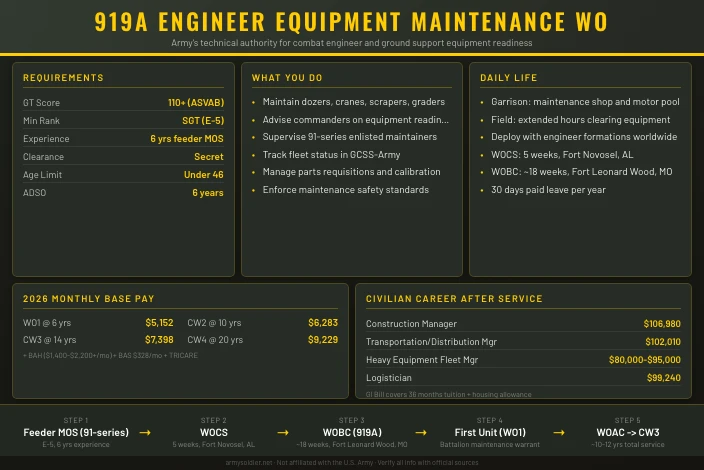
The 919A Engineer Equipment Maintenance Warrant Officer supervises and manages field and sustainment-level maintenance for combat engineer and ground support equipment at brigade and group echelon. As the senior maintenance technical advisor in an engineer formation, the 919A plans maintenance operations, manages shop workloads, ensures parts availability, and advises commanders on equipment readiness across a fleet that includes bulldozers, scrapers, graders, excavators, cranes, and specialized engineer systems. This MOS falls under the Army’s Ordnance Corps but is proponented by the U.S. Army Engineer School at Fort Leonard Wood, Missouri.
Technical Expertise and Scope
The 919A’s technical domain is specifically engineer and ground support equipment, a fleet that differs substantially from the wheeled vehicles managed by the 915A or the tracked combat systems managed by the 915T. Engineer equipment operates under demanding conditions at construction sites, breach lanes, and river-crossing points. A bulldozer clearing a route under fire has different maintenance demands than one grading a road at a garrison installation.
Equipment in the 919A’s lane spans an unusually broad range of systems. Earthmoving machines like the D7 bulldozer and 160M motor grader require different technical knowledge than power generation sets, water purification units, or POL transfer equipment. Adding to that complexity are quarrying and rock-crushing systems, asphalt mixing and surfacing equipment, and water-gap crossing assets. A 919A warrant officer is not a generalist: they are a subject-matter expert across all of these platforms, and they train subordinate 91-series enlisted personnel to the same standard.
The distinction between a senior 91L Construction Equipment Repairer NCO and a 919A warrant officer is authority and scope. The NCO runs a shop and solves problems within it. The warrant officer manages the entire maintenance program, interprets technical data at the systems level, advises the S4 and commander, and signs off on technical calls that determine when equipment returns to service.
Related Warrant Officer MOS
| MOS | Title | Primary Technical Domain |
|---|---|---|
| 919A | Engineer Equipment Maintenance WO | Combat engineer and ground support equipment |
| 915A | Automotive Maintenance WO | Wheeled vehicles (HMMWV, LMTV, MRAP) |
| 915T | Track Maintenance WO | Tracked vehicles (non-Stryker) |
| 915S | Stryker Maintenance WO | Stryker vehicle family |
| 913A | Armament Systems Maintenance WO | Crew-served weapons and armament systems |
Mission Contribution
Engineer units exist to shape the battlefield: clear obstacles, build fortifications, emplace and breach minefields, and support river crossings. All of that requires working equipment. A deadlined crane cannot emplace an Armored Vehicle-Launched Bridge. A broken scraper cannot construct a defensive fighting position. The 919A’s readiness report is not administrative output; it directly shapes what the engineer battalion can execute.
The warrant officer bridges the gap between the engineer Soldier who operates and maintains equipment and the commissioned officer who plans missions. Staff officers plan engineer operations based on what the 919A reports as available. The 919A translates technical condition into operational capacity, and that translation has tactical consequences.
Equipment and Tools
The 919A works with the Army’s Global Combat Support System-Army (GCSS-Army) to track equipment status, work orders, and parts requisitions across the fleet. On the shop floor, the work includes reviewing diagnostic findings, signing off maintenance actions before equipment returns to the unit, managing calibration programs, and overseeing oil analysis schedules for engine health monitoring. For certain engineer-specific systems, the 919A uses specialized technical manuals and diagnostic tools not found in wheeled vehicle or tracked vehicle maintenance shops.
Salary and Benefits
Most 919A warrant officers come from the enlisted ranks with at least six years of service before appointment. That means their pay grade at WO1 reflects years of service already accumulated, putting their starting base pay well above the minimum W-1 rate.
Base Pay at Realistic Career Points
| Rank | Typical YOS | Monthly Base Pay |
|---|---|---|
| WO1 | 6 years | $5,152 |
| WO1 | 8 years | $5,584 |
| CW2 | 10 years | $6,283 |
| CW2 | 12 years | $6,509 |
| CW3 | 14 years | $7,398 |
| CW3 | 18 years | $8,150 |
| CW4 | 20 years | $9,229 |
| CW4 | 24 years | $10,032 |
| CW5 | 26 years | $11,495 |
2026 pay rates per DFAS. YOS = total years of service including enlisted time.
Allowances and Special Pays
BAH for warrant officers is calculated at officer rates and varies by duty station and dependent status. At most major Army installations, a single CW2 draws between roughly $1,400 and $2,200 per month in BAH depending on local housing costs. Officers, including warrant officers, receive BAS at $328.48 per month rather than the enlisted rate.
The 919A does not qualify for flight pay or aviation hazardous duty pay. Warrant officers serving in combat zones receive combat zone tax exclusion on base pay and the same imminent danger pay as enlisted soldiers.
Additional Benefits
Active duty warrant officers receive TRICARE Prime with no enrollment fees, no deductibles, and no copays. Coverage extends to the service member and family members. Dental and vision are included.
Under the Blended Retirement System (BRS), warrant officers earn a pension of 2% per year of service based on the high-36 average monthly base pay at 20 years. The TSP government match adds up to 5% of base pay: 1% automatic contribution plus matching on the first 5% the member contributes. A CW3 or CW4 retiring at 20 years with a high-36 around $8,500 to $9,000 per month walks away with a monthly pension between $3,400 and $3,600 before TSP draws. Many 919As serve 25 or more years, significantly increasing that figure.
Annual leave accrues at 2.5 days per month, with a maximum 60-day carryover. Federal Tuition Assistance covers up to $4,500 per year at $250 per semester hour for soldiers pursuing degrees while on active duty.
Work-Life Balance
In garrison, 919A warrant officers generally work a schedule tied to the unit’s operational tempo and maintenance cycle. Weeks before a major field exercise look very different from a quiet week mid-cycle. The 919A has less schedule unpredictability than commissioned staff officers who attend continuous planning meetings, but more than warrant officers in purely garrison-based technical roles.
The warrant officer lifestyle sits between the senior NCO experience and the commissioned officer experience. More autonomy than a Staff Sergeant, fewer staff grind requirements than a Captain. For someone who likes solving hard technical problems without managing a staff section, that balance is an advantage.
Qualifications and Eligibility
The 919A is an enlisted-to-warrant pathway only. There is no street-to-seat or direct appointment option for this MOS.
Appointment Path
Candidates must be a Sergeant (E-5) or above with at least six years of hands-on experience in a qualifying feeder MOS. That experience must be documented in NCOERs showing technical proficiency and supervisory leadership. Time in service alone is not enough; boards look for NCOERs that specifically validate maintenance expertise.
Qualifying feeder MOS for 919A:
- 91B (Wheeled Vehicle Mechanic)
- 91C (Utilities Equipment Repairer)
- 91D (Power Generation Equipment Repairer)
- 91H (Track Vehicle Repairer)
- 91J (Quartermaster and Chemical Equipment Repairer)
- 91L (Construction Equipment Repairer) – primary feeder
- 91X (any non-MOS qualified 91-series position)
The 91L is the most direct path because it covers construction and engineer equipment in the enlisted maintenance lane, but all qualifying 91-series NCOs bring relevant skills. Combat engineers (12B, 12C) who later cross-trained into a 91-series MOS may also qualify if they meet the rank and experience standards in the feeder MOS.
Requirements Table
| Requirement | Standard | Waiverable? |
|---|---|---|
| Feeder MOS | 91-series (see list above) | No |
| Minimum rank | SGT (E-5) | No |
| Experience | 6 years in feeder MOS | No |
| GT score | 110 minimum | No |
| Age | Under 46 at board date | No |
| Citizenship | U.S. citizen | No |
| Education | High school diploma or GED | No |
| ALC completion | Required | No |
| Security clearance | Final Secret | No |
| Enlistment remaining | 12 months minimum | Yes |
| College credit | 30 hours preferred | Yes |
Test Requirements
Every warrant officer applicant must score 110 or higher on the GT (General Technical) line score. The GT score comes from the Verbal Expression (VE) and Arithmetic Reasoning (AR) subtests of the ASVAB. This threshold is non-waiverable for all non-aviation warrant officer MOS. Candidates below 110 must retest before submitting a packet.
Warrant Officer Candidate School (WOCS)
WOCS runs five weeks at Fort Novosel, Alabama, home of the U.S. Army Warrant Officer Career College. The course covers leadership fundamentals, Army doctrine, and warrant officer roles and responsibilities. It is the same five-week course for all non-aviation warrant officer candidates regardless of MOS. Aviation warrant officer candidates complete a longer six-week version.
Applying for warrant officer appointment requires assembling a DA 61 packet. Required components include:
- DA Form 61 (Application for Appointment)
- NCOERs for the most recent 10 rating periods demonstrating technical supervisory proficiency
- ALC diploma from a qualifying 91-series feeder MOS
- Letters of recommendation from a CW3 or higher in the 919A MOS or a closely related maintenance field
- Academic transcripts
- Physical examination documentation
- Security clearance eligibility determination
Packet and Board Process
Selection boards meet multiple times per year. The most competitive packets share common characteristics:
- NCOERs that document the candidate functioning in roles adjacent to what a 919A does (equipment management, shop supervision, technical advisory)
- ALC completion in a 91-series feeder MOS
- 30 or more college credit hours
- A recommendation letter from a 919A warrant officer who can speak to the candidate’s technical depth
- Any additional certifications in maintenance management or construction equipment systems
The 919A has open positions across active duty, the Army Reserve, and the Army National Guard. Engineer units with maintenance shortfalls recruit actively. Selection rates vary by board and component, but the MOS is not oversubscribed in the way some cyber or aviation warrant officer designations are.
Upon Appointment
New 919A warrant officers enter at WO1 with a warrant of appointment issued by the Secretary of the Army. The standard Active Duty Service Obligation is six years from appointment date. Upon promotion to CW2, warrant officers receive a commission and become commissioned warrant officers.
See our ASVAB study guide for a study plan focused on the GT composite.
Work Environment
Setting and Schedule
The 919A works primarily in and around the engineer equipment maintenance shop and motor pool. Garrison days follow the unit’s training schedule, with extended hours during pre-deployment readiness periods and high-maintenance events. Field exercises change the rhythm dramatically; the warrant officer may be at the maintenance site well into the night getting equipment cleared for next-day operations.
Deployed, the 919A operates from a Forward Operating Base maintenance area. Timelines compress, the parts pipeline shrinks, and the warrant officer manages maintenance operations that often run around the clock during high-tempo phases.
Position in the Unit
The 919A fills the maintenance warrant role at battalion or brigade level in engineer formations, including combat engineer battalions, engineer brigades, and multi-role bridge companies. They advise the battalion S4 and commander on equipment readiness and maintenance resource requirements. They sit outside the NCO support channel and do not work through the battalion sergeant major the way senior NCOs do. Their authority is technical and advisory, not command.
The working relationship with the Motor Sergeant or Maintenance Control NCO (typically an E-7 or E-8) is critical. The NCO runs day-to-day shop operations and leads the enlisted force. The 919A handles the technical calls the NCO escalates, manages the property accountability and parts pipeline above the NCO’s authority, and represents maintenance to the commissioned officer staff. When the relationship works, the shop runs well. When roles overlap or either party doesn’t respect the boundary, the unit’s readiness suffers.
Technical vs. Staff Roles
At WO1 and CW2, most work is hands-on: learning the unit’s specific equipment, building technical credibility with the Motor Sergeant and subordinate maintainers, and developing the judgment that advisory work requires. A new 919A who can’t answer a shop technician’s technical question will lose credibility quickly.
By CW3, the balance shifts. More time goes to staff advisory work at brigade or multi-battalion level, briefing commanders, and tracking readiness across subordinate organizations. At CW4 and CW5, most 919As serve in division or corps sustainment structures with little direct shop involvement. The career arc moves consistently from technical practitioner to technical advisor, but the expertise that underpins advisory roles never becomes optional.
Job Satisfaction and Retention
Warrant officers in engineering maintenance tend to stay for three reasons: the technical work is genuinely complex and interesting, the autonomy versus commissioned staff officers is real, and the compensation at CW3 and above compares favorably to equivalent civilian fleet management roles. The most common trigger for early separation is a civilian offer that substantially exceeds military total compensation. Those who stay tend to value the pension math, the technical challenge at senior grades, and the built-in network of engineer units that creates consistent demand for 919A expertise.
Training and Skill Development
Warrant Officer Basic Course (WOBC)
The 919A WOBC is conducted at the United States Army Engineer School at Fort Leonard Wood, Missouri, with students assigned to the 554th Engineer Battalion. After completing WOCS at Fort Novosel, Alabama, candidates report to Fort Leonard Wood for the MOS-specific phase.
| Phase | Location | Length | Focus |
|---|---|---|---|
| WOCS | Fort Novosel, AL | 5 weeks | Leadership, Army doctrine, WO roles |
| WOBC Resident | Fort Leonard Wood, MO | ~18 weeks | Engineer equipment systems, maintenance management, GCSS-Army |
The resident WOBC covers the full range of engineer equipment in technical depth: earthmoving systems, power generation, water purification, POL transfer, and specialized engineer assets. The curriculum trains warrant officers to manage at the systems level, not just to perform maintenance tasks. Graduates leave Fort Leonard Wood able to run a battalion engineer equipment maintenance program on day one.
Warrant Officer Advanced Course (WOAC)
WOAC is typically attended as a CW2 or early CW3, generally around the 10 to 12-year mark of total service. The course covers advanced maintenance management, sustainment operations doctrine, and the warrant officer’s advisory role at higher echelons. For 919A warrant officers, WOAC is conducted at Fort Leonard Wood through the Engineer School. Completion is a prerequisite for promotion to CW3.
Warrant Officer Intermediate Level Education (WOILE)
WOILE is a five-week, MOS-immaterial resident course conducted at Fort Novosel. Attended as a CW3 or CW4, it develops warrant officers for advisory roles at division and corps. The 919A attends alongside warrant officers from aviation, intelligence, finance, and other branches. The focus moves away from technical depth toward institutional knowledge, joint operations concepts, and senior advisory skills.
Warrant Officer Senior Service Education (WOSSE)
WOSSE prepares senior CW4 and CW5 warrant officers for the Army’s most senior advisory positions. It runs in two phases: a distance learning phase followed by a resident phase. Content focuses on strategic advisory responsibilities, interagency and joint environments, and the CW5’s role at division, corps, and Army command. Not all 919A warrant officers reach WOSSE, but those who do typically serve at division sustainment brigade or higher.
Additional Schools and Certifications
- Airborne School: Available at Fort Moore; opens airborne-qualified engineer unit assignments
- Air Assault School: Fort Campbell; useful for air assault division assignments
- Sapper Leader Course: Fort Leonard Wood; the premier engineer leadership course, available to warrant officers
- Army COOL Program: Covers exam fees for civilian certifications that map to 919A duties, including construction equipment-related credentials
- Certified Equipment Manager (CEM): Available through the Association of Equipment Management Professionals; directly relevant to engineer equipment fleet management
- Tuition Assistance: Up to $4,500 annually for degree completion while on active duty
The Engineer School recommends that 919A candidates have at least 30 college credit hours before their board and target a bachelor’s degree before CW3 promotion. Engineering technology, construction management, and business administration all pair well with 919A career objectives.
A qualifying GT score comes first — our ASVAB study guide covers the subtests that drive GT.
Career Progression and Advancement
Career Timeline
| Rank | Typical Total YOS | Time in Grade | Key Role |
|---|---|---|---|
| WO1 | 6-8 | 18-24 months | Battalion maintenance warrant, junior technical advisor |
| CW2 | 8-12 | 4-6 years | Battalion maintenance officer, shop OIC |
| CW3 | 14-18 | 4-6 years | Brigade or group maintenance technical advisor |
| CW4 | 18-24 | 4-6 years | Division or corps senior technical advisor |
| CW5 | 24-30+ | Terminal grade | Army, MACOM, or Engineer School technical authority |
YOS includes enlisted time. Most 919As enter at 6 or more years of total service.
Promotion System
WO1 to CW2 is time-based after completing WOBC, typically 18 to 24 months. CW3 and above requires board selection. Promotion boards review OERs (DA Form 67-10 series; warrant-officer-specific guidance is in DA Pam 623-3 Appendix B), education records, assignments, and demonstrated technical impact.
Promotion to CW4 requires a complete file: consistent senior rater differentiation, broadening assignments, a degree, and at least one tour at a higher echelon. CW5 is the most selective grade in the warrant officer corps. A small fraction of CW4s are selected, and those who reach it typically serve at division or higher-level organizations.
Building a Competitive Record
Strong 919A careers share a pattern:
- Top-block OERs from senior raters who take time to differentiate candidates in writing
- Assignments across different engineer unit types (combat engineer battalion, engineer brigade, sustainment support)
- One broadening assignment (joint duty, training officer, TRADOC instructor)
- A bachelor’s degree by CW3, master’s preferred before CW4 promotion board
- Sapper Leader Course completion, which signals commitment to the Engineer Regiment
CW5 as Senior Technical Advisor
A CW5 in the 919A specialty typically serves at a division sustainment brigade, an engineer brigade staff, or an Army Materiel Command organization. At this level, the work is not managing a shop. It is advising general officers on fleet readiness policy, equipment fielding for new engineer systems, and maintenance doctrine. Some CW5s represent the Engineer proponent to program managers developing next-generation construction and breach equipment. The 919A CW5 is the Army’s institutional memory for engineer equipment maintenance, and that expertise is genuinely rare.
Physical Demands and Medical Evaluations
Army Fitness Test Standards
Warrant officers take the Army Fitness Test (AFT), which replaced the ACFT on June 1, 2025. The AFT has five events scored 0 to 100 each, for a maximum of 500 points. The general standard requires a minimum of 60 points per event and 300 total. The 919A is not among the 21 designated combat MOSs requiring the 350-point combat specialty standard.
| Event | Abbreviation | Scoring |
|---|---|---|
| 3 Rep Max Deadlift | MDL | Age/sex normed; min 60 pts |
| Hand Release Push-Up | HRP | Age/sex normed; min 60 pts |
| Sprint-Drag-Carry | SDC | Age/sex normed; min 60 pts |
| Plank | PLK | Age/sex normed; min 60 pts |
| Two-Mile Run | 2MR | Age/sex normed; min 60 pts |
Current scoring tables and minimum raw performance thresholds by age group and sex are published at army.mil/aft.
MOS-Specific Physical Demands
Engineer equipment maintenance involves working around large, heavy systems in challenging environments. Climbing on and under dozers and cranes, managing heavy components, and working in heat and cold are part of the job at all grades, though senior warrant officers spend progressively less time in direct physical work.
No special medical evaluations beyond the standard Army physical are required for 919A appointment. No flight physical, no special vision standards, no unusual hearing requirements. The standard Army medical fitness criteria apply.
Deployment and Duty Stations
Deployment Considerations
Engineer units deploy with the formations they support, which means the 919A deploys wherever combat engineer capabilities are needed. Active duty deployment tempo tracks closely with the parent unit’s assignment. A 919A in a combat engineer battalion attached to an infantry brigade combat team will deploy more frequently than one assigned to an engineer training unit or depot-level maintenance organization.
Deployed, the 919A runs maintenance from a Forward Operating Base maintenance area. Parts requisitions route through the theater sustainment command, evacuation of equipment beyond field-level repair capability requires coordination with higher maintenance organizations, and the warrant officer often juggles maintenance operations alongside the engineer unit’s combat mission requirements.
Primary Duty Stations
Fort Leonard Wood, Missouri is the home of the Engineer Regiment and houses a significant concentration of engineer units and training commands with 919A positions. Beyond the Engineer School installation, 919A warrant officers serve across the Army wherever engineer formations are stationed.
| Installation | Location | Major Engineer Units |
|---|---|---|
| Fort Leonard Wood | Missouri | 1st Engineer Brigade, 554th Engineer Battalion, Engineer School |
| Fort Stewart | Georgia | 3rd Infantry Division engineer units |
| Fort Campbell | Kentucky | 101st Airborne Division engineer units |
| Fort Liberty | North Carolina | XVIII Airborne Corps engineer units |
| Fort Cavazos | Texas | III Corps engineer units |
| Fort Drum | New York | 10th Mountain Division engineer units |
| OCONUS | Germany, Korea | USAREUR-AF, USARPAC engineer formations |
Assignment preferences go through HRC, but unit vacancies and Army needs govern final assignments. Warrant officers generally PCS less often than commissioned officers, which means more time at each installation.
Risk, Safety, and Legal Considerations
Job Hazards
Engineer equipment maintenance carries the physical risks common to heavy equipment work: hydraulic systems under pressure, crane loads, fuel and lubricant hazards, and working around large moving components. Beyond the physical risk, the 919A owns the professional consequences of maintenance decisions. Equipment that fails in the field after being cleared for service reflects directly on the technical authority who signed it off.
Deployed operations add combat risk. Working on FOBs means the 919A operates near hostile fire threat while simultaneously managing maintenance that cannot pause. Engineer equipment that supports a breach operation cannot be deadline-cleared after the mission starts.
Safety Protocols
The 919A applies Composite Risk Management (CRM) to all maintenance operations. They enforce maintenance safety standards under Army Technical Manual procedures and applicable DA Pamphlets governing field maintenance. Crane operations, which fall within the 919A’s lane, require adherence to rigger and operator certification standards, and the warrant officer is responsible for ensuring those standards are met.
Technical failures traced to improper maintenance sign-off can result in UCMJ action. The 919A’s signature on a maintenance completion document carries legal weight.
Authority and Responsibility
The 919A does not hold command authority in the traditional sense. Their authority is technical and advisory, not positional command. They can direct enlisted soldiers on technical matters and are expected to challenge technically flawed decisions made by commissioned officers through proper channels. If a commissioned officer wants to return equipment to service that the 919A judges unsafe, the warrant officer is expected to document the determination and escalate rather than simply comply.
Impact on Family and Personal Life
Family Considerations
Garrison maintenance positions generally follow a defined daily schedule, with extended hours during high-tempo events, field exercises, and pre-deployment periods. Families experience deployment separations consistent with the parent unit’s tempo, typically one deployment per three to four years on active duty for most active component assignments.
The Army provides Army Community Service (ACS), Family Readiness Groups, on-post childcare, and installation schools at all primary 919A duty stations. Fort Leonard Wood, the primary hub for engineer units, has the full suite of family support programs.
PCS Tempo and Stability
Warrant officers PCS less frequently than commissioned officers as a rule. A commissioned engineer officer might rotate through battalion, brigade, and school assignments every two to three years. A CW2 or CW3 in a stable maintenance billet can expect three to five years between moves, which matters for spouses with careers and children in established schools.
Dual-military couples with one 919A warrant can request join-spouse assignments through HRC. Engineer units at multiple major installations give 919A warrant officers enough of a geographic footprint that join-spouse requests are workable, though not guaranteed. The concentration of engineer units at Fort Leonard Wood means some couples who both serve in engineer-adjacent fields have options to co-locate.
Reserve and National Guard
Component Availability
The 919A is available in both the Army Reserve and the Army National Guard. Engineer maintenance warrant positions exist in both components because every engineer battalion, bridge company, and combat engineer company needs equipment readiness expertise, and those units exist throughout the Reserve and Guard structure.
Appointment Paths in Reserve Components
Reserve and Guard candidates follow the same feeder MOS, rank, and GT score requirements as active duty. WOCS and WOBC are the same courses at the same installations. Most Reserve and Guard 919As are former active duty soldiers who transitioned to a component, though NCOs who served only in the Reserve or Guard can apply if they meet all requirements.
National Guard candidates apply through their state’s Warrant Officer Strength Manager. Engineer-heavy states, particularly those with significant National Guard engineer units, recruit maintenance warrants aggressively.
Drill and Training Commitment
The standard Reserve and Guard obligation is one weekend per month (Battle Assembly, four drill periods) plus two weeks of Annual Training per year. The 919A may have additional requirements tied to GCSS-Army system access certification and equipment currency training, but the tempo does not approach the flight-hour requirements of aviation warrant officers.
Part-Time Pay
Drill pay is calculated from the same base pay tables as active duty, divided by 30 days per month.
| Rank/YOS | Per Weekend (4 Drills) | Annualized (48 drills + AT) |
|---|---|---|
| WO1 < 2 yrs | $541 | ~$12,400 |
| WO1 @ 2 yrs | $599 | ~$13,700 |
| CW2 < 2 yrs | $616 | ~$14,100 |
| CW2 @ 2 yrs | $675 | ~$15,500 |
Annual Training adds approximately 14 days of additional base pay. Based on 2026 pay tables per DFAS.
Benefits Comparison
| Category | Active Duty | Army Reserve | Army National Guard |
|---|---|---|---|
| Monthly pay model | Full base pay | Drill pay only | Drill pay only |
| Healthcare | TRICARE Prime ($0) | TRICARE Reserve Select ($58/mo individual) | TRICARE Reserve Select ($58/mo individual) |
| Education | TA up to $4,500/yr | TA up to $4,500/yr | TA + possible state tuition waiver |
| Retirement | 20-yr pension + TSP | Points-based, collect at 60 | Points-based, collect at 60 |
| Deployment tempo | High | Moderate (mobilization-driven) | Moderate (state + federal) |
| Advancement to CW4/CW5 | Yes | Yes (slower timeline) | Yes (slower timeline) |
| PME (WOAC, WOILE) | Required on schedule | Available, less enforced | Available, less enforced |
TRICARE Reserve Select costs $57.88 per month (individual) or $286.66 (member-plus-family) in 2026. It has premiums, unlike active duty TRICARE Prime, but costs substantially less than most civilian employer plans.
Reserve retirement uses the points-based system under BRS. A 20-year qualifying Reserve or Guard career generates fewer points than continuous active duty service because drill periods accumulate points more slowly than full-time service days. The pension is collected starting at age 60 (reduced by 90 days for each qualifying deployment) and will be smaller than an equivalent active duty pension.
Civilian Career Integration
The 919A pairs directly with heavy equipment management and construction fleet operations in the private sector. A Reserve or Guard 919A who manages a construction company’s equipment fleet, works as a heavy equipment service technician, or runs a municipal public works maintenance program is building parallel credentials that strengthen both the military record and the civilian career. USERRA protections (38 USC 4301-4335) require employers to reinstate Reserve and Guard members after deployments and prohibit discrimination based on military service.
Post-Service Opportunities
Civilian Transition
A 919A CW3 or CW4 who separates after 20 years brings a documented record of managing large, complex equipment fleets under operational pressure. Those skills are immediately legible to civilian employers in construction, infrastructure, and heavy industry. The Army’s Soldier for Life Transition Assistance Program (SFL-TAP) and Hiring Our Heroes corporate fellowship programs connect transitioning warrant officers with employers who specifically recruit veterans with maintenance management backgrounds.
Civilian Career Prospects
| Civilian Role | Median Salary | Job Outlook (2024-2034) |
|---|---|---|
| Heavy Vehicle/Mobile Equipment Service Supervisor | ~$80,000-$95,000/yr | +6% (faster than avg) |
| Construction Manager | $106,980/yr | +9% (much faster than avg) |
| Transportation/Distribution Manager | $102,010/yr | +6% (faster than avg) |
| Logistician | $99,240/yr | +18% (much faster than avg) |
| First-Line Supervisor, Mechanics/Installers | $75,000-$90,000/yr | +4% |
Salary and outlook data from the Bureau of Labor Statistics Occupational Outlook Handbook, 2024-2025 edition. Construction manager median from BLS May 2024 data.
Certifications and Credentials
The Army COOL program covers exam fees for certifications that align with 919A experience. High-value credentials for transition:
- Certified Equipment Manager (CEM): Association of Equipment Management Professionals; directly maps to 919A fleet management duties
- Project Management Professional (PMP): Useful for 919As moving into construction project management or maintenance operations leadership
- OSHA 30-Hour Construction: Relevant for transitioning into construction site safety or management roles
- ASE Certifications (relevant series): Recognized by commercial equipment and fleet employers
The Post-9/11 GI Bill covers up to 36 months of tuition at a public institution (full in-state) or up to $29,920.95 annually at private institutions for the 2025-2026 academic year. Many 919As use this benefit for construction management, engineering technology, or business degrees if they didn’t complete one on active duty.
Is This a Good Job for You? The Right (and Wrong) Fit
Ideal Candidate Profile
The best 919A candidates are typically senior 91L or 91C NCOs who are already filling a quasi-warrant-officer role before they apply. They’re the Staff Sergeant who knows not just how to fix the equipment but why it keeps breaking and what the battalion needs to do differently in its maintenance program. They think across the fleet, not just about their current shop.
Strong personality traits for this role:
- Systematic thinking across many equipment types and maintenance variables simultaneously
- Comfort with both technical documentation and face-to-face advisory conversations with commanders
- Patience for property accountability and administrative requirements alongside hands-on work
- Drive to stay technically current as engineer equipment evolves
Potential Challenges
Candidates who want command authority and a traditional leadership hierarchy often find the warrant officer path less satisfying than expected. The 919A advises and influences; they do not command. A newly appointed WO1 coming from a Staff Sergeant billet may feel a genuine reduction in direct authority over soldiers, even as technical authority increases.
The peer community is small. There are far fewer 919As in the Army than 91L or 91B enlisted soldiers, which means fewer warrant officer mentors at any given installation, fewer opportunities to compare notes with peers, and less institutional support than larger MOS communities receive. Engineer-maintenance warrant officers need to be self-reliant in ways that officers in larger specialties do not.
Promotion to CW5 is competitive and not guaranteed. Most 919As who serve a full career max out at CW4. Those who want CW5 need to build for it deliberately starting at CW2.
Career and Lifestyle Alignment
This MOS fits well for an experienced 91-series NCO who wants to stay technical for a full career rather than moving into the senior NCO administrative pipeline. It also fits someone building toward civilian construction equipment management, where the 919A background and Army COOL credentials create a direct hiring path.
It fits less well for someone who wants command authority, visible unit leadership recognition, or rapid promotion. The motor pool and maintenance shop are not glamorous. But for the right person, they offer something genuinely hard to find: problems that matter, tools to solve them, and measurable proof that the unit is ready because of your work.
More Information
Contact an Army warrant officer recruiter before putting together a packet. The Army Warrant Officer Recruiting page lists current requirements, board schedules, and recruiter contacts by state. If your GT score is below 110, work with a recruiter on a retest plan first. The ASVAB Verbal Expression and Arithmetic Reasoning subtests drive the GT composite, so focused preparation in those two areas will move the number. The 919A proponent at the Engineer School at Fort Leonard Wood can also answer questions about MOS-specific requirements.
- Prepare for the ASVAB with our study guide to meet the GT 110 requirement
This site is not affiliated with the U.S. Army or any government agency. Verify all information with official Army sources before making enlistment or career decisions.
Explore more Army warrant officer careers such as the 915A Automotive Maintenance Warrant Officer and the 120A Construction Engineering Technician.