920A Property Accounting Technician
Every brigade-level unit in the Army owns millions of dollars in equipment. Rifles, vehicles, radios, night optics, generators, aircraft ground support gear – every line item on that property book has to be accounted for, every day, whether the unit is in garrison or downrange. The officer responsible for that accountability isn’t a commissioned officer with a year-long assignment. It’s a 920A warrant officer who has spent years inside Army supply systems and knows GCSS-Army like most people know their phone.
Property book work sounds administrative until the unit fails its Command Supply Discipline Program inspection or a battalion commander faces a $2.3 million shortage. That’s when the 920A becomes the most important person in the building. The demand for experienced property accounting technicians far exceeds supply at every echelon, and that gap isn’t closing.
Warrant officer candidates need a GT score of at least 110 — our ASVAB study guide covers what drives that number.
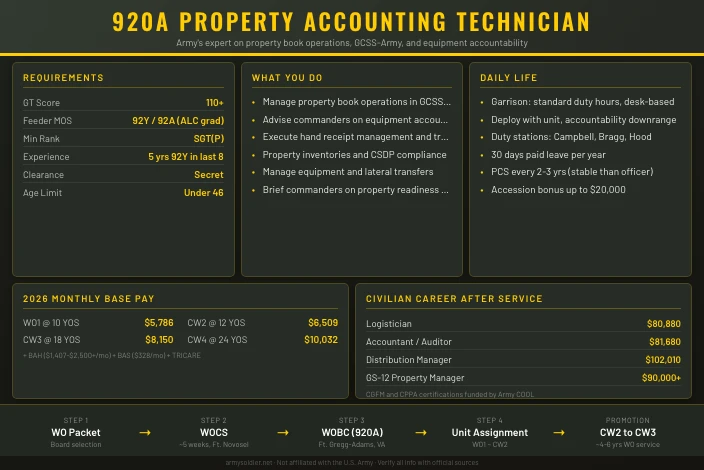
Job Role and Responsibilities
The 920A Property Accounting Technician is an Army warrant officer who manages property accountability, hand receipt systems, and property book operations for units at battalion level and above. These warrant officers serve as the primary technical expert on Army property accountability regulations, automated property systems, and equipment readiness reporting – solving accountability problems that no enlisted soldier or commissioned officer is trained to handle independently.
Technical Domain
The 920A owns the property book. That means every line item of organizational property – assigned, on hand, or on hand receipt to a subordinate – falls under this warrant officer’s technical authority. At the battalion level, a 920A might manage 8,000 to 12,000 line items worth tens of millions of dollars. At brigade and above, the numbers grow significantly.
The core system is GCSS-Army (Global Combat Support System - Army), the enterprise resource planning system that replaced multiple legacy supply systems. A 920A must know GCSS-Army well enough to train others, audit transactions, troubleshoot discrepancies, and extract data for commander decision briefs.
How This Role Differs from Enlisted and Commissioned Officers
A supply sergeant (92A or 92Y) operates inside the system, processing transactions and managing day-to-day hand receipts. A commissioned officer signs for property but rarely has the depth to manage complex accountability actions independently. The 920A sits between both – technically deeper than any enlisted soldier in the property book domain, and accountable for advising the commander on every aspect of property management policy and execution.
Related MOS Codes and Designators
| Designator | Title | Typical Echelon |
|---|---|---|
| 920A (WO1/CW2) | Property Accounting Technician | Battalion, Squadron |
| 920A (CW3/CW4) | Senior Property Accounting Technician | Brigade, Group, Regiment |
| 920A (CW5) | Command Property Accounting Technician | Division, Corps, Army |
Systems and Tools
Beyond GCSS-Army, 920A warrant officers work with Property Book Unit Supply Enhanced (PBUSE) on older legacy platforms, Army’s Global Combat Support System (GCSS-Army SAP), the Army Property Book and Unit Supply-Enhanced (SPBS-R), and various supporting systems for lateral transfers, turn-ins, and equipment readiness reporting. Supply chain data analysis and reporting to commanders are significant parts of the job at CW3 and above.
Salary and Benefits
Base Pay at Realistic Entry Points
Most 920A candidates enter at Sergeant First Class (E-7) or Staff Sergeant (E-6) level after 8 to 14 years of enlisted service. Their years of service (YOS) for pay purposes carries over, so a new WO1 who enters with 10 years of enlisted time draws substantially more than the minimum W-1 rate.
All figures are 2026 rates per DFAS.
| Rank | Typical YOS at Entry | Monthly Base Pay |
|---|---|---|
| WO1 | 8 YOS | $5,584 |
| WO1 | 10 YOS | $5,786 |
| CW2 | 10 YOS | $6,283 |
| CW2 | 12 YOS | $6,509 |
| CW3 | 14 YOS | $7,398 |
| CW3 | 18 YOS | $8,150 |
| CW4 | 20 YOS | $9,229 |
| CW4 | 24 YOS | $10,032 |
| CW5 | 26 YOS | $11,495 |
| CW5 | 30 YOS | $12,071 |
Bonuses and Special Pay
The Army offers a Warrant Officer Accession Bonus (WAOB) for 920A appointments. Current incentives run up to $20,000 for eligible applicants; confirm the current rate with a warrant officer recruiter at HRC, as bonus amounts change with each fiscal year. Continuation pay under the Blended Retirement System (BRS) is available between years 8 and 12 of service, worth 2.5x to 13x monthly base pay with a 3-year service commitment.
No flight pay or hazardous duty pay applies to this MOS. Special Duty Assignment Pay (SDAP) may apply to specific instructor or recruiting positions.
Additional Benefits
BAH rates for warrant officers use officer pay grade tables, which run higher than enlisted rates. At Fort Gregg-Adams, Virginia, a WO1 draws roughly $1,407 per month without dependents; a CW3 draws approximately $1,764 monthly. Rates vary significantly by installation and dependency status – check the DoD BAH calculator for your duty station. BAS for officers is $328.48 per month.
TRICARE Prime covers the warrant officer and all family members at no premium cost, with zero copays for primary care. The Post-9/11 GI Bill provides up to $29,920.95 per year at private schools (AY 2025-2026 cap) or full in-state tuition at public schools, plus a monthly housing stipend and $1,000 annual book allowance.
The Army matches up to 5% of basic pay in the Thrift Savings Plan (TSP) under BRS: 1% automatic contribution after 60 days, with matching beginning in year three of service.
Work-Life Balance
A 920A in garrison typically works standard duty hours Monday through Friday, though end-of-fiscal-year property accountability periods, pre-deployment preparations, and CSDP inspections drive longer stretches. The workload is predictable compared to many combat arms fields. Unlike most commissioned officers, warrant officers rarely face forced PCS moves into unwanted staff positions – they go where their technical specialty is needed, which provides more assignment stability than the typical commissioned officer career pattern.
Qualifications and Eligibility
Appointment Path
The 920A has one primary appointment path: enlisted-to-warrant. There is no street-to-seat or direct civilian appointment for this MOS. Candidates must already serve as an Army enlisted soldier with qualifying experience in supply and property operations.
TABLE REQUIRED: Appointment Requirements
| Requirement | Details |
|---|---|
| Minimum Rank | Sergeant Promotable (SGT/P) or above (Active Component); E-5 or above (Reserve/Guard) |
| Feeder MOS | 92Y (Unit Supply Specialist), ALC graduate; 92A (Automated Logistical Specialist) with ALC graduate equivalent; 68J (Medical Logistics Specialist) with equivalent 92Y experience (waiverable, case-by-case) |
| Experience | Minimum 5 years performing 92Y duties within the last 8 years |
| Education | TABE (Test for Adult Basic Education) score at 12th-grade level on Language portion (TABE 11/12 A only); or 6 college credit hours in English/CLEP equivalent |
| GT Score | 110 minimum (non-waiverable for all warrant officer appointments) |
| Security Clearance | Eligible for Secret (required prior to appointment) |
| Age | Maximum 46 years of age on the effective date of WO1 appointment (waiverable) |
| ADSO | 6 years upon graduation from WOBC |
| Citizenship | U.S. citizen by birth or naturalization |
| Physical | Must meet Army height/weight standards (AR 600-9) and pass the AFT |
| Recommendation | Letter from a currently serving Senior Property Accounting Technician (CW3 or above) required |
Warrant Officer Candidate School (WOCS)
All newly appointed Army warrant officers – regardless of MOS – attend Warrant Officer Candidate School at Fort Novosel (formerly Fort Rucker), Alabama. WOCS runs approximately five weeks and focuses on leadership, Army doctrine, land navigation, and the role and responsibilities of the warrant officer corps. It is a leadership and mental challenge as much as a physical one.
The WOCS packet process requires the candidate to assemble documentation through their unit S1 and senior chain of command. Key packet components include:
- DA Form 61 (Application for Appointment)
- Official military personnel file (ORB/iPERMS)
- NCOERs for the preceding 3 years
- Physical examination (must be current)
- TABE score results
- GT score verification
- Letters of recommendation (including the required senior 920A letter)
- Transcripts (if applicable)
- Commander endorsement at battalion level and above
Packets are submitted through the Warrant Officer Recruiting Company; candidates should work with their career counselor and a warrant officer recruiter well before their target board date. Boards typically meet twice per year.
Test Requirements
All warrant officer applicants need a minimum GT score of 110 from the ASVAB. The GT score is derived from Verbal Expression (VE) + Arithmetic Reasoning (AR). Candidates who scored below 110 on their original ASVAB can retest. No MOS-specific ASVAB composite beyond GT applies to 920A – the test burden is lighter than many technical warrant officer fields.
The 920A does not require the SIFT. That test is only mandatory for aviation warrant officer programs (153A, 153D, 153M).
Upon Appointment
New warrant officers enter at WO1 (Warrant Officer 1). WO1 holds a federal warrant of appointment issued by the Secretary of the Army. Promotion to CW2 is time-based and occurs after completion of WOBC, typically within the first 18 months of appointment. From CW2 forward, warrant officers receive a commission and are titled Chief Warrant Officers.
The ADSO is 6 years from WOBC graduation for non-aviation technical warrant officers.
See our ASVAB study guide for a study plan focused on the GT composite.
Work Environment
Daily Setting
Most of a 920A’s work happens in a property book office or S4 shop – a combination of GCSS-Army screen time, coordination meetings, hand receipt briefings to commanders, and floor walks through equipment storage areas. The environment is primarily administrative and analytical rather than physically demanding, though field exercises and deployments change that picture significantly.
During garrison operations, work is Monday-through-Friday during duty hours, with peaks at fiscal year-end and ahead of CSDP inspections. During pre-deployment or field exercises, the 920A deploys alongside the unit to maintain property accountability in an austere environment.
Position in the Unit
A 920A typically works for the battalion S4 or brigade S4 section, advising the property book officer (PBO) and commander directly on all matters of property accountability. They are not in the NCO support channel and do not supervise soldiers through a traditional chain of command. Their authority is technical and advisory, not command authority.
The relationship with the S4 officer (usually a captain or major) is collaborative. Many commissioned officers depend heavily on their 920A for day-to-day property book execution because warrant officers bring depth the officer cannot match. The relationship with supply sergeants (92A and 92Y) is mentorship-heavy – the 920A is the technical resource those NCOs escalate complex issues to.
Technical vs. Staff Roles
A WO1 and CW2 spend most of their time in direct execution: running transactions, managing hand receipts, preparing property book updates, and resolving discrepancies. By CW3, the role shifts toward advising and supervising – reviewing subordinate property book operations, providing technical guidance, and briefing commanders on property status. Senior CW4 and CW5 officers operate largely at staff advisory level, shaping policy, managing complex equipment transfers, and serving as the principal property accountability advisor to general officers.
Job Satisfaction
Property accounting is one of the more stable warrant officer fields. Demand is steady across the force because every brigade-level unit needs qualified property book support. Warrant officers in this field cite the combination of technical depth, autonomy, and predictable schedule as major retention factors. The primary frustration is the administrative friction of large-scale property transactions and the slow pace of some Army bureaucratic processes.
Training and Skill Development
Warrant Officer Basic Course (WOBC)
After WOCS, all newly appointed 920A warrant officers attend the Warrant Officer Basic Course at the U.S. Army Quartermaster School, Fort Gregg-Adams, Virginia. The Quartermaster WOBC covers the technical fundamentals of Army property accountability, GCSS-Army operations, Army supply regulations, and the practical skills needed to function as a property book technician at battalion and brigade level.
| Phase | Location | Focus |
|---|---|---|
| WOCS | Fort Novosel, AL | Leadership, doctrine, WO roles, land navigation |
| WOBC (920A) | Fort Gregg-Adams, VA | GCSS-Army, property book operations, accountability regulations, supply policy |
WOBC is more operationally focused than enlisted AIT – it assumes the candidate already knows supply operations and builds on that experience with officer-level application. Unlike commissioned officer BOLC, WOBC does not include unit command training; it is purely technical specialty development combined with warrant officer leadership foundations.
Warrant Officer Advanced Course (WOAC)
The 920A WOAC is attended as a CW2 or CW3, typically at the 4- to 6-year mark of warrant officer service. Also conducted at Fort Gregg-Adams, WOAC builds on WOBC with advanced property accountability topics, complex equipment transfer procedures, CSDP methodology, and advisory skills for higher-echelon staff positions. Distance learning modules precede the resident phase; the QM school publishes the required DL courses at the Quartermaster Warrant Officer proponency page.
Warrant Officer Intermediate Level Education (WOILE)
WOILE is a 5-week, MOS-immaterial resident course typically attended by CW3 or CW4 warrant officers. Conducted at Fort Leavenworth, Kansas, it develops warrant officers for service at higher echelons and includes curriculum on joint operations, inter-agency coordination, and strategic-level advisory roles. WOILE is a prerequisite for promotion to CW4.
Warrant Officer Senior Service Education (WOSSE)
WOSSE is the senior-level professional military education course for CW4s and CW5s approaching the end of their careers. It runs as a two-phase program (distance learning followed by a resident phase) and covers strategic-level advisory responsibilities, joint operations, and executive leadership. WOSSE is required for promotion consideration to CW5.
Additional Schools and Civilian Certifications
The Army funds several civilian professional certifications for 920A warrant officers through Army COOL (Credentialing Opportunities On-Line):
- CGFM (Certified Government Financial Manager) – issued by AGA (Association of Government Accountants), directly aligned with federal property management duties
- CPPA (Certified Professional Property Specialist/Administrator) – NPMA credential for property accountability professionals
- CPPB / CPPO – contract and procurement credentials applicable to supply officers
Tuition Assistance covers up to $4,500 per year for college coursework while serving. Many 920A warrant officers pursue bachelor’s or master’s degrees in accounting, business, or supply chain management during their careers.
A qualifying GT score comes first — our ASVAB study guide covers the subtests that drive GT.
Career Progression and Advancement
Career Timeline
| Rank | Time-in-Grade | Typical Total YOS | Key Assignments |
|---|---|---|---|
| WO1 | 18 months | ~10-12 | Battalion property book technician, WOBC student |
| CW2 | 2-5 years | ~12-15 | Battalion/squadron PB technician, brigade PB support |
| CW3 | 2-6 years | ~16-20 | Senior PB technician, brigade S4 advisor, WOAC |
| CW4 | 4-6 years | ~22-26 | Division G4 staff, branch technical advisor, WOILE |
| CW5 | Indefinite | ~28-34 | Corps/Army-level property advisor, WOSSE, senior technical mentor |
WO1 to CW2 is time-based and does not require a promotion board – it happens automatically after completing WOBC and meeting time requirements. CW3 and above require competitive board selection. Promotion rates to CW3 are generally competitive but consistent given the steady demand for experienced property accounting warrant officers across the force.
Promotion System
Warrant officers receive Officer Evaluation Reports (OERs) under the same DA Form 67-10 series as commissioned officers, with warrant-officer-specific guidance in DA Pam 623-3, Appendix B. Board selection from CW3 upward looks at technical performance, broadening assignments, PME completion, and senior rater assessments.
Building a Competitive Record
Warrant officers who advance quickly in 920A share several traits: they complete PME on time or early, they volunteer for joint or interagency staff billets, they pursue civilian certifications (CGFM or CPPA in particular), and they document their technical contributions clearly in OERs. A CW3 with a joint assignment, a completed degree, and a CGFM certification stands apart in the board file.
CW5 as Command Property Accounting Technician
A 920A CW5 serves as the Command Property Accounting Technician at division, corps, or Army headquarters. This is a policy-setting and senior advisory role – briefing general officers, shaping theater-level property accountability policy, and mentoring junior warrant officers across the formation. CW5s do not typically execute day-to-day property transactions; they govern the system that everyone else operates.
Physical Demands and Medical Evaluations
AFT Standards
Warrant officers take the Army Fitness Test (AFT), the same test as all soldiers, regardless of MOS. The AFT replaced the ACFT on June 1, 2025. It consists of five events scored 0-100 each, with a minimum of 60 points per event to pass.
| Event | Abbreviation | Minimum Score (All Ages) |
|---|---|---|
| 3 Rep Max Deadlift | MDL | 60 |
| Hand Release Push-Up | HRP | 60 |
| Sprint-Drag-Carry | SDC | 60 |
| Plank | PLK | 60 |
| Two-Mile Run | 2MR | 60 |
The general standard is 300 total points (60 per event), sex- and age-normed. The 920A is not a designated combat MOS, so the 350-point combat standard does not apply. Detailed scoring tables by age and sex are available at army.mil/aft.
MOS-Specific Physical Demands
Beyond the AFT, 920A warrant officers face no aviation-equivalent flight physicals or extreme physical requirements. The role involves regular walking through motor pools, supply rooms, and warehouse facilities, occasional lifting of equipment during inventories, and extended periods of desk work. No specific vision, hearing, or cardiac standards beyond standard Army requirements apply to this MOS.
Deployment and Duty Stations
Deployment Patterns
Property accountability does not pause during deployments. The 920A deploys with the unit as the property book expert, maintaining accountability records in a deployed environment, managing equipment transfers during Relief in Place/Transfer of Authority (RIP/TOA), and advising commanders on accountability posture throughout the deployment cycle.
Deployment tempo for 920A warrant officers varies by unit type. Brigade Combat Teams deploy on rotational cycles – historically 9 to 12 months, with 2 to 3 years between deployments. Sustainment brigades and support commands may deploy at different frequencies and durations. Combat is not a primary risk for 920A warrant officers, but forward-deployed environments carry the inherent risks of theater operations.
Duty Station Options
The 920A is found at nearly every major installation in the Army because every maneuver unit, support command, and generating force headquarters needs property book support. High-density installations include:
- Fort Campbell, KY (101st Airborne Division)
- Fort Bragg (Fort Liberty), NC (XVIII Airborne Corps)
- Fort Hood (Fort Cavazos), TX (III Corps)
- Fort Bliss, TX (1st Armored Division)
- Fort Stewart, GA (3rd Infantry Division)
- Fort Gregg-Adams, VA (TRADOC / Quartermaster School)
- OCONUS – Germany (USAREUR-AF), Korea, Japan, Hawaii
HRC manages warrant officer assignment preferences through the Assignment Interactive Module (AIM). Warrant officers submit preferences, and HRC fills vacancies based on the needs of the Army and the officer’s qualifications. Experienced 920A warrant officers generally have more assignment flexibility than junior officers because the field is demand-driven across many installations.
Risk, Safety, and Legal Considerations
Job Hazards
The 920A faces few physical hazards in garrison – the work is administrative and analytical. Deployed environments add the standard theater risks: hostile fire potential, vehicle movement, and austere conditions. The more significant risk in this MOS is financial liability. Warrant officers who sign for or manage hand receipts can face financial liability investigations if property is lost, stolen, or damaged through negligence.
Authority and Responsibility
A 920A does not hold command authority in the traditional sense – they advise and execute, but soldiers are not in their direct chain of command. Their authority is technical: they are the installation-level or unit-level expert, and their technical rulings on property accountability carry weight because of expertise rather than rank.
UCMJ responsibilities are the same as any commissioned warrant officer. Financial liability under Army Regulation 735-5 is a significant legal consideration in this field. Mismanagement of Army property – even through negligence rather than intent – can result in a Financial Liability Investigation of Property Loss (FLIPL), with the warrant officer potentially held personally liable for dollar amounts that can reach tens of thousands of dollars.
Safety Protocols
Risk management in the 920A context focuses on preventing accountability failures through procedural controls: regular cyclic inventories, proper hand receipt documentation, commander’s annual property inventory requirements, and GCSS-Army audit trails. Warrant officers trained in CSDP methodology build systematic accountability safeguards that protect both the unit and individual soldiers from liability exposure.
Impact on Family and Personal Life
Family Considerations
The 920A lifestyle is generally more family-friendly than combat arms fields. Garrison hours are predictable, PCS frequency is moderate (typically every 2 to 3 years), and the risk profile is lower than aviation or infantry warrants. Army Community Service (ACS), Family Readiness Groups (FRGs), and the Soldier and Family Assistance Center network provide support at most installations.
Deployments create family stress like any Army MOS – extended separations, solo parenting, financial management at home. The 920A’s relatively predictable deployment cycle (tied to unit rotation schedules) helps families plan ahead better than some other fields.
Dual-Military Families
HRC manages join spouse requests for dual-military couples, including warrant-commissioned and warrant-warrant combinations. Joint spousing is not guaranteed, but the Army’s expanding assignment flexibility programs make it increasingly achievable. The breadth of 920A positions across all installations improves the chances of finding overlapping assignment options.
Stability Compared to Commissioned Officers
Warrant officers generally PCS less frequently than commissioned officers. A commissioned officer might move every 18 to 24 months to fill developmental assignments. A 920A with established technical performance at a stable installation can remain in the same location for 3 or more years. This stability benefits children’s schooling, spouse employment, and community integration.
Reserve and National Guard
Component Availability
The 920A MOS is available in both the Army Reserve and the Army National Guard. Property accountability requirements exist in all components – sustainment commands, logistics support elements, and maneuver enhancement brigades all need property book expertise. Reserve and Guard 920A warrant officers often directly support the same unit they know from enlisted service.
Appointment in Reserve and Guard
Reserve and Guard candidates follow the same warrant officer packet process as active component soldiers, with submissions managed through the respective component’s warrant officer proponency office. Enlisted soldiers in Army Reserve or Guard units with qualifying 92Y or 92A experience can apply directly. Guard and Reserve warrant officers attend WOCS and WOBC at the same installations as active component candidates.
Drill and Training Commitment
The standard Reserve and Guard commitment is one weekend per month (4 drill periods) plus two weeks of Annual Training. Some 920A positions require additional GCSS-Army certification training or property accountability currency training beyond the standard schedule – especially ahead of unit deployments or major equipment draws.
Part-Time Pay
Reserve drill pay is calculated as (monthly base pay / 30) x number of drill periods. A CW2 with fewer than 2 years of warrant service earns approximately $616 per weekend (4 drills). A CW3 with 6 years earns approximately $796 per weekend. Annual Training at 14 days adds roughly one additional half-month of pay at the active component rate.
Component Comparison
| Factor | Active Duty | Army Reserve | Army National Guard |
|---|---|---|---|
| Commitment | Full-time | 1 weekend/month + 2 weeks AT | 1 weekend/month + 2 weeks AT |
| Monthly Pay (CW2, <2 YOS) | $4,622 | ~$616/weekend | ~$616/weekend |
| Healthcare | TRICARE Prime (free) | TRICARE Reserve Select ($57.88/mo member-only) | TRICARE Reserve Select ($57.88/mo member-only) |
| Education Benefits | Post-9/11 GI Bill (full) | Ch. 1606: $493/mo; Post-9/11 if activated 90+ days | Ch. 1606: $493/mo + state tuition waivers (varies) |
| Retirement | 20-yr pension (40% of high-36) | Points-based, collect at 60 | Points-based, collect at 60; earlier if mobilized |
| Deployment Tempo | Moderate (tied to unit cycle) | Variable, mobilization-based | Variable, mobilization + state missions |
| Promotion Pace | Competitive, board-driven | Slower; fewer billets | Slower; fewer billets |
| Career Ceiling | CW5 | CW5 (fewer vacancies) | CW5 (fewer vacancies) |
Civilian Career Integration
The 920A field aligns directly with government property management, federal contracting, and defense logistics careers. A Reserve or Guard 920A who also works as a federal civilian GS-11 or GS-12 property manager is one of the most common and effective career combinations in the warrant officer corps. USERRA protects civilian employment during deployments and mobilizations – employers cannot deny reemployment or benefits because of military service.
Post-Service Opportunities
Transition to Civilian Life
Deep GCSS-Army expertise, federal property accountability experience, and years of managing high-value asset portfolios translate directly into competitive civilian careers. Defense contractors, federal agencies, and state governments actively recruit former 920A warrant officers because the combination of military logistics discipline and automated system proficiency is hard to find in the civilian workforce.
SFL-TAP (Soldier for Life - Transition Assistance Program) provides pre-separation counseling, resume writing, and federal application guidance. The Hiring Our Heroes program facilitates hiring partnerships with defense-sector employers. The Army Career Alumni Program (ACAP) offers mentorship connections in the logistics and property management fields.
Civilian Career Prospects
| Civilian Job Title | Median Annual Salary | Job Outlook (2024-2034) |
|---|---|---|
| Logistician | $80,880 | +17% (much faster than average) |
| Accountant / Auditor | $81,680 | +5% (faster than average) |
| Transportation/Distribution Manager | $102,010 | +6% (faster than average) |
| Government Property Manager (GS-11 to GS-13) | $73,939-$117,962 | Steady federal demand |
Salary figures are from the BLS Occupational Outlook Handbook (May 2024). The government property manager range reflects the OPM GS pay table for GS-11 step 5 through GS-13 step 5 at the 2026 rate.
A retired CW4 or CW5 with 20 to 24 years of service enters the civilian job market with a pension, post-service healthcare access, and a resume that reads like a senior logistics executive’s. Many transition into GS-12 or GS-13 federal civilian positions and move up from there.
Certifications and Credentials
Army COOL funds several certifications directly applicable to post-service careers:
- CGFM – Certified Government Financial Manager, issued by AGA, valued by federal agencies and defense contractors
- CPPA (Certified Professional Property Administrator) – NPMA credential, directly transferable to civilian property management roles
- CPPB / CPPO – procurement and contract management credentials from NIGP
The Post-9/11 GI Bill covers up to 36 months of tuition, plus a monthly housing allowance scaled to the E-5 BAH rate at the school’s ZIP code. For a warrant officer separating after 10 or more years of active service, this benefit fully funds a master’s degree program. Many 920A alumni pursue master’s degrees in supply chain management, public administration, or accounting.
Is This a Good Job for You? The Right (and Wrong) Fit
Ideal Candidate Profile
The best 920A candidates are detail-oriented soldiers who find satisfaction in bringing order to complex systems. They genuinely like working with data, tracking down discrepancies, and building airtight accountability records. They’re comfortable briefing commanders and holding their technical ground in front of senior officers. They want to be the expert in the room, not the one who rotates through multiple assignments to build a generalist resume.
A 92Y or 92A Staff Sergeant with 8 to 10 years of supply experience, a history of strong NCOERs, and an itch for more autonomy and technical authority is exactly who this MOS was designed for. If you’ve spent years teaching younger soldiers how the property book works and you want to move into a role where that knowledge becomes your career identity, 920A fits.
Potential Challenges
The work is administrative. Long stretches in front of GCSS-Army screens are a real part of the job. Soldiers who want physical challenge, constant unit movement, or command authority over a formation will find this field frustrating. Property book accountability can also be genuinely stressful during inspections, deployment preparations, and equipment draws when discrepancies surface under command pressure.
Promotion to CW5 is competitive. The field has strong mid-career retention but the path to senior warrant officer grades requires sustained technical excellence, completed PME, broadening assignments, and a strong senior rater network. Warrant officers who coast after CW3 often plateau.
Long-Term Fit
The 920A suits three career patterns well. First, the full 20-to-30-year career to CW4 or CW5, finishing as a senior technical advisor with full pension and benefits. Second, the 10-to-12-year profile – fulfilling the ADSO, building expertise, and transitioning into a GS-12 or contractor role with an active pension already in hand. Third, the Reserve or Guard path, where the 920A skillset directly enhances a civilian federal government career without requiring full-time military service.
The warrant officer path beats staying enlisted for someone who wants technical depth without the rotational staff assignments of the commissioned officer track. It beats commissioning for someone who prefers being the specialist over being the generalist commander.
More Information
Talk to a warrant officer recruiter before you build your packet. The Warrant Officer Recruiting Company manages applications for all technical warrant officer programs, and a recruiter can tell you whether your current NCOER file, ALC status, and TABE score put you in a competitive position before you invest months in packet preparation. Start at goarmy.com/careers-and-jobs/find-your-path/warrant-officers for an overview, then contact your unit S1 or career counselor to request contact with the warrant officer recruiting team.
If your GT score is below 110, an ASVAB study guide can close that gap. The GT composite pulls from Verbal Expression and Arithmetic Reasoning, so focused prep in those two areas is the most efficient path to a qualifying score.
- Prepare for the ASVAB with our study guide to meet the GT 110 requirement
This site is not affiliated with the U.S. Army or any government agency. Verify all information with official Army sources before making enlistment or career decisions.
Explore more Army warrant officer careers such as 920B Supply Systems Technician and 922A Food Service Technician.