921A Airdrop Systems Technician
Every successful airborne operation starts long before the jump. Someone has to certify the parachutes are packed correctly, the cargo rigging will hold, and the Joint Precision Airdrop System (JPADS) guidance unit is programmed to hit the mark. That someone is a 921A Airdrop Systems Technician.
This is one of the Army’s smallest and most specialized warrant officer fields. There are fewer than a few hundred 921As on active duty at any time, and every one of them is a former senior Parachute Rigger (92R) who earned the right to wear jumpmaster wings and then decided the technical expert path suited them better than the NCO track. If you’re a Staff Sergeant or Sergeant First Class rigger thinking about a warrant officer packet, this guide covers every requirement, every training phase, and exactly what the career looks like from WO1 to CW5.
Warrant officer candidates need a GT score of at least 110 — our ASVAB study guide covers what drives that number.
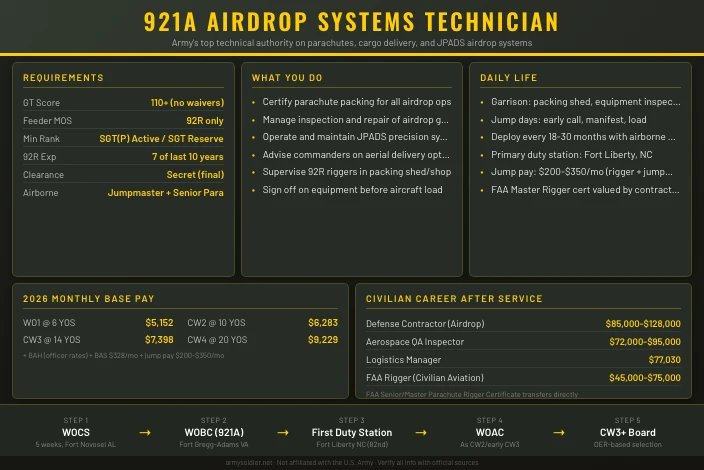
Job Role and Responsibilities
The 921A Airdrop Systems Technician is the Army’s top technical authority on all aerial delivery equipment, including personnel parachutes, cargo delivery systems, the Low-Altitude Parachute Extraction System (LAPES), Container Delivery System (CDS), and JPADS. This warrant officer supervises inspection, packing, maintenance, repair, and certification of all airdrop equipment in the unit. At higher echelons, the 921A advises commanders and staff on aerial delivery planning, force structure, and equipment capability limitations.
Technical Domain
The 921A owns the full life cycle of airdrop equipment. That includes parachute systems for personnel (T-11, MC-6), cargo systems (G-12, G-14), extraction systems, and precision airdrop guidance units. Every piece of equipment that goes out the back of a C-130 or C-17 requires a certified technician’s signature before it leaves the ground.
Junior riggers (92Rs) pack and inspect under supervision. Commissioned officers command the unit and present the aerial delivery plan at the operations order. The 921A sits between those two worlds as the technical backstop – the person who knows whether the rigging plan is physically sound, whether the parachute lot has an open deficiency, and whether the JPADS waypoint programming is correct for the drop zone.
Related MOS Codes and Designations
| Duty Title | Grades |
|---|---|
| Airdrop Systems Technician | WO1, CW2 |
| Senior Airdrop Systems Technician | CW3, CW4 |
| Command Airdrop Systems Technician | CW5 |
Mission Contribution
Airborne forces are only as effective as their aerial delivery pipeline. A 101st Airborne or 82nd Airborne Division can plan a perfect combat jump, but if the equipment is improperly rigged or the JPADS coordinates are wrong, the mission fails before the aircraft ever reaches the drop zone. The 921A is the warrant who prevents that.
At the platoon and company level, this warrant officer runs the packing shed and repair shop. At battalion and brigade, they become the subject matter expert advising the S4 and S3 on what aerial delivery is feasible given equipment status and load constraints. At corps and Army level, CW4 and CW5 921As shape doctrine, write technical manuals, and advise on force structure for airborne operations worldwide.
Equipment and Systems
- Personnel parachutes: T-11 static line, MC-6 maneuverable canopy, MC-4 HALO/HAHO ram-air systems
- Cargo delivery: G-12E, G-14 cargo parachutes; Container Delivery System (CDS) bundles
- Extraction systems: Low-Altitude Parachute Extraction System (LAPES), Ground Proximity Extraction System (GPES)
- Precision airdrop: JPADS (Joint Precision Airdrop System), including GPS-guided steerable cargo platforms
- Support equipment: Airdrop platforms, extraction chutes, tie-down equipment, rigging hardware
- Diagnostic tools: Technical Manuals (TMs), load charts, rigging data tables, packing data cards
Salary and Benefits
Most 921As enter the warrant officer ranks as E-6 or E-7 with six to ten years of service, so their pay-for-YOS bracket is meaningfully higher than a brand-new WO1 from civilian life. The table below shows realistic pay at typical career waypoints, using 2026 DFAS rates.
Base Pay at Realistic Career Points
| Rank | Typical YOS at Appointment | Monthly Base Pay |
|---|---|---|
| WO1 | 6 YOS | $5,152 |
| WO1 | 8 YOS | $5,584 |
| CW2 | 10 YOS | $6,283 |
| CW3 | 14 YOS | $7,398 |
| CW4 | 20 YOS | $9,229 |
| CW5 | 26 YOS | $11,495 |
Pay figures are drawn from the DFAS 2026 Military Pay Charts.
Special Pays
The 921A is Airborne qualified and maintains jump currency throughout their career. That means hazardous duty incentive pay on top of base pay.
- Parachutist HDIP: $200 per month for qualified static-line parachutists in designated airborne positions
- Jumpmaster SDAP: $150 per month for qualified jumpmasters, stacked on top of HDIP
- Total jump pay for jumpmasters: $350 per month
Warrant officers use officer BAH rates, which are higher than enlisted rates at the same installation. A CW2 at Fort Liberty (NC) can expect BAH ranging from roughly $1,600 to $2,300 per month depending on dependency status. BAS for officers runs $328 per month in 2026. Neither of those figures counts toward federal income tax.
The Army does not currently publish a dedicated accession bonus for 921A. The field is small enough and the feeder pipeline specific enough that bonus incentives are uncommon compared to high-demand technical fields like aviation or cyber. Check with your warrant officer recruiter for current incentive status before submitting a packet.
Retirement and TSP
Warrant officers appointed under the Blended Retirement System (BRS) earn a 20-year pension at 40% of their high-36 average basic pay, plus TSP matching of up to 5% of basic pay. Most 921As come in with six to ten years of service already accrued, putting them well on track for retirement in their late 30s or early 40s. Many serve 25 to 30 years and reach CW4 or CW5 before retiring.
Work-Life Balance
Garrison life for a 921A running a packing shed looks like a normal duty day – physical training in the morning, equipment inspections and packing operations through the afternoon. The pace accelerates significantly during jump cycles, which at Fort Liberty can run several times a week. Field exercises and deployment rotations are demanding, but the 921A does not carry the same staff burden as a commissioned officer. There are no battalion command boards to worry about and no brigade staff officer rotations eating up evenings.
Qualifications and Eligibility
The 921A is an enlisted-to-warrant path only. There is no street-to-seat or direct appointment option for this MOS. Aviation and cyber are the only warrant officer fields that accept candidates without prior enlisted service.
Appointment Requirements
| Requirement | Standard |
|---|---|
| Feeder MOS | 92R (Parachute Rigger) – only feeder MOS |
| Minimum Rank (Active) | SGT (Promotable) |
| Minimum Rank (Reserve/Guard) | SGT |
| ALC Completion | ALC graduate in MOS 92R required |
| Feeder MOS Experience | 7 of the last 10 years in 92R; most recent year must be in 92R |
| Supervisory Experience | 2 years supervising packing shed, repair shop, or aerial delivery facility |
| GT Score | 110 minimum (no waivers) |
| Security Clearance | Secret (final; interim will not satisfy requirement) |
| Airborne Qualification | Required – Airborne School graduate |
| Jumpmaster Qualification | Required – Jumpmaster qualified |
| Parachutist Rating | Senior Parachutist badge required |
| Airdrop Qualifications | Airdrop Load Inspectors Course completion required |
| Age Limit | Maximum 46 at time of appointment (waiverable) |
| Education | 12th-grade English proficiency (TABE), waived with Associate degree or higher |
| Recommendation | Letter from a 921A (CW3-CW5) |
Feeder MOS Detail
The 921A has exactly one feeder MOS: 92R (Parachute Rigger). No other MOS qualifies. A candidate who has cross-trained out of 92R must return to it and reestablish currency before submitting a packet. The seven-year experience requirement means you need a documented track record of hands-on rigging work, not just holding the MOS on paper.
The supervisory requirement is equally specific. Two years leading operations in a packing shed, repair shop, or cargo airdrop facility means you’ve been the NCO in charge of the workspace, not just working in it. This weeds out applicants who have MOS time but haven’t actually led riggers.
Warrant Officer Candidate School
All 921A candidates attend Warrant Officer Candidate School (WOCS) at Fort Novosel, Alabama (formerly Fort Rucker). The course is five weeks and runs continuously, Monday through Friday with weekend duties. WOCS focuses on officership, leadership development, Army doctrine, ethics, land navigation, and tactical exercises. It does not cover MOS-specific airdrop content – that comes in WOBC.
Candidates apply through the warrant officer packet process managed by the Army Warrant Officer Recruiting (AWOR) team. A complete packet includes:
Selection boards convene periodically throughout the year. The 921A field is small, so boards can be competitive even with a limited number of slots. A packet with documented jumpmaster time, strong NCOERs, and a recommendation from a respected senior 921A stands out.
Active Duty Service Obligation
New WO1s incur a three-year Active Duty Service Obligation (ADSO) upon appointment. This is shorter than the aviation ADSO (which runs 10 years from the date of rated wings) but still meaningful for planning purposes.
See our ASVAB study guide for a study plan focused on the GT composite.
Work Environment
Daily Setting
A 921A’s home base is the rigging company or aerial delivery section within an airborne unit. At Fort Liberty, that means the 82nd Airborne Division’s support structure, where packing sheds run on a tempo set by the division’s jump schedule. A typical week includes equipment inspections, packing operations, maintenance coordination, and technical reviews of rigging data cards.
The work is physical. Rigging equipment is heavy, the working environment is industrial, and jump day means early mornings and sustained activity through manifest call and aircraft load. As a warrant officer, the 921A is directing that work rather than doing every task personally, but staying sharp on hands-on skills is an expectation.
Position in the Unit
The 921A does not sit in the NCO support channel and does not hold a position in the traditional command authority chain (except where command authority is specifically delegated). This warrant officer advises the commander directly on technical matters.
The relationship with the senior rigger NCO (typically a Sergeant First Class or Master Sergeant) is important to get right. The 921A brings technical depth and the authority of the warrant officer position. The senior NCO runs the day-to-day enlisted discipline and personnel management. When those two roles complement each other, the section runs well.
Technical vs. Staff Shift
At WO1 and CW2, most of the job is technical – running the packing shed, certifying equipment, supervising inspections. At CW3, the balance shifts toward advising the battalion or brigade staff and managing programs across multiple subordinate units. A CW4 at division level may spend the majority of their time in planning cells, working with S4 and S3 on aerial delivery feasibility for operational plans. CW5s are primarily at corps, Army, or institutional Army positions.
Retention
The 921A field retains well. The technical nature of the work, the tight community of riggers, and the predictable career path (no branch-qualifying command required) all contribute to long careers. Many 921As serve 22 to 28 years and retire as CW4 or CW5. The primary reason warrant officers leave early is the pay differential between military service and civilian defense contracting roles, which can run $30,000 to $60,000 higher for experienced riggers with FAA credentials.
Training and Skill Development
Warrant Officer Basic Course (WOBC)
After WOCS graduation and WO1 appointment, every 921A attends the MOS-specific Warrant Officer Basic Course at the Army Sustainment University (ASU), located at Fort Gregg-Adams, Virginia (formerly Fort Lee). The WOBC for 921A is conducted through the Quartermaster School and covers technical content at the warrant officer level – not a repeat of 92R AIT.
| Phase | Location | Focus |
|---|---|---|
| WOCS | Fort Novosel, AL | Officership, leadership, Army doctrine |
| WOBC (921A) | Fort Gregg-Adams, VA | Advanced airdrop systems, technical management, warrant officer role in aerial delivery operations |
WOBC covers equipment certification procedures, technical inspection standards, unit-level program management, and the regulatory framework governing aerial delivery operations (Army TMs, Joint pubs, FAA regulations where applicable). Graduates leave qualified to lead an aerial delivery section as a WO1.
Warrant Officer Advanced Course (WOAC)
The WOAC is typically attended as a CW2 or early CW3. It deepens technical knowledge and prepares warrant officers to advise at battalion and brigade level. The course expands coverage of joint airdrop operations, doctrine writing, and program management across larger formations. Location is also Fort Gregg-Adams through the Quartermaster School.
Warrant Officer Intermediate Level Education (WOILE)
WOILE is a five-week resident course attended as a CW3 or CW4. It is MOS-immaterial – all warrant officers attend the same course regardless of specialty. WOILE focuses on warrant officer roles at higher echelons, joint operations, critical thinking, and preparation for senior advisory positions. It is conducted at the Warrant Officer Career College at Fort Novosel, Alabama.
Warrant Officer Senior Service Education (WOSSE)
WOSSE is a two-phase course (distance learning followed by a resident phase) for senior CW4s and CW5s. It prepares warrant officers for their final advisory roles at corps, Army, and institutional Army organizations. Completion is required for CW5 promotion and assignment to senior technical advisor positions.
Additional Schools and Certifications
Beyond the core PME pathway, 921As have access to a range of additional training:
- Basic Airborne Course: Required prerequisite, completed before warrant officer appointment
- Military Freefall (HALO) Course: Available to qualified 921As; expands knowledge of ram-air parachute systems
- Pathfinder Course: Useful for 921As working with JPADS and drop zone operations
- JPADS Operator/Maintainer Course: MOS-specific, covers the GPS-guided cargo delivery platform in detail
- Master Rigger qualification: Advanced certification within the 92R/921A career field
The Army funds civilian education through Tuition Assistance (TA), which covers up to $4,500 per year in tuition. The Army Credentialing Opportunities On-Line (COOL) program identifies certifications relevant to this MOS and in some cases funds exam fees.
A qualifying GT score comes first — our ASVAB study guide covers the subtests that drive GT.
Career Progression and Advancement
WO1 to CW5 Timeline
| Rank | Typical YOS (Including Enlisted Time) | How to Get There | Key Assignments |
|---|---|---|---|
| WO1 | 6-10 | WOCS + WOBC; time-in-grade based promotion to CW2 | Packing shed OIC, aerial delivery section technician |
| CW2 | 8-12 | Minimum 2 years as WO1; attend WOAC | Section lead, company-level airdrop technician |
| CW3 | 12-16 | Board-selected; strong OERs required | Battalion/brigade airdrop advisor, WOILE attendance |
| CW4 | 18-22 | Board-selected; broadening assignment recommended | Division/corps aerial delivery officer, doctrine writer |
| CW5 | 26-30 | Board-selected; WOSSE required | Corps/Army command airdrop advisor, institutional Army |
Promotion System
WO1 to CW2 is time-based – no board required. Every warrant officer who completes WOBC, meets physical standards, and maintains a clean record promotes to CW2. From CW3 upward, promotion is board-selected using Officer Evaluation Reports (OERs, DA Form 67-10 series). The same forms and standards used for commissioned officers apply, with warrant-officer-specific guidance in DA Pam 623-3, Appendix B.
CW5 is the most competitive grade. There are very few CW5 positions Army-wide for a field as small as 921A, so promotion to CW5 is not guaranteed even for strong CW4s. Those who reach it typically hold division or corps-level advisory positions and have spent years building a record of technical publications, joint assignments, and WOSSE completion.
Building a Competitive Record
The factors that distinguish top 921A records:
- Documented performance in multiple aerial delivery environments (airborne units, joint operations, school assignments)
- Completion of additional qualifications (HALO, Pathfinder, JPADS)
- FAA Senior or Master Parachute Rigger Certificate
- Strong, specific OERs from raters who understand the technical work
- Broadening assignments: joint billets, instructor duty at Fort Gregg-Adams or Fort Liberty, interagency roles
CW5 as Command Airdrop Advisor
A CW5 in this MOS functions as the Army’s senior technical voice on aerial delivery. These warrant officers serve at corps headquarters, Army G4 staff sections, and occasionally at the joint level alongside Air Force and special operations aerial delivery communities. They do not command units in the traditional sense, but they hold significant advisory authority and sign off on doctrine, equipment fielding decisions, and training standards that affect every parachute operation in the Army.
Physical Demands and Medical Evaluations
Army Fitness Test
All warrant officers take the Army Fitness Test (AFT), which replaced the ACFT on June 1, 2025. The AFT has five events scored 0-100 each, for a maximum of 500 points.
| Event | Abbreviation |
|---|---|
| 3-Repetition Maximum Deadlift | MDL |
| Hand Release Push-Up - Arm Extension | HRP |
| Sprint-Drag-Carry | SDC |
| Plank | PLK |
| Two-Mile Run | 2MR |
Minimum passing score per event: 60 points. Minimum total: 300 points (sex- and age-normed for the general standard). The 921A is a Quartermaster MOS, not one of the 21 designated combat MOSs requiring the elevated 350-point combat specialty standard.
OPAT Category
The 921A holds a Moderate physical demands category under the Occupational Physical Assessment Test (OPAT). This reflects the physical requirements of the packing shed and rigging environment – lifting and manipulating parachute equipment and cargo platforms – without reaching the heavy demands of combat arms.
Jump Physical and Airborne Standards
Because the 921A is required to maintain jump currency, periodic review of physical fitness for parachute operations applies. Soldiers must meet weight and physical standards to remain airborne qualified. There is no separate Class 1A flight physical for this MOS – that requirement is specific to aviation warrant officers.
Deployment and Duty Stations
Primary Duty Stations
The 921A follows airborne and air assault units. Most positions are concentrated at a handful of installations:
- Fort Liberty, North Carolina – 82nd Airborne Division; the largest concentration of 921A positions in the Army
- Joint Base Lewis-McChord (JBLM), Washington – Stryker and airborne-capable units; some aerial delivery positions
- Schofield Barracks, Hawaii – 25th Infantry Division; aerial delivery support
- Germany (Grafenwoehr/Baumholder area) – USAREUR-AF units with airborne or joint airdrop missions
- Fort Gregg-Adams, Virginia – Quartermaster School; instructor and writer positions for senior 921As
Most WO1 and CW2s will spend their first assignment at Fort Liberty. Career broadening in mid-grade often means a school assignment at Fort Gregg-Adams or a joint billet supporting special operations aerial delivery.
Deployment Tempo
Airborne units deploy. The 82nd Airborne Division’s Global Response Force mission means the division maintains units on 18-hour deployment notification. A 921A assigned to an 82nd brigade can expect deployments every 18 to 30 months, ranging from short-duration contingency operations to nine-month combat rotations. The JPADS mission also supports special operations and conventional airdrops in active conflict areas, putting some 921As in austere locations during deployed periods.
Warrant officer deployments differ from enlisted deployments in terms of staff advisory demands – the 921A is planning and certifying airdrop operations, not packing individual parachutes during combat.
Assignment Management
HRC manages warrant officer assignments. Warrant officers have more direct influence over their assignment preferences than enlisted soldiers, but popular installations (Fort Liberty, JBLM) are competitive. A CW3 or CW4 with specific broadening needs may negotiate directly with their career manager to align assignments with promotion goals.
Risk, Safety, and Legal Considerations
Job Hazards
Airdrop is inherently hazardous work. A misrigged cargo bundle can break away from the aircraft and strike personnel or equipment on the drop zone. An improperly packed parachute can malfunction. The 921A carries significant personal liability as the certifying official. When a parachute or airdrop equipment failure results in injury or death, Army investigations include a thorough review of the certifying warrant officer’s documentation.
Jump currency itself requires periodic aircraft exits. CW3s and CW4s in staff positions still maintain their jump qualification through scheduled airborne operations, which carries the inherent risk of static-line parachuting.
Safety Framework
The 921A applies Composite Risk Management (CRM) to every aerial delivery operation. Every rigging plan is reviewed against technical manual standards before aircraft load. Packing data cards and inspection records create a documentary trail that supports accident investigation when needed and deters corner-cutting.
Safety authority is reinforced by regulation. Army TMs and Joint Publication 4-02.2 governing airdrop operations assign specific certification responsibilities to the Airdrop Systems Technician. Signing off on improperly prepared equipment is both a safety failure and a legal one under the UCMJ.
Technical Authority and UCMJ
The 921A holds technical certification authority, not command authority. They cannot issue orders outside their area of technical responsibility. But within it, their certification signature carries weight – no aerial delivery operation proceeds without the technician’s approval of the equipment. This authority comes with corresponding accountability under Army regulations and, if negligence is involved, potential UCMJ exposure.
Impact on Family and Personal Life
Tempo and PCS Moves
Fort Liberty is the center of gravity for this MOS. Many 921As spend the majority of their careers there with one or two assignments elsewhere (Fort Gregg-Adams for school duty, a joint billet, or overseas). Compared to commissioned officers who rotate through multiple commands, the warrant officer career often involves fewer total PCS moves. That predictability helps with school enrollment, spousal employment, and family stability.
Jump cycles and deployment rotations do affect family life. When the 82nd division is on alert, soldiers’ schedules are not entirely their own. The FRG (Family Readiness Group) at Fort Liberty is experienced at supporting airborne families through these cycles.
Dual-Military Couples
The Army’s Joint Spouse Program attempts to co-locate dual-military couples at the same installation. Because 921A positions are concentrated at a limited number of installations, joint spouse assignments are more feasible than in fields with a wider geographic spread. But there are no guarantees, and Army needs take priority over family preferences.
Support Programs
Fort Liberty hosts Army Community Service (ACS), which provides financial counseling, employment assistance for spouses, and deployment support resources. The Military OneSource program provides confidential counseling and referral services available 24/7 for all active component service members and their families.
Reserve and National Guard
Component Availability
The 921A MOS exists in both the Army Reserve and Army National Guard. However, authorized positions are limited by the small size of the field and the concentration of aerial delivery capability in active component airborne units. Reserve and Guard 921A positions tend to cluster near active airborne installations or at specific Reserve and Guard units with an airdrop mission.
Appointment Path
Reserve and Guard candidates follow the same warrant officer packet process as active component soldiers. The minimum rank for Reserve and Guard applicants is SGT (not SGT Promotable, as required for active component), which gives Reserve and Guard NCOs a slightly earlier application window. The feeder MOS, experience, jumpmaster, and senior parachutist requirements are identical.
Reserve and Guard candidates may attend either the standard five-week resident WOCS at Fort Novosel or the two-phase Reserve WOCS conducted through authorized Regional Training Institutes.
Drill Commitment and Currency Challenges
Standard Reserve and Guard commitment is one weekend per month plus two weeks of annual training. The challenge for 921A Reserve and Guard warrant officers is maintaining jump currency and equipment certifications on a part-time schedule. Parachute operations require aircraft availability and airborne range access that are not always easy to schedule around drill weekends. Many Reserve and Guard 921As supplement their currency through coordination with nearby active component airborne units during Annual Training periods.
Reserve and Guard Drill Pay
A CW2 at under two years of service earns approximately $616 per weekend (four drill periods). A CW3 at six years of service earns roughly $796 per weekend. These figures do not include jump pay, which applies only during drilling periods that include qualifying parachute operations.
Component Comparison
| Factor | Active Duty | Army Reserve | Army National Guard |
|---|---|---|---|
| Commitment | Full-time | 1 weekend/month + 2 wks/year | 1 weekend/month + 2 wks/year |
| Monthly Pay (CW2, <2 YOS) | $4,622 base | ~$616/weekend | ~$616/weekend |
| Healthcare | TRICARE Prime ($0 premiums) | TRICARE Reserve Select ($57.88/mo individual) | TRICARE Reserve Select ($57.88/mo individual) |
| Education | Full TA ($4,500/yr) + GI Bill (36 mo) | Same federal TA; GI Bill based on activation history | Same federal TA; state tuition waivers may apply |
| Retirement | 20-yr pension (40% high-36) | Points-based, collect at 60 | Points-based, collect at 60; some state bonuses |
| Deployment Tempo | High (airborne division cycle) | Lower; mobilization-dependent | Lower; state mission + federal mobilization |
| Advancement to CW4/CW5 | Yes, competitive board | Yes, slower timeline | Yes, slower timeline |
Civilian Career Integration
The Reserve and Guard path pairs particularly well with FAA-related civilian careers. A rigger who holds an FAA Senior or Master Parachute Rigger Certificate and serves as a Reserve 921A can work for a civilian parachute manufacturer, skydiving operation, or defense contractor during the week while maintaining their warrant officer skills on the weekend. USERRA protects civilian employment rights for drilling Reserve and Guard members up to five cumulative years of absence.
Post-Service Opportunities
Transition Overview
When a 921A transitions out of the military, they carry credentials that most civilian hiring managers have never seen. Jumpmaster qualification, years of technical certification authority, and (typically) an FAA parachute rigging certificate combine to make this a rare skillset. Transition programs like Soldier for Life - Transition Assistance Program (SFL-TAP) help with resume translation and job search strategy.
Civilian Career Prospects
| Civilian Job Title | BLS Median Salary | Job Outlook |
|---|---|---|
| Aerospace Quality Assurance Inspector | ~$72,000-$95,000 | Stable; defense spending drives demand |
| Defense Contractor (Airdrop/Aerial Delivery) | $85,000-$128,000 | Strong; limited qualified candidates |
| FAA Parachute Rigger (Skydiving/Aviation) | $45,000-$75,000 | Niche but consistent demand |
| Logistics Manager (Supply Chain) | $77,030 median (BLS) | 28% growth projected through 2033 |
| Training Specialist / Technical Writer | $63,080 median (BLS) | Steady government and defense contractor demand |
The most valuable civilian role for a retired 921A is with a defense contractor supporting aerial delivery programs – companies like Airborne Systems, Capewell Aerial Systems, or firms supporting Special Operations Command aerial delivery contracts. A CW4 or CW5 with JPADS operator experience and FAA credentials can command salaries at the upper end of that range.
FAA Certifications and Army COOL
The FAA Senior Parachute Rigger Certificate and FAA Master Parachute Rigger Certificate are the primary civilian credentials that transfer from this MOS. FAA 14 CFR Part 65, Subpart F governs these certifications. Senior Rigger requires packing at least 20 parachutes of each type to be rated; Master Rigger requires additional packing hours and repair experience. Most qualified 921A applicants already meet the experience requirements and need only to pass the FAA written and practical tests.
Army COOL identifies these certifications and in some cases covers exam fees through credentialing assistance. Check Army COOL for MOS 921A for current funding status before paying out of pocket.
The Post-9/11 GI Bill provides up to 36 months of tuition, a monthly housing allowance, and an annual book stipend for qualifying education. For a 921A pursuing an aerospace technology or logistics degree after retirement, full in-state tuition is covered at public institutions and up to $29,920 per year at private schools (2025-2026 cap).
Is This a Good Job for You? The Right (and Wrong) Fit
Who Thrives in This Role
The 921A draws a specific type of soldier: someone who spent years as a rigger and found that the technical depth of the work was more satisfying than climbing the NCO promotion ladder. Successful candidates tend to be:
- Detail-oriented – certification work requires zero tolerance for mistakes
- Self-directed – warrant officers manage their own technical programs without constant supervision
- Comfortable with physical work in an industrial setting
- Invested in the airborne mission and the tight-knit rigger community
- Patient with slow career progression (the field is small and senior grades are scarce)
Potential Challenges
This MOS is not suited for everyone who holds the 92R badge. If you want command authority over soldiers, the warrant path limits that – the 921A advises and certifies but does not command a unit the way a commissioned officer does. The small size of the field means fewer peers for professional comparison and fewer senior mentors than you’d find in larger warrant officer communities like aviation or cyber.
Promotion to CW5 is genuinely competitive and not guaranteed. Some strong CW4s retire without pinning the fifth bar simply because the number of CW5 positions in this MOS is very small. If reaching the highest warrant grade is your main motivation, a higher-density field may offer better odds.
Long-Term Fit
For the right person – a senior 92R who loves the technical work and wants to stay connected to airborne operations for a full career – the 921A path offers a coherent 20 to 28-year arc from packing shed technician to corps-level airdrop advisor. The jump pay, the airborne community, the FAA credentials, and the defense contractor market on the back end all add up to a career that rewards technical mastery.
If you’re considering the warrant path but haven’t yet done the supervisory time required, the best move is to get assigned to a packing shed in a leadership role now and start building the documented experience your packet will need.
More Information
Contact an Army Warrant Officer Recruiter through the Army Warrant Officer Recruiting page for current packet deadlines, board schedules, and accession bonus status. Your ASVAB GT score must reach 110 to qualify – if you’re close but not there yet, GT score improvement through targeted study of the Verbal Expression and Arithmetic Reasoning subtests can make the difference.
- Prepare for the ASVAB with our study guide to meet the GT 110 requirement
This site is not affiliated with the U.S. Army or any government agency. Verify all information with official Army sources before making enlistment or career decisions.
Explore more Army warrant officer careers such as 920A Property Accounting Technician and 922A Food Service Technician.