922A Food Service Technician
Most people think of Army food service as a cook slinging chow at a field kitchen. The 922A warrant officer is the person who makes sure every soldier on that installation actually gets fed, safely, legally, and within budget. That means managing multimillion-dollar dining facility operations, passing federal food safety inspections, overseeing nutrition programs, and advising commanders on feeding hundreds or thousands of soldiers simultaneously. It’s a logistics and regulatory role as much as a culinary one, and the Army has exactly one warrant officer MOS dedicated to it.
The 922A community is small and specialized. Fewer than 200 warrant officers hold this designation across the active force. That concentration of expertise makes senior 922As among the most authoritative voices in the Army on food service policy, field feeding doctrine, and nutrition compliance. If you’re a 92G Food Service Specialist who has spent years running DFACs and wants a career built on genuine technical mastery, this is the path.
Warrant officer candidates need a GT score of at least 110 — our ASVAB study guide covers what drives that number.
Job Role and Responsibilities
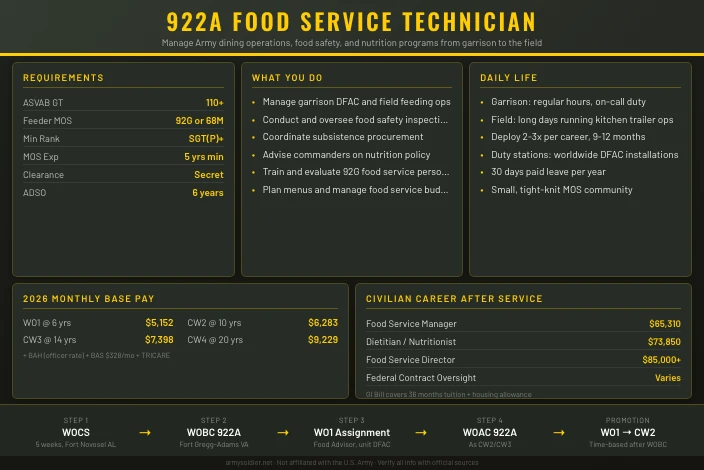
The 922A Food Service Technician is the Army’s warrant officer expert for all food service operations, responsible for supervising dining facilities, managing field feeding programs, enforcing food safety regulations, overseeing nutrition programs, and advising commanders at installation, command, and echelon-above-brigade levels. They plan and execute food service programs for garrison and deployed environments, coordinate subsistence procurement and accountability, develop training for food service personnel, and ensure compliance with Army regulations governing food preparation, sanitation, and nutritional standards.
Technical Domain
The 922A owns the entire food service enterprise. That includes dining facility (DFAC) operations, field kitchens, garrison nutrition programs, and subsistence management. Enlisted 92G cooks operate individual stations; the 922A manages the system those cooks operate within. Commissioned officers command the unit; the 922A tells them what is regulatory, what is operationally feasible, and what is not.
At the center of the job is food safety compliance. DFACs operate under federal food safety law, Army Regulation 30-22, and Department of Defense standards. A 922A at a brigade or installation owns that compliance posture. A failed inspection or a foodborne illness outbreak lands in the warrant officer’s lane.
Related Designations
| Designation | Description |
|---|---|
| 922A | Food Service Technician (primary warrant officer MOS) |
| 92G | Food Service Specialist (enlisted feeder MOS) |
| 68M | Nutrition Care Specialist (enlisted feeder MOS) |
There are no Additional Skill Identifiers or Skill Identifiers specific to 922A published in current sources. Food safety officer functions overlap with the 640A Veterinary Corps Food Safety Officer, but 640A is a separate MOS focused on veterinary public health rather than dining facility management.
Mission Contribution
The 922A fills the gap between the enlisted NCO who runs a shift and the commissioned officer who signs funding documents. A brigade combat team’s soldiers need three meals a day in garrison, and a completely different feeding solution in the field. The warrant officer bridges that gap: advising the S4 on procurement, training the food service NCOs on regulatory requirements, and making sure the field kitchen can push hot food to a battalion that just finished a 72-hour exercise.
At higher echelons, senior 922As advise installation commands on contract food service oversight, food safety inspection programs, and nutrition policy. The Army Food Advisor at major commands is typically a CW4 or CW5 922A.
Systems and Tools
Day-to-day work involves the Army’s subsistence management systems, including the Standard Army Retail Supply System (SARSS) and Force Provider module planning tools. 922As use the Army’s Master Menu Program, nutritional analysis software, and food service inspection checklists. In the field, they work with unitized group rations (UGR), Meals Ready to Eat (MRE) accountability, and mobile kitchen trailer (MKT) operations.
Salary and Benefits
Base Pay
Most 922A warrant officers enter with six or more years of enlisted service as a 92G or 68M. Their pay starts at the appropriate years-of-service column from the moment they’re appointed WO1. The table below shows realistic pay at each warrant grade using typical years-of-service milestones. All figures are 2026 monthly base pay per DFAS.
| Rank | Typical YOS | Monthly Base Pay |
|---|---|---|
| WO1 (W-1) | 6 years | $5,152 |
| CW2 (W-2) | 10 years | $6,283 |
| CW3 (W-3) | 14 years | $7,398 |
| CW4 (W-4) | 20 years | $9,229 |
| CW5 (W-5) | 26 years | $11,495 |
Special and Incentive Pays
The 922A MOS does not carry aviation bonus pay, hazardous duty pay, or special duty assignment pay as baseline entitlements. Some 922As may qualify for the Army’s Officer Retention Bonus at certain career milestones, though exact bonus amounts and availability change with annual policy guidance. Verify current accession and retention bonus status with your Army Warrant Officer Recruiter.
Additional Benefits
Warrant officers receive BAH at officer rates, which run higher than the equivalent enlisted rate. A WO1 at Fort Novosel, AL receives $1,407 per month without dependents and $1,761 with dependents. BAH varies significantly by duty location; use the official BAH Rate Lookup for your specific installation. Officers receive BAS of $328.48 per month.
Healthcare is TRICARE Prime for the active-duty member and family, with zero premiums and zero copays at military treatment facilities. Dental and vision are included. The family catastrophic cap is $1,000 per year.
At 20 years, active-duty warrant officers retire at 40% of their high-36 average basic pay. A CW4 retiring at 20 years with a $9,229 base pay would receive roughly $3,692 per month. Many 922As serve 25 to 30 years, which increases the multiplier substantially.
Work-Life Balance
Garrison life for a 922A follows normal business hours with on-call duties tied to DFAC inspections, major exercises, or command visits. The job is largely predictable in peacetime. Field exercises and deployments shift the tempo entirely: 12- to 16-hour days running field feeding operations during major training events are normal. The warrant officer lifestyle offers more stability than a commissioned officer rotating through staff and command positions, and more autonomy than an NCO working in the unit’s support channel.
Qualifications and Eligibility
Appointment Path
The 922A has one path: enlisted-to-warrant. There is no civilian direct appointment and no WOFT equivalent. You must be an active 92G (Food Service Specialist) or 68M (Nutrition Care Specialist), hold the minimum rank and time-in-service, and submit a competitive warrant officer packet.
| Requirement | Active Component | Reserve / Guard |
|---|---|---|
| Feeder MOS | 92G or 68M | 92G or 68M |
| Minimum rank | SGT(P) or above | SGT or above |
| MOS experience | 5 years in feeder MOS within last 8 years | 5 years in feeder MOS within last 8 years |
| Supervisory experience | 2 years minimum | 2 years minimum |
| Age limit | Under 46 at appointment | Under 46 at appointment |
| GT score | 110 or higher (no waiver) | 110 or higher (no waiver) |
| TABE requirement | 12th-grade language (waivable with 6 credit hours college English) | Same |
| Security clearance | Eligible for Secret | Eligible for Secret |
| SIFT test | Not required | Not required |
| Physical standard | Pass AFT, meet AR 600-9 | Pass AFT, meet AR 600-9 |
Warrant Officer Candidate School (WOCS)
All 922A candidates attend WOCS at Fort Novosel, Alabama, run by the U.S. Army Warrant Officer Career College (WOCC). The course runs five weeks. WOCS covers leadership fundamentals, Army doctrine, officership, military history, ethics, land navigation, and tactical problem-solving. The focus is not on food service. It’s on whether you can lead as a warrant officer, regardless of MOS.
The application process runs through HRC and requires a warrant officer packet submitted through your chain of command. Packets typically include your DA Form 61 (application), letters of recommendation from senior officers or warrant officers, NCOERs, college transcripts if applicable, and a physical and medical screening. Packets are reviewed by a selection board at HRC.
Test Requirements
The GT score of 110 is non-waiverable for all Army warrant officer candidates. GT is derived from the ASVAB’s Verbal Expression and Arithmetic Reasoning subtests. Many 92G soldiers score below 110 on initial enlistment, so retesting is common. If your GT score is below 110, retake the ASVAB well before your submission window.
The TABE (Test for Adult Basic Education) language requirement at the 12th-grade level is specific to 922A. Soldiers who complete six college credit hours in English or pass an equivalent CLEP exam are exempt.
Upon Appointment
New 922A warrant officers enter at WO1 and incur a six-year Active Duty Service Obligation (ADSO). This ADSO begins on the date of appointment, not WOBC completion. After WOBC graduation, the WO1 is assigned to a unit as a Food Advisor. Promotion to CW2 is time-based and follows completion of WOBC.
Packets that stand out demonstrate: sustained performance as a food service NCO, documented supervisory experience in large DFACs or field feeding environments, consistent NCOER excellence, and ideally some civilian credentialing (ServSafe, culinary management coursework).
See our ASVAB study guide for a study plan focused on the GT composite.
Work Environment
Setting and Schedule
Most 922As work in or around dining facilities, food service offices, and installation food program management offices. The physical work environment is a mix of office work (budget planning, training coordination, inspection reporting) and hands-on DFAC oversight. Daily work involves reviewing subsistence accountability records, conducting or supervising food safety inspections, and advising unit leadership on food service status.
In garrison, a 922A at a brigade might oversee one or two DFACs serving several hundred soldiers. At an installation level, a senior 922A may manage multiple contracted and government-run dining facilities across the post, with oversight of civilian and military food service personnel.
Position in the Unit
The 922A sits outside the NCO support channel and outside the traditional command chain. At the brigade or battalion level, the 922A typically works for the S4 (logistics officer) or reports through the Food Service Sergeant (92G SGT or SSG) chain up to the warrant officer. They advise the commander, not execute the commander’s orders through an NCO chain.
At installation level, a senior 922A may function as the senior food service advisor to the Directorate of Family and Morale, Welfare, and Recreation (DFMWR) or the garrison command. The relationship with 92G enlisted soldiers is one of technical oversight: the warrant officer sets standards and trains the force, while the NCOs execute daily operations.
Technical vs. Staff Balance
Junior warrant officers (WO1 and CW2) spend most of their time doing hands-on technical work, directly managing DFACs, running inspections, and training enlisted food service soldiers. By CW3, the balance shifts toward advisory and staff functions: developing food service policy, evaluating programs across a command, and serving on higher-echelon staffs.
CW4 and CW5 warrant officers fill senior staff advisory positions at installation commands, division sustainment brigades, or Army-level food program offices. The senior 922A at a major command is the Army Food Advisor, the technical authority on all things food service for that headquarters.
Job Satisfaction and Retention
The 922A community is cohesive partly because it’s small. Warrant officers in this MOS tend to stay: the technical depth required, combined with the niche expertise, makes career military service a logical choice for most. Reasons to leave typically involve civilian food service management opportunities that pay significantly more than base pay, particularly for senior warrant officers with federal contracting experience.
Training and Skill Development
Training Pipeline
| Phase | Location | Focus |
|---|---|---|
| WOCS | Fort Novosel, AL | Leadership, doctrine, officership |
| WOBC 922A | Fort Gregg-Adams, VA | Food service management, field feeding, sanitation, nutrition, budgeting |
| WOAC 922A | Fort Gregg-Adams, VA | Advanced food service systems, senior advisor functions |
Warrant Officer Basic Course (WOBC)
The 922A WOBC is conducted at the U.S. Army Quartermaster Center and School, Fort Gregg-Adams, Virginia. It covers food service program management, garrison and field feeding operations, subsistence procurement and accountability, food safety and sanitation regulations, nutrition program administration, and budget planning. The course goes significantly deeper than enlisted 92G AIT, shifting from individual cook tasks to program management and regulatory compliance across an entire command’s food service operations.
WOBC is also where new 922A warrant officers connect with the broader Quartermaster warrant officer community, including 920A, 920B, and 923A warrant officers who share some sustainment logistics training phases.
Warrant Officer Advanced Course (WOAC)
WOAC for 922A is also at Fort Gregg-Adams and is typically attended as a CW2 or CW3. It develops advanced skills in food service system management, senior advisor functions, contract oversight, and higher-echelon staff roles. Graduates of WOAC are eligible for the Training with Industry (TWI) program, which places 922A warrant officers at civilian food service companies like Sodexo for 10 to 12 months, with a follow-on assignment at the Quartermaster School.
Warrant Officer Intermediate Level Education (WOILE)
WOILE is a five-week, MOS-immaterial resident course that prepares CW3 and CW4 warrant officers for senior roles at brigade and above. It focuses on joint operations, theater-level logistics, and leadership at higher echelons rather than MOS-specific skills.
Warrant Officer Senior Service Education (WOSSE)
Senior CW4 and CW5 warrant officers attend WOSSE, which runs in two phases: a distance learning phase and a resident phase. WOSSE prepares senior warrant officers for Army-level advisory positions and addresses strategic-level leadership, Army policy, and the senior technical expert role at major commands.
Additional Training and Certifications
The Army funds ServSafe certification for 922A warrant officers through the Quartermaster Credentialing Program, proponent-funded and available through Army COOL. Other credentials commonly pursued include:
- Certified Dietary Manager (CDM) – Association of Nutrition and Foodservice Professionals
- American Culinary Federation (ACF) certifications, including Certified Food Service Manager (CFSM)
- Registered Dietitian (RD/RDN) pathway – requires a bachelor’s degree in dietetics and a supervised practice program; some 922As pursue this through tuition assistance
- HAZMAT/food safety certifications relevant to field feeding and subsistence storage
The Army COOL portal lists credentialing opportunities and funding options for 922A. Tuition Assistance covers up to $4,500 per year and $250 per semester hour for degree coursework.
A qualifying GT score comes first — our ASVAB study guide covers the subtests that drive GT.
Career Progression and Advancement
Career Timeline
| Rank | Typical TIG | Cumulative YOS | Key Assignments |
|---|---|---|---|
| WO1 | 1-2 years | 6-8 total | Food Advisor, brigade/battalion DFAC oversight |
| CW2 | 5-6 years | 10-12 total | Food Advisor, WOAC, larger DFAC or garrison program |
| CW3 | 6+ years | 14-16 total | Senior Food Advisor, installation food program, WOILE |
| CW4 | 6+ years | 20+ total | Senior advisor, major command food program, TWI |
| CW5 | Board-selected | 24+ total | Command Food Advisor, Army-level staff |
WO1 to CW2 promotion is time-based and tied to WOBC completion. CW3 and above require selection board action. The 922A community’s small size means promotion boards see fewer files, but the number of available CW4 and CW5 positions is also smaller. Competition for senior grades is real.
Promotion System
Warrant officers receive Officer Evaluation Reports (OERs) using DA Form 67-10, with warrant-officer-specific guidance in DA Pam 623-3. The same standards applied to commissioned officer OERs apply here: senior rater ratings, developmental tasks, and promotion recommendations all feed the selection board.
Key factors for competitive promotion to CW4 and CW5 include: broadening assignments (WOILE, WOSSE, TWI), joint service or interagency experience, demonstrated advisory impact at command level, and sustained superior performance across multiple OER cycles.
CW5 as Command Food Advisor
The Command Food Advisor is the Army’s most senior food service warrant officer at a given command. CW5 922As serve at Army Service Component Commands, Army Forces Commands, and major installations as the food service technical authority. They advise senior commanders on food program policy, contract oversight, regulatory compliance, and force-wide nutrition initiatives. There are very few CW5 billets in this MOS. Selection is competitive and typically requires 24 or more years of service.
Building a Competitive Record
A strong 922A career record typically includes early credentialing (ServSafe at minimum, CDM or ACF preferred), a deployment or operational experience in field feeding, completion of WOAC and WOILE on schedule, at least one broadening assignment, and OERs that document specific advisory impact at multiple echelons. Warrant officers who pursue a relevant degree (food science, nutrition, or hospitality management) through tuition assistance stand out at senior promotion boards.
Physical Demands and Medical Evaluations
Army Fitness Test (AFT)
All Army warrant officers, regardless of MOS, take the Army Fitness Test. The AFT replaced the ACFT on June 1, 2025. It has five events scored 0 to 100 each, for a maximum of 500 points. Soldiers must score at least 60 points per event. The 922A is not a designated combat MOS, so the general standard applies: a minimum total score of 300 (sex- and age-normed).
| Event | Abbreviation | Description |
|---|---|---|
| 3-Rep Max Deadlift | MDL | Maximum weight deadlifted for 3 reps |
| Hand-Release Push-Up | HRP | Push-ups with hand release at bottom |
| Sprint-Drag-Carry | SDC | 50-meter sprint, drag, lateral shuffle, carry, sprint |
| Plank | PLK | Timed plank hold |
| Two-Mile Run | 2MR | Timed 2-mile run |
Minimum passing: 60 points per event, 300 total. Scores are sex- and age-normed, so the raw performance required varies by demographic group. Check the official Army AFT scoring tables at army.mil/aft/ for the current year’s standards.
MOS-Specific Physical and Medical
The 922A has no aviation flight physical requirement and no specialized vision or hearing standard beyond Army-wide accession norms. The job involves some lifting and physical activity in kitchen and storage environments, but there is no OPAT category with elevated physical demands specific to this MOS.
Warrant officers must meet the body composition standards in AR 600-9 at every point in their career. A soldier flagged for weight or fitness failure cannot attend selection boards or most military schools.
Deployment and Duty Stations
Deployment Tempo
The 922A deploys in support of brigade and division-level sustainment operations. Deployments are typically 9 to 12 months and follow the unit’s deployment cycle rather than the warrant officer’s individual preferences. During a deployment, the 922A manages field feeding operations, coordinates with theater sustainment commands on subsistence supply, and advises the SPO (Support Operations Officer) on food service capabilities.
Compared to aviation or special operations warrant officers, 922A deployments are less frequent. A typical active-duty 922A might deploy two to three times across a 20-year career, though operational tempo varies significantly by unit assignment.
Duty Station Options
The 922A serves wherever the Army has dining facilities, which means installations worldwide. Common duty stations include:
- Fort Gregg-Adams, VA (Quartermaster Center and School; frequent assignment for instructors and WOBC/WOAC cadre)
- Fort Campbell, KY (101st Airborne Division sustainment brigade)
- Fort Liberty, NC (XVIII Airborne Corps and 82nd Airborne Division)
- Fort Moore, GA (Maneuver Center of Excellence, large installation food program)
- OCONUS installations in Korea, Germany, and Japan with significant DFAC footprints
HRC manages warrant officer assignments. 922A warrant officers submit preference statements but assignment is ultimately driven by unit vacancies and Army needs. The small community size means limited options at any given cycle.
Risk, Safety, and Legal Considerations
Job Hazards
The primary risks in this MOS are not combat-related. They are regulatory and legal: foodborne illness outbreaks, failed federal food safety inspections, and subsistence fraud or misappropriation. A 922A who allows a DFAC to operate in violation of food safety law faces potential relief for cause, adverse administrative action, and in cases involving fraud or waste, UCMJ consequences.
Field feeding operations carry the physical risks typical of field environments: vehicle accidents during resupply, injury operating field kitchen equipment, and exposure to environmental hazards during extended exercises or deployments.
Safety Protocols
The 922A applies Composite Risk Management (CRM) to food service operations, from assessing field kitchen setup procedures to reviewing fire suppression systems in garrison DFACs. Food safety inspections are formal regulatory events, and the warrant officer maintains a standing inspection program to identify and correct deficiencies before external inspectors arrive.
Authority and Responsibility
The 922A does not hold command authority except in limited circumstances, such as serving as an Officer in Charge (OIC) of a food service detachment during a specific operation. The typical authority is advisory: the warrant officer makes technical recommendations to the commander and S4, and the commander acts on those recommendations.
All warrant officers are subject to the Uniform Code of Military Justice (UCMJ). The 922A also operates under Army Regulation 30-22 (Army Food Service Program) and relevant federal food safety laws, meaning violations of food safety standards can carry both administrative and UCMJ consequences.
Impact on Family and Personal Life
Family Considerations
The 922A’s garrison schedule is more predictable than most combat arms MOSs. Normal duty hours, manageable field exercise rotations, and relatively infrequent deployments make this MOS family-friendly by Army standards. PCS (permanent change of station) moves occur every two to three years on average. That’s comparable to other technical warrant officer MOS and somewhat more stable than commissioned officer assignment patterns.
The Army’s support infrastructure is available to all warrant officers: Army Community Service (ACS), Family Readiness Groups (FRG), and the Army’s Soldier and Family Assistance Programs all apply. Spouse employment can be challenging at some installations, particularly smaller posts where civilian food service management jobs may compete with the same skills the spouse brings from prior Army-adjacent work.
Dual-Military and Family Planning
Dual-military couples with one or both partners serving as warrant officers can request joint domicile assignments through HRC. This is more feasible for 922A than for aviation or special operations warrant officers because the duty station pool is broader. The Army manages these requests case by case, and approval depends on vacancies at shared installations.
Extended field exercises during the Army’s training calendar are the primary family impact in garrison. Spouses should expect the warrant officer to be unavailable for two to four weeks at a time during annual training events and Combat Training Center rotations.
Reserve and National Guard
Component Availability
The 922A MOS is available in both the Army Reserve and the Army National Guard. Reserve and Guard units with food service missions carry 922A warrant officer positions, though the number of billets is smaller than the active component and concentrated in sustainment brigades, logistics support elements, and combat support hospitals with food service requirements.
Appointment Path
Reserve and Guard 922A warrant officers follow the same enlisted-to-warrant path as their active-duty counterparts. The minimum rank is SGT (without promotable status in some Guard states). Reserve component WOCS may be completed through the five-week active component resident course at Fort Novosel or through a phase-based Reserve format conducted by authorized Regional Training Institutes.
Active-duty 922As separating from service can transfer to a Reserve or Guard unit and retain their warrant officer status subject to component needs and available billets.
Drill and Training Commitment
Standard commitment is one weekend per month (Battle Assembly, four drill periods) plus two weeks of Annual Training. The 922A may require additional training days tied to food service certification renewals, annual inspections, or unit training events that involve DFAC operations. Reserve component AFT enforcement for 922A began January 1, 2026 for active duty, June 1, 2026 for Reserve and Guard.
Part-Time Pay
Drill pay uses the same base pay tables as active duty, calculated as monthly base pay divided by 30, multiplied by drill periods worked. A CW2 with fewer than two years of service earns roughly $616 per weekend (four drill periods). A CW3 with 10 years earns approximately $921 per weekend. Annual Training weeks count as active-duty pay at the daily rate.
Benefits Comparison
| Category | Active Duty | Army Reserve | Army National Guard |
|---|---|---|---|
| Commitment | Full time | 1 WE/mo + 2 wks AT | 1 WE/mo + 2 wks AT |
| Monthly base pay (CW2, 10 YOS) | $6,283 | ~$921/weekend drill | ~$921/weekend drill |
| Healthcare | TRICARE Prime (free) | TRICARE Reserve Select ($57.88/mo single) | TRICARE Reserve Select ($57.88/mo single) |
| Education | TA ($4,500/yr) + Post-9/11 GI Bill | TA ($4,500/yr) + MGIB-SR ($493/mo) | TA + MGIB-SR + state tuition waivers (varies) |
| Deployment tempo | Moderate (unit-driven) | Low (mobilization-driven) | Low (mobilization-driven) |
| Advancement to CW4/CW5 | Board-selected | Board-selected, slower pace | Board-selected, slower pace |
| Retirement | 20-yr pension (high-36) | Points-based, collect at 60 | Points-based, collect at 60 |
Guard members may also qualify for state-specific benefits: tuition waivers, state bonuses, and state income tax exemptions on military pay vary by state.
Civilian Career Integration
The 922A’s food service management skills map directly to institutional food service, healthcare foodservice, and contract dining operations in the civilian sector. A Reserve or Guard 922A can work as a food service director or DFAC contract oversight specialist during the week while maintaining a drilling warrant officer status. Sodexo, Aramark, and other large federal contractors actively seek candidates with Army food service management backgrounds and active Secret clearances for federal facility contracts.
USERRA protections ensure that drilling warrant officers cannot be denied employment, promotion, or seniority due to Reserve or Guard service.
Post-Service Opportunities
Transition to Civilian Life
The 922A’s technical expertise transfers directly to institutional food service management. Military food service programs operate under federal safety laws, strict budget controls, and large-scale logistics, which are exactly the conditions that large healthcare systems, universities, and federal contractors run their own programs under. Former 922A warrant officers typically transition faster and at higher salary levels than general food service workers because of the regulatory and management depth the Army instills.
SFL-TAP (Soldier for Life – Transition Assistance Program) and Hiring Our Heroes both provide structured transition support. The Army COOL portal documents certifications earned during service that carry civilian market value.
Civilian Career Prospects
| Civilian Role | Median Annual Salary | Job Outlook |
|---|---|---|
| Food Service Manager (SOC 11-9051) | $65,310 | +6% through 2034 |
| Dietitian / Nutritionist (SOC 29-1031) | $73,850 | +6% through 2034 |
| Food Service Director (senior management) | $85,000-$110,000+ | Steady demand in healthcare and federal facilities |
| Federal Contract Food Service Oversight | Varies by contract | Strong demand from DoD contractors |
Salary data for Food Service Managers and Dietitians/Nutritionists from the Bureau of Labor Statistics Occupational Outlook Handbook, May 2024 survey.
Senior 922As with CW4 or CW5 experience and federal contracting background can command salaries at the high end of the food service director range, particularly in healthcare networks and federal dining contract oversight roles.
Certifications and Credentials
Military training and experience support several civilian credentials:
- ServSafe – funded through the Army Quartermaster Credentialing Program during service; widely recognized in civilian food service
- Certified Dietary Manager (CDM) – recognized by healthcare employers; experience in Army nutrition programs supports the eligibility requirements
- ACF Certified Food Service Manager (CFSM) – recognizes demonstrated food service management competency
- Registered Dietitian (RD/RDN) – requires a bachelor’s degree and supervised practice beyond Army training alone, but warrant officers who pursued tuition-assisted nutrition degrees may be positioned to pursue this credential
The Army COOL portal identifies which credentials have direct training overlap with 922A duties and which require additional civilian preparation. The GI Bill covers up to 36 months of full-time school at a public institution, including private school programs up to $29,920.95 per academic year (AY 2025-2026 cap), plus a housing allowance and $1,000 annual book stipend.
Is This a Good Job for You? The Right (and Wrong) Fit
Ideal Candidate Profile
The strongest 922A candidates are 92G or 68M soldiers who have already been doing warrant officer work without the warrant officer title. If you’re the food service NCO your company commander calls when something breaks, the one who actually understands subsistence accountability and regulatory compliance, and you want a career built around genuine technical expertise rather than rotating through command positions, this MOS fits.
Practical comfort with budgets, logistics systems, and regulatory inspections matters as much as culinary knowledge. The job has more in common with a facilities manager who specializes in food safety than with an executive chef.
Potential Challenges
The 922A community’s small size is both a strength and a limitation. There are fewer peers to network with, fewer positions to choose from at each PCS cycle, and fewer billets at the senior warrant grades. Promotion to CW5 is genuinely competitive. Soldiers who want a large peer cohort or frequent lateral moves will find the community constraining.
The MOS also doesn’t offer the high-profile visibility of aviation or cyber warrant officer roles. A 922A who executes flawlessly may go largely unnoticed by general officers, while a food safety inspection failure makes national headlines. That asymmetry is a real part of the job.
Career and Lifestyle Alignment
This path works well for a 92G or 68M who wants to stay in the Army for 20 or more years, build genuine regulatory and management expertise, and transition into a civilian career with a clear direct lane. It works less well for someone seeking command authority, frequent reassignments, or the prestige of a high-demand combat arms warrant officer community.
Compared to staying enlisted, the 922A warrant path offers better pay, greater technical authority, and a cleaner post-service transition into food service management roles. Compared to commissioning, it offers deeper MOS-specific expertise and a more stable assignment pattern, with the trade-off of no command track.
More Information
Talk to an Army Warrant Officer Recruiter through recruiting.army.mil/ISO/AWOR/922A/ for current packet submission timelines, board dates, and any bonus programs tied to 922A accessions. The Quartermaster Warrant Officer Proponency at Fort Gregg-Adams is the authoritative source for MOS-specific requirements, WOBC scheduling, and career field updates. If your GT score needs improvement before you apply, study for the ASVAB with a focus on the Verbal Expression and Arithmetic Reasoning sections, since GT is the only ASVAB composite relevant to warrant officer eligibility.
- Prepare for the ASVAB with our study guide to meet the GT 110 requirement
This site is not affiliated with the U.S. Army or any government agency. Verify all information with official Army sources before making enlistment or career decisions.
Explore more Army warrant officer careers such as 920A Property Accounting Technician and 923A Petroleum Systems Technician.