923A Petroleum Systems Technician
No fuel, no fight. That’s not a slogan – it’s arithmetic. Every tank, helicopter, convoy truck, and generator in a deployed force needs a constant, uninterrupted supply of clean, correctly tested petroleum. The 923A Petroleum Systems Technician is the warrant officer responsible for making that happen. Not at the nozzle level. At the level where fuel requirements get calculated weeks in advance, where storage systems get inspected and certified, where a contaminated fuel sample triggers a supply chain decision before a single engine fails.
This is a small community – fewer 923As serve in the Army than almost any other warrant officer MOS – which means every one of them carries significant weight. If you’re a 92F, 92L, or 92W with five years of experience and a drive to move from operating the system to owning it technically, the 923A path deserves a serious look.
Warrant officer candidates need a GT score of at least 110 — our ASVAB study guide covers what drives that number.
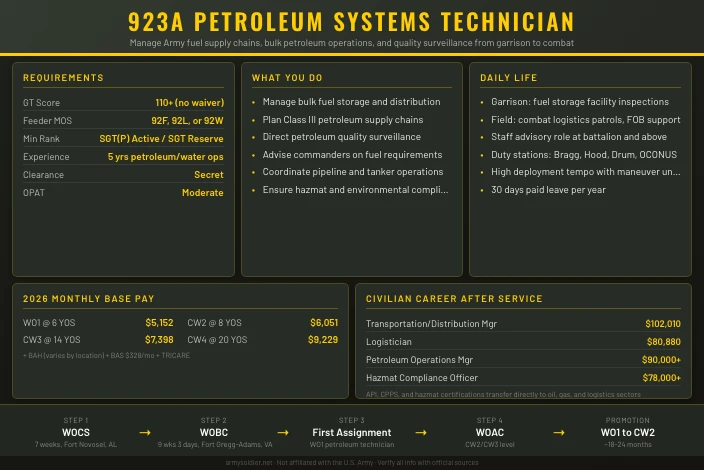
Job Role and Responsibilities
The 923A Petroleum Systems Technician is an Army warrant officer who serves as the technical expert on all petroleum operations: bulk fuel storage, distribution, pipeline operations, quality surveillance, and Class III supply chain management. These warrant officers advise commanders at battalion, brigade, division, and corps levels on fuel requirements, petroleum system capabilities, and risk – solving problems that generalist officers and senior NCOs are not trained to handle independently.
What the 923A Actually Does
At the unit level, a 923A determines fuel requirements for operations, oversees storage and distribution systems, and monitors quality surveillance procedures for bulk petroleum products. The role sits above the 92F who pumps and moves fuel – the 923A is the expert who plans, validates, and technically directs those operations.
Staff positions at higher echelons involve advising the S4 or G4 on petroleum supply chain planning, assessing host nation fuel infrastructure, and coordinating with theater logistics commands. In a deployed environment, a 923A may be responsible for coordinating fuel operations across multiple forward operating bases, tracking consumption rates, and preventing supply shortfalls before they become operational failures.
Environmental compliance is a growing part of the job. Bulk petroleum operations involve hazardous materials, spill response requirements, and strict regulations on fuel handling. The 923A owns those procedures and ensures unit compliance.
Related MOS Codes and Designations
| Code | Title | Notes |
|---|---|---|
| 923A | Petroleum Systems Technician | Warrant Officer – primary subject of this page |
| 92F | Petroleum Supply Specialist | Primary enlisted feeder MOS |
| 92L | Petroleum Laboratory Specialist | Enlisted feeder MOS |
| 92W | Water Treatment Specialist | Enlisted feeder MOS (waiverable) |
The 923A is one of five Quartermaster Corps warrant officer MOS codes, alongside 920A (Property Accounting), 920B (Supply Systems), 921A (Airdrop Systems), and 922A (Food Service). Petroleum technicians are the most operationally critical given how directly fuel availability affects combat power.
How This Role Differs from Enlisted and Officer
A 92F sergeant operates fuel distribution points and runs quality checks. A commissioned officer (92A or the S4) manages the logistics plan and commands the unit. The 923A is neither. The warrant officer owns the technical depth: understanding why a fuel sample failed quality testing, determining whether a storage bladder system is within specifications, and knowing exactly how much fuel a task force needs for a 72-hour operation before the commissioned officer asks. That technical authority is the reason the position exists.
Salary and Benefits
Warrant officers use officer BAH rates, which are higher than enlisted rates at the same installation. When you combine base pay, housing allowance, BAS, and tax-free deployment allowances, total compensation is competitive with many mid-level civilian logistics management roles.
Most 923A candidates enter WOCS as E-5 to E-7, which means their years of service for pay purposes typically range from 6 to 12 years by the time they reach WO1. The pay table below reflects realistic entry and progression points.
Base Pay at Realistic Career Points
| Rank | Typical YOS | Monthly Base Pay |
|---|---|---|
| WO1 | 6 YOS | $5,152 |
| CW2 | 8 YOS | $6,051 |
| CW3 | 14 YOS | $7,398 |
| CW4 | 20 YOS | $9,229 |
| CW5 | 26 YOS | $11,495 |
Pay figures reflect DFAS 2026 military pay tables effective January 1, 2026.
Special Pays and Bonuses
The 923A MOS does not carry aviation bonus pay or hazardous duty flight pay. Warrant officers in this MOS who serve in designated hazardous duty positions may qualify for Hazardous Duty Incentive Pay (HDIP) when working directly with certain petroleum materials, though this requires assignment in a qualifying duty position.
The Army introduced a warrant officer retention bonus bidding system in early 2026, allowing senior warrant officers to bid for retention incentives in exchange for a six-year active duty commitment. Whether 923A falls within the initial eligible MOS list varies by fiscal year – check with your warrant officer branch manager at HRC for current bonus availability.
Benefits Package
Officers at the warrant officer grades receive the same core benefits package as all active duty soldiers:
- TRICARE Prime at no premium, no deductible, no copay for the service member and family
- BAH at the with-dependents or without-dependents officer rate for your duty station. At a high-cost installation like Fort Liberty (NC), W-2 BAH with dependents can exceed $2,200 per month
- BAS of $328.48 per month (officer rate)
- 30 days of paid leave per year with up to 60 days carryover
- TSP with government matching up to 5% of basic pay under the Blended Retirement System, with matching beginning in year three
The 20-year pension under BRS pays 40% of your high-36 average base pay. A CW3 retiring at 20 years with a $7,400 monthly base salary would receive roughly $2,960 per month in pension. Continuation Pay between years 7 and 12 offers an additional lump sum of 2.5x to 13x monthly basic pay in exchange for a three-year service extension.
Qualifications and Eligibility
Appointment Path
The 923A MOS does not offer a direct civilian appointment. There is no street-to-seat option. Every 923A candidate comes through the enlisted ranks, typically with years of hands-on petroleum operations experience before submitting a warrant officer packet.
Active Component requirements:
- Minimum rank: SGT(P) (Sergeant Promotable – a secondary zone E-5 with a promotion sequence number)
- Competence in MOS 92F, 92L, or 92W
- Five years of documented experience as a fuel or water handler within the last eight years
- GT score of 110 or higher (non-waiverable for all warrant officer MOS)
- Age under 46 at time the packet is boarded (Exception to Policy available)
- Secret security clearance (final; no interim clearances accepted)
Reserve Component requirements:
- Minimum rank: SGT (not required to be promotable)
- ALC (Advanced Leaders Course) graduate in 92F, 92L, or 92W (waiverable case-by-case)
- Five years of documented petroleum or water operations experience
Education Requirements
The 923A MOS requires candidates to score at the 12th-grade level on the English (Language) portion of the Test for Adult Basic Education (TABE). This requirement is waived for candidates who hold an associate degree or higher. Three semester hours of college algebra – or a CLEP equivalent – are also required.
Qualifications at a Glance
| Requirement | Active Component | Reserve Component |
|---|---|---|
| Minimum rank | SGT(P) | SGT |
| Feeder MOS | 92F, 92L, or 92W | 92F, 92L, or 92W |
| Experience | 5 yrs within last 8 yrs | 5 yrs documented |
| GT score | 110 (no waiver) | 110 (no waiver) |
| Education | TABE 12th grade or degree | TABE 12th grade or degree |
| Age limit | Under 46 at board (ETP avail.) | Under 46 at board (ETP avail.) |
| Security clearance | Secret (final) | Secret (final) |
| OPAT category | Moderate | Moderate |
WOCS and the Packet Process
The warrant officer selection process starts with submitting a DA Form 61 packet through your chain of command to Army Human Resources Command (HRC). Your packet must include:
- DA Form 61 (application)
- Three letters of recommendation (at least one from a senior 923A warrant officer, CW3-CW5, or a senior Quartermaster warrant officer)
- Official transcripts (if applicable)
- Recent NCOERs showing “Successful” performance and “Superior” potential ratings from the Senior Rater
- TABE score documentation
- Physical and medical clearance documentation
Selection boards convene periodically. The 923A community is small, and competition can be meaningful – a packet that shows consistent excellence on NCOERs, relevant operational experience in fuel-intensive environments, and letters from senior warrant officers in the Quartermaster Corps carries the most weight.
Upon selection, WO1 candidates attend Warrant Officer Candidate School (WOCS) at Fort Novosel, Alabama. WOCS runs approximately seven weeks and covers leadership principles, Army doctrine, warrant officer roles and responsibilities, and adaptive leadership under stress. It is mentally and physically demanding, closer to Officer Candidate School than to a professional military education course.
All candidates enter military service as WO1 upon commissioning. The standard Active Duty Service Obligation (ADSO) for non-aviation warrant officers is six years from the date of appointment.
See our ASVAB study guide for a study plan focused on the GT composite.
Work Environment
Garrison vs. Field
In garrison, a 923A typically works standard duty hours but spends significant time conducting petroleum facility inspections, reviewing quality surveillance reports, and advising the S4 on Class III planning for upcoming training events. The work environment ranges from an office setting at the battalion S4 shop to fuel storage facilities, POL (petroleum, oils, and lubricants) points, and supply support activities.
During field training exercises, the pace changes sharply. Fuel operations run around the clock during major exercises, and the warrant officer’s job is to stay ahead of consumption rates, coordinate resupply, and troubleshoot distribution problems as they emerge.
In a deployed environment, 923As often operate in austere conditions alongside combat logistics patrols and at forward operating bases where fuel security and conservation become critical. The role demands both technical precision and operational adaptability.
Position in the Unit
The 923A does not sit in the NCO support channel or the command chain. The warrant officer functions as a technical advisor – reporting to the unit commander or S4 while providing expert guidance that neither the commander nor the senior NCO is expected to possess independently. This means the 923A often briefs commanders directly on fuel status, distribution risks, and system readiness.
At battalion and brigade, a 923A typically works alongside or for the S4 officer. At division and above, the warrant officer fills a staff advisor role within the G4 or sustainment brigade headquarters, with broader responsibility and fewer peers to cross-check their technical calls.
Technical vs. Staff Balance
A WO1 or CW2 spends the majority of time doing hands-on technical work: running quality surveillance, inspecting storage systems, training enlisted soldiers on petroleum procedures. As experience grows, the ratio shifts. By CW3 and CW4, the 923A is primarily a staff advisor and planner, spending more time in briefing rooms and planning sessions than at a fuel point. CW5s operate almost exclusively at the institutional and strategic level, shaping doctrine and advising senior commanders.
Warrant officers in this MOS report consistently high job satisfaction tied to the technical depth of the role and the direct operational impact of fuel operations. The small community size means every 923A is visible and valued. Common reasons for leaving earlier than planned include the limited peer group, slower promotion timelines compared to larger MOS communities, and the substantial compensation gap with equivalent civilian petroleum logistics roles.
Training and Skill Development
Warrant Officer Basic Course (WOBC)
After WOCS, newly commissioned WO1s attend the Warrant Officer Basic Course at Fort Gregg-Adams, Virginia (formerly Fort Lee). The 923A WOBC runs nine weeks and three days and covers both classroom instruction and hands-on technical training in petroleum systems operations.
| Phase | Focus | Duration |
|---|---|---|
| Foundation | Petroleum systems theory, quality surveillance procedures | Weeks 1-3 |
| Technical Operations | Bulk fuel storage, distribution systems, pipeline ops | Weeks 4-7 |
| Staff Integration | Class III planning, advisor role, environmental compliance | Weeks 8-9+ |
WOBC differs substantially from enlisted AIT (which focuses on hands-on skill execution) and from officer BOLC (which focuses on leadership and command competencies). The 923A WOBC assumes you already know how to operate petroleum systems and teaches you to manage and advise on them at the institutional level.
Warrant Officer Advanced Course (WOAC)
WOAC is attended as a CW2 or CW3, typically around the 8 to 12-year mark of total service. The course covers advanced technical skills and prepares the warrant officer for senior staff advisory roles at brigade and division. The Quartermaster Corps proponent at Fort Gregg-Adams hosts 923A WOAC, with distance learning prerequisites completed before the resident phase.
Warrant Officer Intermediate Level Education (WOILE)
WOILE is a five-week, MOS-immaterial resident course that develops CW3s and CW4s for service at higher echelons. The course is not focused on petroleum operations specifically – it builds judgment, staff skills, and the ability to advise senior commanders across warfighting functions. WOILE attendance is a professional development milestone that signals readiness for senior staff positions.
Warrant Officer Senior Service Education (WOSSE)
Senior CW4s and CW5s attend WOSSE, a two-phase program combining distance learning with a resident phase. WOSSE prepares senior warrant officers for corps, Army, and joint staff roles. For a 923A at this level, the focus shifts to theater-level petroleum operations, strategic supply chain resilience, and advising general officers.
Additional Training and Certifications
The Army funds several relevant professional development opportunities for 923A warrant officers:
- Hazardous materials transportation and handling certifications (HAZMAT DOT requirements)
- Petroleum quality surveillance training through the Defense Logistics Agency
- Training with Industry (TWI) – a competitive program placing warrant officers with petroleum industry partners for a year-long immersion assignment
- Army Tuition Assistance covers up to $4,500 per year in tuition for degree completion while serving
- Post-9/11 GI Bill provides up to 36 months of full education benefits after separation or retirement
Army COOL (Credentialing Opportunities On-Line) identifies civilian certifications aligned with 923A experience, including API certifications and hazmat credentials, and in some cases funds the examination fees.
A qualifying GT score comes first — our ASVAB study guide covers the subtests that drive GT.
Career Progression and Advancement
Career Timeline
| Rank | Typical Total YOS | Time in Grade | Key Assignments |
|---|---|---|---|
| WO1 | 6-8 YOS | 18-24 months | Petroleum technician, unit S4 section |
| CW2 | 8-12 YOS | 3-5 years | Senior technician, platoon/section lead advisor |
| CW3 | 13-18 YOS | 4-6 years | Senior petroleum systems technician, brigade staff |
| CW4 | 18-24 YOS | 4-6 years | Division/corps staff petroleum advisor |
| CW5 | 24-30+ YOS | Until retirement | Theater/Army-level senior technical advisor |
WO1 to CW2 promotion is time-based, occurring after completing WOBC and approximately 18 to 24 months in grade. CW3 and above are board-selected, evaluated against a competitive pool of peers. Officers receive DA Form 67-10 series OERs, the same evaluation system used for commissioned officers, with warrant-officer-specific guidance in DA Pam 623-3 Appendix B.
Promotion Rates and Competitiveness
The 923A community is small. Promotion to CW3 is moderately competitive; promotion to CW4 requires a strong record of staff assignments and broadening experiences. Promotion to CW5 is selective and typically reserved for warrant officers who have served in division, corps, or Army-level staff positions and built a record of sustained excellence across multiple evaluations.
To build a competitive record:
- Pursue broadening assignments beyond petroleum operations (joint staff, interagency, training with industry)
- Complete advanced civil schooling or degree programs while serving
- Maintain top-block OERs at every grade
- Seek letters of endorsement from senior 923A warrant officers in your network
The CW5 Role
A CW5 Petroleum Systems Technician serves at theater army, corps, or major Army command (MACOM) level. The role is almost entirely advisory and institutional: shaping petroleum doctrine, advising general officers on Class III supply chain vulnerabilities, and representing the warrant officer corps in policy discussions. There are very few CW5 billets for this MOS – it is a pinnacle assignment, not a routine career endpoint.
Physical Demands and Medical Evaluations
Warrant officers in all MOS meet the same Army Fitness Test (AFT) standard as every other soldier. The AFT replaced the ACFT on June 1, 2025. It consists of five events scored 0-100 each, with a maximum score of 500.
AFT Minimum Standards (Ages 17-21)
| Event | Male Minimum | Female Minimum |
|---|---|---|
| 3-Rep Max Deadlift (MDL) | 60 pts | 60 pts |
| Hand Release Push-Up (HRP) | 60 pts | 60 pts |
| Sprint-Drag-Carry (SDC) | 60 pts | 60 pts |
| Plank (PLK) | 60 pts | 60 pts |
| Two-Mile Run (2MR) | 60 pts | 60 pts |
| Total minimum | 300 pts | 300 pts |
Scoring thresholds are sex- and age-normed. The 923A MOS carries a Moderate OPAT (Occupational Physical Assessment Test) category, reflecting physical demands that include lifting and handling fuel containers, operating at fuel points in austere environments, and working in confined storage spaces. The Moderate category requires candidates to pass at least at the Moderate level on the OPAT before appointment.
The 923A does not require a flight physical. No specific vision or hearing standards beyond standard military medical fitness apply to this MOS. Medical evaluations follow the standard periodic health assessment schedule for all soldiers.
Deployment and Duty Stations
Deployment Tempo
Petroleum is a combat multiplier, which means 923As deploy wherever maneuver forces go. The deployment tempo for this MOS is high. Fuel-intensive operations in the Middle East, Europe, and the Pacific require petroleum warrant officers to support rotational forces, combat deployments, and theater-level logistics exercises. Typical combat deployment lengths run 9 to 12 months; rotational training deployments may run 3 to 9 months.
Warrant officers in this MOS generally deploy at the same rate as the units they support. An assignment to a brigade combat team carries a different deployment expectation than a position in a sustainment brigade at corps level – though both will deploy.
Duty Station Options
Primary duty stations align with large fuel operations and maneuver forces:
- Fort Liberty, NC (XVIII Airborne Corps, sustainment brigades)
- Fort Cavazos, TX (III Corps, heavy forces)
- Fort Campbell, KY (101st Airborne Division)
- Fort Drum, NY (10th Mountain Division)
- Fort Stewart, GA (3rd Infantry Division)
- OCONUS: Korea (Camp Humphreys), Germany (Grafenwoehr), Kuwait (Camp Arifjan)
HRC manages warrant officer assignments. Unlike enlisted soldiers who can submit assignment preferences through levy cycles, warrant officers negotiate assignments through branch managers at HRC who balance individual preferences with valid position requirements. The small size of the 923A community means assignment choices are more constrained than in larger MOS.
Risk, Safety, and Legal Considerations
Job Hazards
Petroleum operations carry inherent physical risk. Bulk fuels are flammable, and large-scale storage and distribution operations create fire, explosion, and toxic exposure hazards. The 923A warrant officer is not simply present during these operations – the warrant officer is the person responsible for ensuring safety protocols are followed and that soldiers working around petroleum do so within established safety margins.
Combat deployments add the risks common to any soldier in a forward area: direct and indirect fire threats, IED exposure during convoy operations, and the stresses of extended field environments.
Safety Frameworks
The 923A employs Composite Risk Management (CRM) as the standard framework for petroleum safety planning. Environmental compliance adds a layer of regulatory requirements: bulk petroleum spills trigger immediate reporting requirements, containment procedures, and documentation obligations. The warrant officer is expected to know these procedures and ensure the unit follows them – failures here carry legal and financial consequences for the Army and personal accountability implications for the warrant officer.
Authority and UCMJ
The 923A does not hold command authority in the conventional sense. The warrant officer advises and executes under the commander’s authority. However, the technical authority of the warrant officer is real: a 923A who identifies a safety violation or a quality surveillance failure has both the professional obligation and the positional standing to halt operations until the problem is corrected. That authority, exercised responsibly, is part of what makes the role valuable. UCMJ applies fully, and technical failures that result from negligence can carry serious professional consequences.
Impact on Family and Personal Life
Family Life Considerations
The high deployment tempo is the most significant family life factor for the 923A. Fuel-intensive operations require petroleum technicians early in a deployment build-up and throughout sustained operations, which means 923As are often among the first warrant officers to deploy. Families should plan for extended separations, particularly during periods of elevated operational tempo.
PCS moves for warrant officers in this MOS occur roughly every two to three years, similar to commissioned officers but potentially with fewer installation options given the smaller number of 923A billets. Families benefit from Army Community Service (ACS) programs, Family Readiness Groups (FRGs), and the Military OneSource network, which provides counseling, childcare referrals, and financial guidance.
Dual-military couples are accommodated through the Army’s join spouse program when possible, though the small 923A community limits the number of installations where both a petroleum warrant officer and a spouse in a different career field can be co-located.
Warrant Officer vs. Commissioned Officer Lifestyle
Warrant officers in this MOS generally face fewer PCS moves than commissioned officers in the same functional area. The commissioned logistics officer rotates through multiple branches and staff assignments to build a generalist record; the 923A stays in petroleum operations throughout, which tends to create more predictable assignment patterns and tighter professional networks. That stability comes with less variety – a warrant officer who wants broad command and staff experience will not find it here.
Reserve and National Guard
The 923A MOS is available in both the Army Reserve and the Army National Guard. Reserve and Guard 923As fill petroleum officer positions within sustainment brigades, theater sustainment commands, and state area commands. The operational demand for petroleum expertise during mobilizations means Reserve and Guard 923As have been activated at significant rates during recent conflicts and major exercises.
Reserve and Guard Appointment
Reserve Component candidates must hold SGT rank (not SGT Promotable), be ALC graduates in 92F, 92L, or 92W (waiverable), and have five years of documented petroleum or water operations experience. The packet and board process mirrors the Active Component, though boards may convene at different intervals.
Active duty 923As who transition to the Reserve or Guard retain their warrant officer status and typically enter at their current grade, subject to available billets in the receiving component.
Drill Commitment and Pay
The standard Reserve and Guard commitment is one weekend per month (four drill periods) plus two weeks of annual training. Some 923A positions require additional training days for petroleum-specific currency requirements or hazmat recertification.
| Component | Monthly Pay (CW2 at 8 YOS) | Healthcare | Education Benefits |
|---|---|---|---|
| Active Duty | $6,051 base + BAH + BAS | TRICARE Prime ($0 premium) | Full Post-9/11 GI Bill |
| Army Reserve | $807/drill weekend | TRICARE Reserve Select ($57.88/mo) | MGIB-SR ($493/mo) or Ch. 33 if activated |
| Army National Guard | $807/drill weekend | TRICARE Reserve Select ($57.88/mo) | MGIB-SR + state tuition benefits vary |
Component Comparison
| Factor | Active Duty | Army Reserve | Army National Guard |
|---|---|---|---|
| Commitment | Full time | 1 wkd/mo + 2 wks AT | 1 wkd/mo + 2 wks AT |
| Monthly base pay (CW2 @ 8 YOS) | $6,051 | ~$807/drill wkd | ~$807/drill wkd |
| Healthcare | TRICARE Prime ($0) | TRS ($57.88/mo) | TRS ($57.88/mo) |
| Education | Full GI Bill while serving | MGIB-SR or Ch. 33 if deployed | MGIB-SR + state benefits |
| Deployment tempo | High | Mobilization-dependent | Mobilization-dependent |
| Advancement to CW4/CW5 | Yes | Yes, slower | Yes, slower |
| Retirement | 20-yr active pension | Points-based, collect at 60 | Points-based, collect at 60 |
Reserve and Guard petroleum warrant officers often hold civilian careers in oil and gas, hazmat compliance, or logistics that pair directly with their military specialty. USERRA protections guarantee reemployment rights after mobilization, and many employers in the energy sector actively support reservists with that background.
Post-Service Opportunities
The petroleum industry and logistics sector both actively recruit former 923A warrant officers. Deep technical expertise in bulk fuel operations, quality surveillance, and supply chain management is rare outside the military – and companies know it. A CW3 or CW4 with 15 to 20 years of petroleum systems experience brings a combination of technical depth and operational leadership that civilian programs do not produce.
Civilian Career Prospects
| Job Title | Median Annual Salary | Job Outlook (2024-2034) |
|---|---|---|
| Transportation, Storage & Distribution Manager | $102,010 | +6% (faster than avg) |
| Logistician | $80,880 | +17% (much faster than avg) |
| Petroleum Operations Manager | $90,000+ | Strong in energy sector |
| Hazmat Compliance Officer | $78,000+ | Steady demand |
Salary and outlook data from the Bureau of Labor Statistics Occupational Outlook Handbook (May 2024).
Industries that recruit 923A veterans include petroleum refining and distribution companies, pipeline operators, bulk liquid terminal operators, defense contractors supporting logistics operations, and federal civilian agencies including the Defense Logistics Agency (DLA) and the Department of Energy.
Certifications and Credentials
Army COOL supports 923A warrant officers in obtaining civilian credentials that validate their military training. Relevant certifications include:
- API (American Petroleum Institute) certifications in storage tank inspection and petroleum equipment
- CPPS (Certified Petroleum Products Supervisor) through NACS (National Association of Convenience Stores)
- HAZMAT DOT certifications for hazardous materials handling and transportation
- Certified Professional Logistician (CPL) through the International Society of Logistics
The GI Bill’s Post-9/11 Chapter 33 benefit covers up to 36 months of tuition at the in-state rate for public universities, with no annual cap, plus a monthly housing allowance based on the E-5 with dependents BAH rate at the school’s ZIP code. A 923A retiring at 20 years with a GI Bill transferability already set up for dependents carries a significant education asset into post-service life.
The SFL-TAP (Soldier for Life – Transition Assistance Program) helps warrant officers translate their experience into civilian resume language and connect with employers through programs like Hiring Our Heroes and the Army Career Alumni Program (ACAP).
Is This a Good Job for You? The Right (and Wrong) Fit
Who Thrives as a 923A
The ideal 923A candidate is a 92F, 92L, or 92W sergeant who genuinely enjoys the technical side of petroleum operations and wants to go deeper into it – not escape it. If you’ve spent five years running quality surveillance, troubleshooting distribution problems, and training junior soldiers on petroleum systems, and you find yourself wanting to own those decisions at the advisory level rather than just execute them, the 923A path makes sense.
Successful petroleum warrant officers tend to be methodical, detail-oriented, and comfortable with regulatory complexity. The job requires precision – a contaminated fuel sample or a misfiled hazmat document has real consequences. You also need to be comfortable briefing commanders and standing behind your technical judgments in high-pressure situations.
Potential Challenges
The 923A community is small enough that your peer group, at any given installation, may consist of one or two other warrant officers. That can feel isolating compared to larger MOS communities. Promotion to CW4 and especially CW5 is competitive, and the number of senior billets is limited.
The role does not offer command authority. If you envision leading formations, making command decisions, or following the traditional officer career path, this is not the right MOS. The 923A exists to advise and to provide technical depth – command belongs to the commissioned officer in the unit.
Deployment frequency is real. If your priority is stability and predictable schedules for your family, the high operational tempo of petroleum-intensive units is worth factoring carefully.
How This Compares to Other Paths
Staying enlisted to SGM or CSM gives you command authority in the NCO support channel and broader leadership roles at the unit level. Commissioning as an officer puts you in a generalist career path with more command opportunity but less technical depth. The warrant officer path keeps you in your technical specialty while elevating you to an advisory role with more autonomy, better pay, and broader influence than a senior NCO – but without the command track of a commissioned officer.
If your identity and satisfaction come from being the technical expert in the room, the 923A is built for you.
More Information
Contact an Army Warrant Officer Recruiter through the Army Warrant Officer Recruiting Command for current packet deadlines, board dates, and MOS-specific guidance. Your GT score drives eligibility – if you’re below 110, focus on ASVAB preparation before submitting your packet. The Quartermaster Corps Warrant Officer proponency office at Fort Gregg-Adams can answer questions about the training pipeline and career development.
- Prepare for the ASVAB with our study guide to meet the GT 110 requirement
This site is not affiliated with the U.S. Army or any government agency. Verify all information with official Army sources before making enlistment or career decisions.
Explore more Army warrant officer careers including the 920A Property Accounting Technician and the 920B Supply Systems Technician.