948B Electronic Systems Maintenance Warrant Officer
Every Army unit runs on electronics. Radios break in the field. Radar systems go offline during a critical training rotation. Night vision devices malfunction before a mission. When that happens, the commander doesn’t call the equipment manufacturer. The call goes to the 948B Electronic Systems Maintenance Warrant Officer.
This is one of the broadest technical warrant officer specialties in the Army. A 948B manages maintenance across the full spectrum of communications-electronics equipment: tactical radios, radar systems, night vision devices, electronic warfare systems, C4ISR infrastructure, and controlled cryptographic items. The scope is wide on purpose. Electronic systems touch every branch and every echelon, and the Army needs a warrant officer who can own all of it.
If you’ve spent five or more years as a 94-series electronics technician and you’re good at the work, the 948B path deserves a serious look. The pay jump is substantial, the technical depth stays intact, and you become the person commanders rely on to keep the electronic backbone of the unit running.
Warrant officer candidates need a GT score of at least 110 — our ASVAB study guide covers what drives that number.
Job Role and Responsibilities
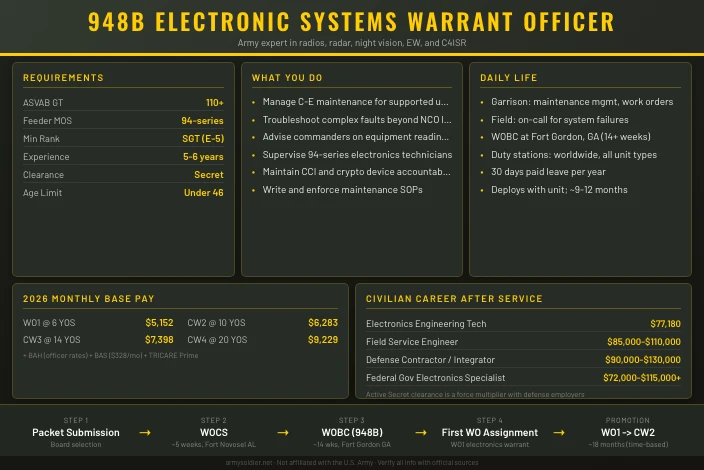
The 948B Electronic Systems Maintenance Warrant Officer is the Army’s resident expert in the maintenance, management, and technical supervision of all communications-electronics (C-E) and related electronic equipment. Operating at battalion through division echelons, the 948B manages the full electronics maintenance program for supported units, troubleshoots complex system failures that exceed enlisted capabilities, and advises commanders on equipment readiness, maintenance priorities, and sustainment planning. This includes radio and radar systems, night vision devices, electronic warfare equipment, computer and electronic data processing systems, fiber optic communications gear, cryptographic devices, and C4ISR infrastructure.
Technical Expertise and Scope
The 948B’s technical domain spans nearly everything that runs on electricity and carries a signal. At the unit level, that means owning maintenance management for every system the unit fields, from man-portable tactical radios to vehicle-mounted electronic warfare systems to the servers in the operations center.
This is a fundamentally different role from both the 94-series technicians who work for the 948B and the commissioned officer who commands the unit. Enlisted technicians execute repairs on specific platforms under their lane. Officers manage personnel and mission priorities. The warrant officer bridges both worlds: technically credentialed enough to solve the hardest problems, experienced enough to manage a shop and advise the commander on what’s actually possible.
Specific MOS Codes and Designations
| MOS | Title | Relationship |
|---|---|---|
| 948B | Electronic Systems Maintenance WO | Primary MOS covered in this profile |
| 948D | Electronic Missile Systems Maintenance WO | Closely related; focuses on missile electronics |
| 913A | Armament Systems Maintenance WO | Related ordnance warrant; weapons systems electronics |
| 255A | Data Operations Warrant Officer | Frequent collaboration on C4ISR networks |
| 255S | Cyberspace Defense Warrant Officer | Frequent collaboration on EW/cyber intersections |
| 170B | Electromagnetic Warfare Technician | Partners with 948B on EW equipment sustainment |
Additional Skill Identifiers (ASIs) and Skill Identifiers (SIs) may apply based on specialized training in specific platforms or equipment types. Your career manager at HRC can advise on which are available and most valued for your career path.
Mission Contribution
The Army’s operational effectiveness depends on the communications and sensor systems that give units awareness and connectivity. A unit with degraded radios cannot coordinate fires or call for medevac. A commander without functioning night vision can’t execute night operations. The 948B ensures none of that happens through preventive maintenance programs, rapid troubleshooting, and technically sound sustainment planning.
Warrant officers in this MOS sit at the intersection of technical expertise and organizational leadership. They’re not in the NCO support channel and they’re not in the traditional command chain, but their technical authority carries real weight. When a 948B tells a commander that a system needs to come off-line for maintenance, that assessment carries the weight of years of hands-on expertise. Commanders rely on it.
Technology, Equipment, and Systems
The 948B maintains expert-level knowledge across a wide equipment portfolio:
- Tactical communications: AN/PRC radios, vehicular-mounted radio systems, satellite communications terminals
- Radar systems: ground surveillance radar, weapon-locating radar, air defense radar
- Night vision and thermal imaging: AN/PVS and AN/PSQ family devices, forward-looking infrared systems
- Electronic warfare: jammers, receivers, direction-finding equipment
- C4ISR infrastructure: digital data systems, network nodes, command post computing environments
- Controlled cryptographic items (CCI): encryption devices, key management systems
- Diagnostic tools: automated test equipment, spectrum analyzers, oscilloscopes, technical manuals in electronic format
Because the portfolio is so broad, no single 948B will be expert in every system. The expectation is deep knowledge in the systems the unit fields and the technical foundation to learn new ones fast.
Salary and Benefits
Financial Benefits
Most 948B candidates come from the E-5 to E-7 range with six or more years of service. Unlike aviation warrant officers who may enter with minimal prior service, a 948B’s pay table entry point typically reflects their existing years of service. A Sergeant (SGT) with six years who is appointed WO1 enters at the W-1 six-year bracket, not at the baseline W-1 rate.
2026 Monthly Base Pay at Realistic Entry Points
| Rank | Years of Service | Monthly Base Pay |
|---|---|---|
| WO1 | 6 YOS | $5,152 |
| WO1 | 8 YOS | $5,584 |
| CW2 | 8 YOS | $6,051 |
| CW2 | 10 YOS | $6,283 |
| CW3 | 14 YOS | $7,398 |
| CW3 | 18 YOS | $8,150 |
| CW4 | 20 YOS | $9,229 |
| CW4 | 24 YOS | $10,032 |
| CW5 | 26 YOS | $11,495 |
| CW5 | 30 YOS | $12,071 |
DFAS 2026 pay tables confirm a 3.8% across-the-board raise effective January 1, 2026.
Special pays for 948B are limited. This MOS does not carry flight pay or hazardous duty pay in the same automatic way as aviation or EOD warrants. Hazardous duty pay may apply in specific assignment contexts. Check with your career manager for current entitlements.
On the bonus front, the Army has moved toward a competitive bidding model for warrant officer retention bonuses. Check HRC’s warrant officer bonus page for current Fiscal Year accession and retention bonus offerings for the 948B MOS, as amounts change annually based on Army manning priorities.
Additional Benefits
Warrant officers receive BAH at officer rates, which run higher than enlisted BAH at the same location. A single WO1 at Fort Novosel, Alabama earns roughly $1,407 monthly in BAH; a CW2 at the same installation earns around $1,608 monthly. Rates at high-cost installations like Fort Liberty (Fayetteville, NC) or Joint Base Lewis-McChord (Tacoma, WA) are substantially higher. Always check the BAH Rate Lookup tool for your specific location.
Healthcare is TRICARE Prime: zero premiums, zero copays, and zero deductibles for active duty warrant officers and their families. Dental and vision are included. The family catastrophic cap is $1,000 annually for out-of-network services.
Retirement under the Blended Retirement System (BRS) combines a pension at 20 years (40% of high-36 average basic pay) with TSP matching. The government contributes up to 5% of basic pay to TSP when you contribute 5% yourself. Many 948B warrant officers serve well past 20 years, reaching CW4 or CW5 before retiring. A CW4 retiring at 24 years at the 2026 pay rate earns a pension based on roughly $10,032 monthly, meaning the base pension would be approximately $4,816 per month before TSP and other income.
Work-Life Balance
Garrison life for a 948B follows a standard work week with occasional extended hours during equipment readiness surges, inspections, or major exercises. Field time increases during training cycles, and deployment tempo depends heavily on unit type and global posture. The warrant officer has more schedule autonomy than a junior NCO but less than a senior staff officer. Technical advisory work is visible and valued, which generally translates to a low-drama professional environment.
Compared to commissioned officers, warrant officers avoid much of the administrative and staff meeting overhead that characterizes O-grade careers. The 948B’s primary obligation is technical excellence and readiness management, not briefing the brigade commander every week on something a sergeant could have resolved.
Qualifications and Eligibility
Appointment Paths
The 948B is an enlisted-to-warrant MOS. There is no direct appointment path for civilians and no equivalent to the aviation WOFT street-to-seat program. You must first serve as an enlisted soldier in a qualifying feeder MOS.
Qualification Requirements Table
| Requirement | Detail |
|---|---|
| Appointment path | Enlisted-to-warrant only |
| Feeder MOS | 94D, 94E, 94F, 94H, 94K, 94L, 94R, 94W, 94Y, 94Z (25S with waiver) |
| Minimum rank | SGT (E-5); no candidates below E-4 considered |
| Experience | 5-6 years hands-on in a feeder MOS |
| Education | Must have graduated from Advanced Leaders Course (ALC) in feeder MOS |
| GT score | 110 minimum (non-waiverable) |
| Age limit | Under 46 at time of appointment |
| Security clearance | Secret (required to enter; some positions require TS/SCI) |
| Citizenship | U.S. citizenship required |
| Contract | Minimum 12 months remaining on enlistment contract |
| Physical | Must meet height/weight and Army Fitness Test standards |
| Recommendations | Written recommendation from a senior 948B or senior warrant officer |
Requirements are published on the Army Warrant Officer Recruiting Command 948B page and the basic qualification standards.
Warrant Officer Candidate School (WOCS)
WOCS is conducted at Fort Novosel, Alabama (home of the Warrant Officer Career Center) and runs approximately five weeks for the active component resident course. The program focuses on leadership, Army doctrine, ethics, and the unique role of the warrant officer in the Army structure. It is demanding mentally and physically, with a culture closer to OCS than to any enlisted school.
The application process starts with building a warrant officer packet. A complete packet includes:
Selection is competitive. Packets are reviewed holistically, with NCOERs weighted heavily. Consistent “Among the Best” ratings with strong bullet narratives outweigh civilian degrees in most cases, though a college degree does strengthen a packet.
Test Requirements
All warrant officer candidates need a GT score of at least 110 on the ASVAB. The GT composite is calculated as: VE + AR (where VE = Word Knowledge + Paragraph Comprehension, standardized). The 948B does not require the SIFT test; that is aviation-only. No MOS-specific aptitude test beyond the GT score is required for 948B.
If you are close to the 110 threshold, systematic ASVAB preparation on the AR and VE subtests is the most efficient path to improvement.
Upon Appointment
New 948B warrant officers enter at the rank of WO1 (Warrant Officer 1). WO1 is the only true warrant rank, held under a federal warrant of appointment issued by the Secretary of the Army. Upon promotion to CW2, warrant officers receive a federal commission and become commissioned warrant officers.
The Active Duty Service Obligation (ADSO) upon appointment as a warrant officer is typically three years. Aviation warrants carry longer obligations (six years for initial, ten for additional flight training). The 948B follows the standard three-year ADSO. Confirm the current obligation with your recruiter, as Congress adjusts ADSOs periodically.
See our ASVAB study guide for a study plan focused on the GT composite.
Work Environment
Setting and Schedule
The 948B operates primarily in maintenance shops, equipment yards, and unit motor pools, but the job extends well beyond any fixed location. A typical garrison week might start with reviewing maintenance status reports and work orders, shift to hands-on troubleshooting with technicians on a difficult fault, then end with an update briefing to the battalion S4 or XO on readiness.
During field exercises and combat training center rotations, the tempo accelerates. Electronic systems fail under field conditions in ways they don’t in a controlled shop environment. The 948B is on call to respond to readiness issues around the clock during sustained operations.
Position in the Unit
The 948B sits outside both the NCO support channel and the direct command chain. The role is advisory and technical, not supervisory in the traditional Army sense. In practice, the warrant officer holds enormous informal authority because commanders lean on their technical judgment to make readiness decisions.
Relationships with senior NCOs vary by unit culture, but the most effective 948Bs treat the senior electronics maintenance sergeant as a partner. The NCO runs the shop floor; the warrant officer provides technical guidance and organizational access that an NCO in the same role couldn’t command. They complement each other rather than compete.
At battalion, the 948B typically reports to the S4 or the battalion maintenance officer. At brigade and higher, the position expands into a broader technical advisor role covering multiple subordinate units.
Technical vs. Staff Roles
Early in the career (WO1 to CW2), the 948B spends most time in direct technical work: troubleshooting complex faults, validating repairs, writing SOPs for maintenance procedures, and training junior technicians. As the career progresses to CW3 and CW4, the balance shifts toward advisory, assessment, and staff functions. A CW4 at a corps or theater support command may spend the majority of their time advising on equipment fielding decisions, writing technical policy, and mentoring subordinate warrant officers.
CW5s in this MOS typically serve as senior technical advisors at division, corps, or FORSCOM-level staff positions. Their value is pattern recognition built over 20+ years of seeing how electronic systems behave across diverse operational environments.
Job Satisfaction and Retention
Warrant officers in technical MOS like the 948B tend to stay because the work keeps changing. New systems are fielded regularly, and mastering them requires the kind of sustained technical engagement that keeps the job from going stale. The autonomy the role provides, relative to both enlisted service and commissioned officer careers, is a consistent retention factor. The chief complaints center on limited promotion speed to CW5 and the pay gap with equivalent defense contractor roles, which is real and grows as experience accumulates.
Training and Skill Development
Warrant Officer Basic Course (WOBC)
After completing WOCS, newly appointed WO1s attend WOBC for their MOS-specific qualification. The 948B WOBC is conducted at Fort Gordon, Georgia (home of the Army Cyber Center of Excellence and Signal School) through the 73d Ordnance Battalion, Ordnance Training Detachment-Gordon.
948B WOBC Training Pipeline
| Phase | Location | Length | Focus |
|---|---|---|---|
| WOCS | Fort Novosel, AL | ~5 weeks | Leadership, doctrine, warrant officer roles |
| WOBC (948B) | Fort Gordon, GA | ~14 weeks 1 day | Electronics maintenance management, technical systems, sustainment operations |
WOBC covers the management, supervision, and coordination of installation, operation, repair, maintenance, and modification of the full 948B equipment portfolio. It goes well beyond what any single 94-series technician would have learned in AIT. The program connects technical skills to Army sustainment systems: how to run a maintenance program, how to manage work orders, how to advise commanders using readiness data, and how to train subordinates across multiple equipment types.
Warrant Officer Advanced Course (WOAC)
WOAC is attended as a CW2 or CW3. It builds on WOBC by adding advanced technical content, leadership at higher echelons, and staff advisory skills. The 948B WOAC is also conducted through the ordnance warrant officer schoolhouse at Fort Lee (now Fort Gregg-Adams) or Fort Gordon, depending on course configuration. Length varies; plan for approximately 4-6 weeks of resident instruction.
Warrant Officer Intermediate Level Education (WOILE)
WOILE is a five-week MOS-immaterial resident course attended as a CW3 or CW4. It’s conducted at Fort Novosel and prepares warrant officers for service at higher echelons. WOILE is not about technical content; it’s about organizational leadership, joint operations, and understanding the Army at the operational level. For a technically focused MOS like 948B, this course is often a significant shift in perspective.
Warrant Officer Senior Service Education (WOSSE)
WOSSE is for senior CW4s and CW5s. It runs in two phases: a distance-learning phase followed by a resident period. WOSSE prepares senior warrant officers to advise at the highest Army staff levels and to operate effectively in joint and interagency environments. Think of it as the warrant officer equivalent of Senior Service College for commissioned officers.
Additional Schools and Certifications
The Army funds several continuing education and certification paths for 948B warrant officers through Army COOL (Credentialing Opportunities On-Line) and unit training budgets:
- CompTIA A+, Network+, Security+ for systems and network-adjacent work
- Certified Electronics Technician (CET) through ISCET
- FCC General Radiotelephone Operator License (GROL) for radio systems work
- OSHA 10/30 for safety management in maintenance environments
- Tuition Assistance covers up to $4,500 annually and $250 per semester hour for degree programs
Many 948Bs use Tuition Assistance and then the Post-9/11 GI Bill to complete bachelor’s or master’s degrees in electrical engineering technology, information systems, or systems engineering while on active duty.
A qualifying GT score comes first — our ASVAB study guide covers the subtests that drive GT.
Career Progression and Advancement
Career Path
Most 948Bs enter with six to eight years of enlisted service, which means they’re already in their late 20s or early 30s at WO1. The typical full career runs from WO1 to CW4 or CW5 over the next 12-20 years.
948B Career Timeline
| Rank | Typical Time-in-Grade | Total YOS (approx.) | Key Assignments |
|---|---|---|---|
| WO1 | 18 months (time-based) | 6-10 | WOCS, WOBC, first unit assignment as electronics maintenance warrant |
| CW2 | 3-5 years (board-selected at most) | 8-14 | Technical lead, shop officer-in-charge, first advisory role |
| CW3 | 4-6 years (board-selected) | 12-20 | Senior technical advisor at battalion/brigade; WOAC and WOILE required |
| CW4 | 5-8 years (board-selected) | 18-26 | Division/corps staff advisor, senior readiness manager, WOSSE |
| CW5 | Terminal grade | 22-30+ | Senior technical advisor at ASCC, FORSCOM, or Army HQ level |
W-1 to CW2 promotion is time-based and tied to completion of WOBC. CW3 through CW5 require board selection. Warrant Officer OERs use DA Form 67-10-1A, with DA Pam 623-3, Appendix B covering warrant-specific rating guidance.
Promotion System
The board looks at OER narratives, rater and senior rater profiles, duty positions, military education completion, and civilian education. For 948B, technical credibility is the baseline expectation. What separates competitive packets is demonstrated impact: warrant officers who solved problems that mattered, trained subordinates effectively, and operated seamlessly at the echelon above their grade.
Promotion to CW5 is selective and slow. Fewer positions exist at that grade, and the selection rate is low enough that many strong CW4s retire before reaching it. Building a record that supports CW5 means taking broadening assignments, completing PME on time, and maintaining a visible presence with your career manager at HRC.
CW5 as Senior Technical Advisor
A CW5 in the 948B MOS is the top of the warrant officer pyramid for electronics systems. At this level, the job is less about fixing equipment and more about shaping Army-wide policy on C-E system sustainment, advising general officers on readiness trade-offs, and mentoring the next generation of electronics warrant officers. CW5 positions exist at FORSCOM, TRADOC, Army Materiel Command, and in senior staff roles at division and corps headquarters.
Building a competitive record means prioritizing: WOAC and WOILE completion before your respective board windows, at least one broadening assignment (joint billet, TRADOC instructor, HRC career manager role), civilian education at the bachelor’s level or higher, and NCOERs that demonstrate consistent technical impact in progressively more complex environments.
Physical Demands and Medical Evaluations
Physical Requirements
948B warrant officers take the Army Fitness Test (AFT), which replaced the ACFT on June 1, 2025. The AFT has five events scored on a 0-100 scale each, with a maximum of 500 points. The minimum passing score is 60 points per event (300 total), sex- and age-normed. The 948B is not a combat-designated MOS under the current combat specialty standard, so the general standard of 300 total applies.
AFT Minimum Passing Standards (Ages 17-21)
| Event | Abbreviation | Min Score (Male 17-21) | Min Score (Female 17-21) |
|---|---|---|---|
| 3 Rep Max Deadlift | MDL | 60 pts | 60 pts |
| Hand Release Push-Up | HRP | 60 pts | 60 pts |
| Sprint-Drag-Carry | SDC | 60 pts | 60 pts |
| Plank | PLK | 60 pts | 60 pts |
| Two-Mile Run | 2MR | 60 pts | 60 pts |
| Total minimum | 300 pts | 300 pts |
Standards are age-normed; the raw performance thresholds for a 60-point score are different for a 17-year-old and a 45-year-old. Official scoring tables are at army.mil/aft/.
Flight Physicals and MOS-Specific Medical
The 948B does not require a flight physical. Unlike aviation warrant officers, 948Bs are not rated aircrew and have no aviation medical requirements. The standard Army periodic health assessment (PHA) applies, conducted annually. No additional vision or hearing standards exist for this MOS beyond Army-wide requirements for appointment.
Deployment and Duty Stations
Deployment Details
The 948B deploys wherever electronic systems need sustained maintenance. Deployment tempo depends heavily on unit type. Signal units, intelligence brigades, combat aviation brigades, and maneuver-heavy formations all carry significant electronics maintenance requirements. Warrant officers in these formations can expect deployment cycles roughly aligned with their unit.
A 948B with a Stryker brigade will deploy differently than one assigned to a sustainment command or an ROTC support brigade. The warrant officer’s assignment history therefore shapes their deployment experience as much as the MOS itself does.
Warrant officers typically deploy as advisors and managers rather than individual technicians. The 948B leads the electronics maintenance element, interfaces with support units for parts and back-shop support, and ensures readiness across the deployed equipment fleet. This is qualitatively different from how a 94E or 94W deploys.
Duty Station Options
The 948B is a worldwide MOS. Electronic systems exist on every Army installation and in every contingency theater. Typical active duty assignments include:
- CONUS: Fort Liberty (NC), Fort Cavazos (TX), Joint Base Lewis-McChord (WA), Fort Campbell (KY), Fort Wainwright (AK), Fort Bliss (TX)
- OCONUS: Camp Humphreys and Camp Casey (South Korea), Grafenwoehr and Wiesbaden (Germany), various theater support positions
- Joint and staff assignments: Pentagon, FORSCOM, Army Materiel Command installations
HRC manages warrant officer assignments, and warrant officers compete for positions based on rank, qualifications, and expressed preferences. The 948B generally has a wider range of assignment options than a highly specialized warrant MOS because electronics maintenance requirements exist across every force structure type.
Risk, Safety, and Legal Considerations
Job Hazards
Maintenance of high-voltage electronic systems carries inherent risks. Radar systems and some communications equipment operate at voltages that can be lethal without proper lockout/tagout procedures. Controlled cryptographic items require strict handling protocols, and mishandling them carries serious legal consequences under Army regulations and potentially federal law. Working in field environments adds weather, vehicle, and terrain hazards to the technical risks.
The risk profile is meaningfully different from combat arms, but it’s not zero. An electronics maintenance warrant who gets complacent about electrical safety procedures in a high-tempo environment is taking real risks.
Safety Protocols
The 948B applies Army Composite Risk Management (CRM) to maintenance operations. This means documenting hazards, assessing likelihood and severity, implementing controls, and supervising to ensure compliance. Specific electrical safety protocols follow Army safety publications and applicable technical manuals for each equipment type.
Calibration and testing of high-power systems requires additional coordination. Spectrum management is another safety-adjacent concern: RF emissions from radar and communications systems must be managed to avoid interference and to comply with host nation agreements overseas.
Authority and Responsibility
The 948B holds technical authority, not command authority. Warrant officers in this MOS do not command companies or battalions. Their authority comes from technical expertise and the trust commanders place in their judgment. That authority is real and consequential: a 948B who recommends taking a radar offline for maintenance is making a recommendation that affects mission capability.
Under the UCMJ, 948B warrant officers are commissioned officers upon reaching CW2 and held to officer-level conduct standards. Technical failures that result from negligence, lack of supervision, or falsification of maintenance records can carry serious UCMJ consequences. Accurate, timely maintenance documentation is not just good practice; it’s a legal requirement.
Impact on Family and Personal Life
Family Considerations
The 948B follows typical warrant officer PCS patterns: moves every two to three years based on assignment cycles. This is generally fewer moves than an equivalent commissioned officer career, but more than staying in a single duty station as an NCO. Spouses and families benefit from Army Community Service (ACS), Family Readiness Groups (FRGs), and installation support programs at all major installations.
Fort Gordon (where WOBC is conducted) is a mid-sized installation near Augusta, Georgia, with solid school districts and a reasonable cost of living for the region. Families stationed there for the duration of WOBC have access to full on-post support.
Dual-Military and Family Planning
Dual-military couples in Army technical specialties can request joint domicile consideration through HRC. Approval depends on available positions at the same or nearby installations. The 948B’s broad assignment options improve the odds of finding a joint posting relative to a narrow specialty.
Deployments are the main family disruption. The 948B typically deploys with a unit rather than as an individual augmentee, which means more predictable deployment timelines and better unit cohesion during the rotation. Extended field exercises during major training cycles are a consistent factor regardless of deployment status.
Warrant officers tend to have more predictable careers than commissioned officers in terms of assignment stability. The technical track avoids the frequent lateral moves of the officer generalist career model, which typically means fewer cross-country moves for the family.
Reserve and National Guard
Component Availability
The 948B MOS is available in both the Army Reserve and the Army National Guard. Electronics maintenance warrant officer positions exist in signal units, maintenance companies, and support brigades across both components. Specific position availability varies by state and unit; contact your state’s warrant officer recruiter or the Army Reserve career management office for current vacancies.
Appointment Paths
The enlisted-to-warrant path for Reserve and Guard soldiers mirrors the active component process. The candidate must be serving in a qualifying feeder MOS in a Reserve or Guard unit, meet all basic qualifications, and submit a complete warrant officer packet to compete at the centralized selection board. Active duty warrant officers who separate can also request transfer to a Reserve or Guard unit and compete for available 948B positions.
State National Guard programs may have slightly different packet timelines and board dates; check with your state Adjutant General’s office.
Drill and Training Commitment
The standard commitment is one weekend per month (Battle Assembly) plus two weeks of Annual Training per year. The 948B may require additional training days for equipment-specific currency, calibration certifications, or unit readiness exercises. Aviation warrants have significant additional flight hour requirements; the 948B does not carry a comparable mandatory currency burden, but complex electronic systems may require periodic technical updates as new systems are fielded.
Part-Time Pay
Drill pay is calculated as (monthly base pay divided by 30) times the number of drill periods. A standard weekend counts as four drill periods.
| Rank | YOS | Pay per Weekend (4 Drills) |
|---|---|---|
| WO1 | Under 2 | $540.93 |
| WO1 | 2 years | $599.20 |
| CW2 | Under 2 | $616.27 |
| CW2 | 2 years | $674.53 |
Annual Training at full active duty pay rates adds approximately two weeks of additional income per year.
Benefits Differences
Active Duty vs. Army Reserve vs. Army National Guard
| Category | Active Duty | Army Reserve | Army National Guard |
|---|---|---|---|
| Commitment | Full-time | 1 weekend/mo + 2 wks/yr | 1 weekend/mo + 2 wks/yr |
| Monthly pay (CW2 at 2 YOS) | $5,059 | ~$675/weekend (4 drills) | ~$675/weekend (4 drills) |
| Healthcare | TRICARE Prime ($0 premium) | TRICARE Reserve Select ($57.88/mo individual; $286.66/mo family) | TRICARE Reserve Select (same as Reserve) |
| Education benefits | Tuition Assistance ($4,500/yr); Post-9/11 GI Bill (transferable) | Federal TA ($4,500/yr); MGIB-SR ($493/mo while serving); Post-9/11 GI Bill if deployed | Federal TA; state tuition waivers (varies by state); MGIB-SR; Post-9/11 GI Bill if deployed |
| Deployment tempo | Unit-dependent; regular rotations | Mobilization-based; varies | State emergency + federal mobilization |
| Advancement to CW4/CW5 | Yes; board-selected | Yes; board-selected; slower pace | Yes; board-selected; slower pace |
| Retirement | 20-year pension at ~40% high-36 (BRS) | Points-based; collect at 60 | Points-based; collect at 60; state supplements vary |
Civilian Career Integration
The 948B skill set pairs directly with careers in defense electronics, telecommunications, and systems integration. Reserve and Guard service enhances civilian credentials in these fields: security clearance, verified electronics maintenance expertise, and documented leadership of technical teams are exactly what defense contractors and federal agencies want.
USERRA protections ensure civilian employers cannot penalize you for military service or deny reemployment after deployments. Many defense industry employers actively support Guard and Reserve service because it keeps their technical staff current on Army systems.
Post-Service Opportunities
Transition to Civilian Life
A 948B retiring after 20-plus years brings credentials that map directly to high-demand civilian roles. The clearance is often the most immediately valuable asset: many defense contractor positions require an active Secret or higher, and cleared candidates with electronics expertise command premium salaries. SFL-TAP (Soldier for Life Transition Assistance Program) and Hiring Our Heroes corporate fellowships are the primary transition support resources.
The breadth of the 948B’s technical experience (not a single platform, but the full C-E spectrum) makes these warrant officers more adaptable than a specialist in a single system. Defense contractors, federal agencies, and communications companies all value that generalist-but-credentialed profile.
Civilian Career Prospects
Post-Service Career Options (BLS Data)
| Job Title | Median Annual Salary | Job Outlook (2024-2034) |
|---|---|---|
| Electrical/Electronics Engineering Technician | $77,180 | +1% (approx. 8,400 openings/yr) |
| Electrical/Electronics Engineer | ~$107,000+ | Solid growth in defense sector |
| Field Service Engineer (defense/communications) | $85,000-$110,000 | Strong; driven by defense electronics demand |
| Defense Contractor Systems Integrator | $90,000-$130,000 | Strong; C4ISR and EW spending increasing |
| Federal Government Electronics Specialist (GS-11 to GS-13) | $72,000-$115,000+ | Stable; federal hiring for cleared technical roles |
Salary figures draw from Bureau of Labor Statistics May 2024 wage data.
Defense industry salaries often exceed BLS medians for cleared, experienced candidates. A CW4 or CW5 retiring with an active TS/SCI clearance and 20+ years of C-E maintenance leadership is a recruiter’s target, not an applicant waiting in line.
Certifications and Credentials
Army COOL identifies multiple civilian credentials that align with 948B duties. Certifications to pursue during your service career:
- CompTIA A+, Network+, Security+ (vendor-neutral, widely recognized)
- Certified Electronics Technician (CET) through the International Society of Certified Electronics Technicians (ISCET)
- FCC General Radiotelephone Operator License (GROL) for radar and radio systems work
- Project Management Professional (PMP) for senior warrant officers moving into program advisory roles
The Post-9/11 GI Bill covers 36 months of tuition at full in-state rates for public schools (up to $29,920.95 annually for private schools under the 2025-2026 academic year cap), plus a monthly housing allowance. Warrant officers who complete a degree in electrical engineering technology or systems engineering find the credential opens additional doors into program management and systems engineering roles that purely technical career tracks might not.
Is This a Good Job for You? The Right (and Wrong) Fit
Ideal Candidate Profile
The best 948B candidates are 94-series electronics technicians who are already good at diagnosing complex faults, have strong organizational instincts, and want more influence over how their shop runs than an NCO billet allows. If you get frustrated watching readiness decisions get made by people who don’t understand the technical realities, the warrant officer path is designed for you.
The role rewards curiosity. New systems enter Army inventory regularly. A 948B who finds that process energizing rather than tedious will thrive. Strong technical writers also have an edge: much of the advisory work at higher echelons involves producing assessments, SOPs, and recommendations in written form.
Potential Challenges
The breadth that makes this MOS interesting can also be its frustration. Unlike a 153A aviator who is deeply expert in a defined platform, the 948B covers so many systems that genuine depth in all of them is not realistic. Balancing breadth and depth is a constant career-long challenge.
Promotion speed is another honest consideration. The path from WO1 to CW5 spans 20-plus years, and CW5 selection is not guaranteed for anyone. Soldiers who want visible rank progression quickly will find the warrant track slower than the NCO senior leader pathway.
Command authority is also limited. A 948B will never command a company or battalion in the traditional sense. If leading soldiers in a command capacity is important to you, the commissioned officer or command sergeant major track is a better fit.
Career and Lifestyle Alignment
The 948B is well suited to a soldier who wants to stay technically engaged throughout a career, prefers depth over breadth in organizational involvement, and values technical credibility over positional authority. The MOS is also a solid bridge to a defense contractor or federal civilian career, with credentials that translate directly rather than requiring significant retraining.
For soldiers interested in a part-time commitment, the Guard and Reserve versions of this MOS pair cleanly with civilian defense industry careers, producing a credential stack (clearance, technical experience, military leadership) that is genuinely valuable in both worlds.
If you thrive on solving hard technical problems, have the patience for a long but rewarding career arc, and want to be the expert that commanders call when nothing else works, the 948B is a strong match.
More Information
Contact the Army Warrant Officer Recruiting Team to learn about current accessions for the 948B MOS, packet timelines, and any active bonus programs. Your GT score is the first gate; if you’re close to 110 but not there yet, focused ASVAB preparation on the Arithmetic Reasoning and Verbal Expression subtests is the most direct path to eligibility. ASVAB prep guides can close that gap faster than most soldiers expect.
- Prepare for the ASVAB with our study guide to meet the GT 110 requirement
This site is not affiliated with the U.S. Army or any government agency. Verify all information with official Army sources before making enlistment or career decisions.
Explore more Army warrant officer careers such as 948D Electronic Missile Systems Maintenance Warrant Officer and 913A Armament Systems Maintenance Warrant Officer.