948D Electronic Missile Systems Maintenance Warrant Officer
The Patriot battery protecting a forward operating base just lost radar contact. HIMARS can’t verify launch system integrity before a fire mission. A Javelin round guidance unit is throwing fault codes nobody at the unit level can diagnose. When any of those calls come in, the 948D Electronic Missile Systems Maintenance Warrant Officer is the person who answers them.
This is one of the Army’s most technically demanding warrant officer specialties. The 948D is the senior technical authority for maintenance across the Army’s entire guided missile portfolio, from man-portable systems like the Stinger and Javelin to vehicle-mounted HIMARS and theater-level Patriot air defense batteries. No other warrant officer MOS touches this range of lethality. That scope carries weight, and the small community of 948D warrants knows it.
Warrant officer candidates need a GT score of at least 110 — our ASVAB study guide covers what drives that number.
Job Role and Responsibilities
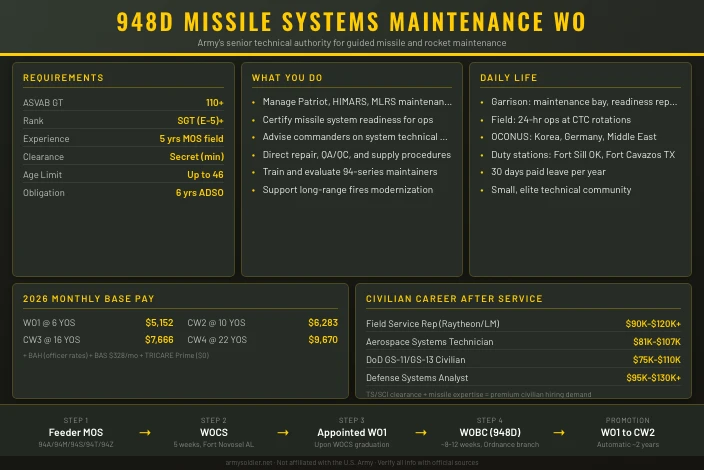
The 948D Electronic Missile Systems Maintenance Warrant Officer supervises and manages all maintenance operations for Army guided missile and rocket systems. The role covers field-level maintenance, technical inspections, supply chain management, and quality assurance across the Army’s most sensitive and strategically valuable weapons. A 948D advises commanders on system readiness, directs maintenance teams, and serves as the technical authority when battalion-level troubleshooting runs out of answers.
Technical Expertise and Scope
A 948D owns maintenance proficiency across every major Army missile system. That includes short-range anti-armor systems (Javelin, TOW, Hellfire), man-portable air defense systems (Stinger), long-range rocket artillery (HIMARS, MLRS), and theater-level air and missile defense (Patriot). No single technician-level soldier covers all of these systems. The 948D does, which is exactly why the warrant officer grade exists for this MOS.
The difference between a 948D and a senior enlisted maintainer comes down to authority and scope. An E-7 team sergeant runs the maintenance section. The 948D sets maintenance standards across the battalion or brigade, evaluates whether systems are safe for employment, and signs off on technical documentation that commanders rely on for operational planning. When a system is broken, the enlisted NCO executes the repair. The 948D determines whether the repair was done right.
Compared to a commissioned Ordnance officer, the 948D goes far deeper into the technical specifics. A commissioned officer manages programs, personnel, and logistics at the organizational level. The 948D understands electronic switching theory, guidance electronics, digital logic, solid-state devices, optics, and infrared systems well enough to diagnose failures that electronic test equipment can’t catch alone.
Related MOS Codes and Designators
| Designation | Title | Notes |
|---|---|---|
| 948D | Electronic Missile Systems Maintenance Warrant Officer | Primary MOS covered in this guide |
| 948B | Electronic Systems Maintenance Warrant Officer | Broader CE/electronics systems, no missile specialty |
| 140A | AMD Systems Integrator | Air and Missile Defense – operations and integration focus |
| 140K | AMD Systems Tactician | AD systems employment, not maintenance |
| 913A | Armament Systems Maintenance Warrant Officer | Conventional armament systems |
Mission Contribution
Army long-range fires and air defense are undergoing the most significant modernization push in decades. The Long Range Hypersonic Weapon (LRHW) and the Typhon ground-based missile system represent new capabilities that will require 948D expertise before any commissioned officer or NCO touches them. Without a functional missile maintenance warrant officer community, none of that hardware translates into combat power.
In practical terms, the 948D serves as the bridge between tactical readiness and strategic capability. When a Patriot battery commander needs to know whether a system is safe to shoot, that answer comes from the 948D. When a HIMARS unit prepares for a degraded-mode fire mission, the 948D certified the system status. The warrant officer’s technical signature is part of every major fire or defense decision their unit makes.
Technology and Systems
The 948D works across multiple weapon system families, each with distinct electronic architectures:
- Patriot PAC-3: Phased-array radar, electronic power conditioning units, engagement control stations, launching stations
- HIMARS / MLRS: Fire control systems, navigation/positioning components, launcher electronics
- Javelin / TOW / Hellfire: Guidance electronics, seeker assemblies, command launch units
- Stinger: Infrared seeker, interrogator systems, battery coolant unit electronics
- Emerging systems: Typhon (Tomahawk/SM-6 ground-launched), LRHW, future directed-energy integration
Diagnostic tools include the Army Electronic Warfare Test Set (EWTS), system-specific automated test equipment (ATE), and proprietary diagnostic software for each platform.
Salary and Benefits
Base Pay
Most 948D warrant officers come from senior enlisted backgrounds with at least five years of technical MOS experience. A candidate who enters as a WO1 after six years of enlisted service will already be well past the minimum pay entries on the warrant officer table. The figures below reflect realistic career pay at typical entry and progression points, sourced from the DFAS 2026 military pay chart.
| Grade | Typical YOS at Grade | Monthly Base Pay |
|---|---|---|
| WO1 (W-1) | 6 YOS | $5,152 |
| WO1 (W-1) | 8 YOS | $5,584 |
| CW2 (W-2) | 10 YOS | $6,283 |
| CW2 (W-2) | 12 YOS | $6,509 |
| CW3 (W-3) | 16 YOS | $7,666 |
| CW3 (W-3) | 18 YOS | $8,150 |
| CW4 (W-4) | 22 YOS | $9,670 |
| CW4 (W-4) | 24 YOS | $10,032 |
| CW5 (W-5) | 26 YOS | $11,495 |
| CW5 (W-5) | 30 YOS | $12,071 |
Special Pays and Bonuses
The 948D does not qualify for flight pay, which distinguishes it from aviation warrant officer MOS. Hazardous duty incentive pay (HDIP) may apply when working directly with certain live ordnance and energetics, though this is assignment-specific.
The Army runs warrant officer accession and retention bonus programs that shift based on manning levels and MOS critical fill rates. The 948D community is small, which often creates favorable bonus conditions, but exact bonus amounts change year to year. Check HRC Warrant Officer Accession and Retention Bonuses for current figures before signing anything.
Additional Benefits
Warrant officers receive BAH at officer rates, which run noticeably higher than enlisted BAH at the same duty station. At Fort Sill, Oklahoma, a WO1 or CW2 with dependents can expect BAH in the range of $1,700 to $2,100 per month depending on grade. All active duty TRICARE Prime coverage costs nothing in premiums or copays for the soldier or family members.
The Blended Retirement System (BRS) provides a pension at 20 years equal to 40% of the high-36 average basic pay. The government also matches up to 4% of TSP contributions beginning in year three. A 948D who serves 20 years and retires at CW4 or CW5 walks away with a pension, lifetime TRICARE access, and VA benefits starting immediately.
Annual leave accrues at 30 days per year. WOCS and WOBC generate no leave restrictions beyond the standard training environment.
Work-Life Balance
The garrison day for a 948D in a non-deployed unit follows a regular duty schedule with occasional weekend maintenance windows during major exercises. Field training rotations and combat training center (CTC) rotations shift that schedule significantly, with maintenance operations running around the clock. Deployment tempo is covered in more detail below.
Compared to commissioned officers, warrant officers generally carry less staff burden. A 948D is not writing the battalion training plan or running the officer professional development program. The role is narrowly focused on technical readiness, which creates more predictable working hours in garrison. Compared to a senior NCO, the warrant officer has more autonomy and authority to make technical decisions without routing through a chain of command for every call.
Qualifications and Eligibility
Appointment Paths
The 948D is an enlisted-to-warrant specialty only. There is no direct civilian appointment or officer-to-warrant path for this MOS. The Army is not accepting WOFT-style street-to-seat applications for missile maintenance warrants.
To apply, a soldier must hold at least the rank of Sergeant (E-5) and have a minimum of five years of documented hands-on field experience in one of the approved feeder MOS. Recruiter time, Drill Sergeant assignments, and other non-technical duty periods do not count toward that five-year threshold. The experience must be in technical field work on the systems themselves.
| Requirement | Detail |
|---|---|
| Minimum rank | Sergeant (E-5) or above |
| Feeder MOS (must qualify) | 94A, 94M, 94P, 94S, 94T, or 94Z |
| Technical experience | 5 years field-level MOS experience (non-technical duty periods excluded) |
| PME | Advanced Leader Course (ALC) graduate from feeder MOS |
| GT score (ASVAB) | 110 minimum – not waiverable |
| Security clearance | Eligible for Secret clearance at minimum; Top Secret/SCI likely required given system sensitivity |
| U.S. citizenship | Required – no waivers |
| Age maximum | Up to 46 years old (waiverable) |
| Physical standards | Pass AFT and meet AR 600-9 height/weight standards |
| Recommendation | Letter from a CW3 or above holding MOS 948D |
The feeder MOS breakdown is worth understanding. 94T (Patriot System Repairer) and 94S (PATRIOT Launching Station Enhanced Operator/Maintainer) produce the most direct preparation for the Patriot-heavy side of the 948D portfolio. 94M (Radar Repairer) covers radar fundamentals that translate into Patriot and missile guidance system diagnostics. 94A (Land Combat Electronic Missile System Repairer) is the broadest feeder and historically produces the largest pool of 948D candidates. 94P and 94Z fill in specific gaps across the wider missile and electronic warfare maintenance portfolio.
Warrant Officer Candidate School
All 948D candidates attend WOCS at Fort Novosel, Alabama. The course runs five weeks and focuses on leadership, Army doctrine, officership, and the distinct role of warrant officers in the Army structure. It is not a technical refresher – the Army already knows the candidate can fix missile systems. WOCS determines whether the candidate can lead and advise at the warrant officer level.
The packet-and-board process works like this:
Packets stand out when they show consistent superior ratings in the MOS technical proficiency block of the NCOER, documented leadership of maintenance sections (not just working in them), and relevant civilian education in electronics or engineering. Additional certifications in electronics or systems integration help differentiate competitive candidates.
Upon Appointment
New 948D warrant officers enter at WO1 upon WOCS graduation and proceed immediately to the Warrant Officer Basic Course. The standard active duty service obligation (ADSO) for technical warrant officers is six years, beginning upon WOBC completion.
See our ASVAB study guide for a study plan focused on the GT composite.
Work Environment
Setting and Schedule
A 948D in a garrison unit spends most working hours in a maintenance bay, integrated maintenance facility, or shop-level environment. The job is hands-on at the WO1 and CW2 level – the newly appointed 948D is learning to lead maintenance teams while still maintaining deep personal proficiency with each system. As grade increases, time shifts toward technical advisory, readiness reporting, maintenance management, and pre-deployment certification.
Field exercises change the environment entirely. Maintenance operations go 24 hours during combat training center rotations at Fort Cavazos or Hohenfels. The 948D is tracking system readiness across the entire unit, coordinating with the direct support maintenance company, and keeping the commander updated on which systems are mission-capable.
Position in the Unit
The 948D sits outside the standard NCO support channel. The warrant officer advises the commanding officer and executive officer on technical matters – that advisory relationship is direct and operates independently of the battalion S-staff structure. In practice, a 948D at the battalion level works closely with the battalion S-4 on parts and logistics, the battalion XO on readiness, and the battalion S-3 on which systems are available for planning purposes.
The relationship with senior NCOs is cooperative rather than hierarchical. A Staff Sergeant section chief runs the maintenance crews. The 948D sets technical standards, validates repair procedures, and approves or rejects maintenance actions at the unit level. That relationship works best when both parties understand their distinct lanes. The NCO leads the team. The warrant officer owns the technical answer.
Technical vs. Staff Roles
At WO1 and CW2, a 948D spends the majority of time in direct technical work: troubleshooting, maintenance management, test equipment calibration, and documentation. By CW3, the balance begins shifting. A CW3 948D spends more time in advisory and staff roles – writing maintenance standard operating procedures, representing the unit at higher-echelon maintenance conferences, advising brigade-level leaders on readiness posture.
A CW4 or CW5 may serve as the senior missile maintenance technician at division or corps level. At that point, the job is almost entirely advisory and institutional. The CW5 does not personally replace circuit cards in a Patriot launcher – the CW5 tells the Army how missile maintenance doctrine should evolve.
Job Satisfaction and Retention
The 948D community is small. That creates a tight-knit peer group and faster access to senior mentorship than larger MOS communities offer. Warrant officers in this specialty routinely cite technical depth and mission significance as the primary retention factors. The frustrations are equally predictable: limited peer competition means fewer promotion comparison points, and some duty stations offer little in the way of family amenities.
Training and Skill Development
Warrant Officer Basic Course (WOBC)
After WOCS graduation, the 948D attends WOBC at the Ordnance branch school. The course covers missile system maintenance management, technical inspection procedures, quality assurance protocols, Army supply system management for Class V (ammunition/missiles) and Class VII (major end items), and leadership at the warrant officer level.
| Phase | Location | Length | Focus |
|---|---|---|---|
| WOCS | Fort Novosel, AL | 5 weeks | Leadership, officership, Army doctrine |
| WOBC (948D) | Fort Novosel, AL (Ordnance branch) | Approximately 8-12 weeks | Missile system maintenance management, technical inspections, supply procedures |
WOBC differs from enlisted AIT in both scope and expectation. AIT trains a technician to repair a system. WOBC trains a warrant officer to manage the full maintenance function across all systems in the unit, evaluate other technicians’ work, and advise commanders on technical decisions. The student is expected to already have the hands-on skills – WOBC builds the management and leadership layer on top.
Warrant Officer Advanced Course (WOAC)
WOAC is attended as a CW2 preparing for CW3-level positions. The course adds advanced maintenance management skills, deepens technical knowledge on newer missile systems entering the force, and develops the warrant officer’s ability to advise at brigade and division echelons. WOAC includes a non-resident distance learning phase followed by a resident phase at the Ordnance school.
Warrant Officer Intermediate Level Education (WOILE)
WOILE runs five weeks in residence at the U.S. Army Warrant Officer Career College (WOCC) at Fort Novosel. CW3 and CW4 warrant officers attend this course to develop leadership and institutional perspective beyond their MOS specialty. The course is MOS-immaterial – a 948D attends alongside aviation, intelligence, and cyber warrants. That cross-functional exposure is intentional; senior warrants need to understand how their technical expertise fits into a larger operational and institutional framework.
Warrant Officer Senior Service Education (WOSSE)
WOSSE is the capstone professional military education for CW4 and CW5 warrant officers. It runs in two phases: a 48-hour distance learning phase and a four-week resident phase at WOCC, Fort Novosel. The course prepares senior warrants for advisory roles at division, corps, and Army command level.
Additional Training and Certifications
Several civilian certifications directly complement 948D technical work. The Army funds these through the Army COOL program:
- CompTIA Security+ – validates information security knowledge; relevant to missile system network interfaces and classified system requirements
- Certified Electronics Technician (CET) – industry credential aligning with electronics diagnostic and repair skills
- IPC/ESD certifications – electronics handling and soldering standards applicable to guidance system components
Tuition assistance covers up to $4,500 per year for degree programs. Many 948D warrants pursue a Bachelor of Science in Electronics Technology, Systems Engineering Technology, or a related field while on active duty. Those degrees translate directly into civilian hiring advantages after separation.
A qualifying GT score comes first — our ASVAB study guide covers the subtests that drive GT.
Career Progression and Advancement
Career Timeline
The warrant officer path from WO1 to CW5 spans roughly 15 to 25 years of service beyond the initial enlisted time. A typical 948D enters WOCS after five to eight years of enlisted service and retires as a CW4 or CW5 with a combined 25-plus years of service.
| Grade | Time in Grade | Typical Total YOS | Key Assignments |
|---|---|---|---|
| WO1 | 1-3 years | 6-12 years | WOBC, initial platoon-level maintenance technical role |
| CW2 | 3-6 years | 9-15 years | Battalion maintenance technician, WOAC, MOS specialty deepening |
| CW3 | 4-7 years | 14-20 years | Brigade/division technical advisor, WOILE, broadening assignments |
| CW4 | 4-7 years | 18-26 years | Division/corps missile maintenance technical lead, WOSSE |
| CW5 | Until retirement | 22-30+ years | Army-level technical advisor, doctrine development, senior advisory billets |
Promotion System
WO1 to CW2 promotion is automatic – no selection board, just time in grade and WOBC completion. From CW3 onward, promotion becomes competitive. A DA selection board reviews officer evaluation reports, which 948D warrant officers receive using the same DA Form 67-10 series as commissioned officers.
What gets a 948D promoted? Consistent superior technical performance in OERs, documented leadership of maintenance sections, and visible contributions at echelons above the home unit. A CW2 who only ever works in their own battalion maintenance bay has a thinner file than a CW2 who participated in a depot-level inspection team, taught a Patriot maintenance refresher course, or supported a joint exercise in a technical advisory role.
CW5 selection is highly competitive. Roughly 5% of the active duty warrant officer population holds the CW5 grade. A 948D CW5 typically serves as the Army’s senior technical authority for a specific missile system family, advises at Army Materiel Command or Program Executive Office Missiles and Space (PEO MS), and shapes maintenance doctrine for systems that will be in service for the next 20 years.
Building a Competitive Record
- Maintain superior ratings in MOS technical proficiency blocks across every NCOER and OER
- Volunteer for cross-functional or joint duty assignments where missile maintenance expertise is needed outside the home unit
- Pursue relevant civilian education and Army COOL certifications proactively
- Develop a reputation as the person who can answer technical questions nobody else can answer
Physical Demands and Medical Evaluations
Army Fitness Test Standards
All Army soldiers, including warrant officers, take the Army Fitness Test (AFT). The AFT replaced the ACFT on June 1, 2025, and has five events scored 0-100 each. The minimum passing score is 60 per event (300 total).
| Event | Abbreviation | 17-21 Male Minimum | 17-21 Female Minimum |
|---|---|---|---|
| 3 Repetition Maximum Deadlift | MDL | 60 pts | 60 pts |
| Hand Release Push-Up | HRP | 60 pts | 60 pts |
| Sprint-Drag-Carry | SDC | 60 pts | 60 pts |
| Plank | PLK | 60 pts | 60 pts |
| Two-Mile Run | 2MR | 60 pts | 60 pts |
| Total minimum | 300 pts | 300 pts |
Scores are sex- and age-normed. The specific raw performance needed to reach 60 points varies by age group and sex bracket – consult official Army AFT scoring tables for current standards.
MOS-Specific Physical Demands
The 948D MOS is not designated as a combat specialty, so the 350-point combat standard does not apply. The general 300-point standard governs.
The physical demands of the work itself are real, though. Patriot launcher components are heavy and awkward. HIMARS pod handling involves significant lifting in constrained environments. Working in missile storage areas and maintenance bays requires the physical capacity to move large assemblies, often with minimal mechanical assist in field conditions. No specific MOS medical waiver beyond the standard Army physical is required for 948D, but a soldier who struggles with sustained physical work in the field will find this job difficult.
Deployment and Duty Stations
Duty Station Options
The 948D serves wherever the Army stations Air Defense Artillery and missile units. Primary locations include:
- Fort Sill, Oklahoma – home of the Air Defense Artillery School and Fires Center of Excellence; largest concentration of ADA and missile units
- Fort Cavazos, Texas (formerly Fort Hood) – home of III Corps and multiple HIMARS-equipped units
- OCONUS Korea – 35th Air Defense Artillery Brigade; forward-deployed Patriot batteries; high-demand environment
- OCONUS Germany – 10th Army Air and Missile Defense Command; Patriot battalions
- OCONUS Middle East – various Patriot and SHORAD deployments under CENTCOM
- Fort Liberty, North Carolina – XVIII Airborne Corps units with organic fires capability
Assignment is driven by HRC based on unit vacancies and the soldier’s record. Warrant officers generally have less assignment flexibility than senior NCOs in high-demand MOS, because the community is small enough that individual fills are visible at the HRC level.
Deployment Tempo
Air Defense Artillery and fires units deploy on a rotational basis. Patriot units in Europe and Korea operate on persistent rotational presence models, meaning 948D warrants cycle through those theaters regularly even outside named combat operations. CENTCOM-area deployments have been frequent for ADA units given the continued demand for Patriot and SHORAD coverage in the region.
A 948D can expect significant OCONUS time over a 20-year career – both operational deployments and rotational presence missions. Compared to a commissioned ADA officer who rotates through multiple branch positions, the 948D will often deploy in the same technical capacity across multiple theaters, building deep familiarity with forward maintenance challenges.
Risk, Safety, and Legal Considerations
Job Hazards
Missile system maintenance involves proximity to explosive ordnance and energetic materials. Patriot and HIMARS work takes place in environments where safety violations have catastrophic consequences. Mishandling a guidance system component or improperly validating a launcher’s readiness can result in loss of life, loss of a multi-million dollar system, or both.
High-voltage systems in Patriot radar and power conditioning units present electrocution hazards. RF emissions from active radar systems create additional exposure risk during maintenance operations. Most 948D safety procedures involve lockout/tagout protocols, RF exposure distance standards, and energetics handling requirements that are system-specific.
Safety Protocols
Risk management in missile maintenance follows the Army’s composite risk management (CRM) framework, layered with system-specific safety operating procedures mandated by the applicable technical manuals and safety of use messages (SOUMs). The 948D is responsible for ensuring all maintenance personnel under their supervision understand and follow these procedures.
Technical manual compliance is not optional and not interpretable. When a TM says a procedure requires two-person integrity, the 948D enforces that standard – rank or urgency does not change it.
Authority and Responsibility
The 948D holds no command authority in the traditional sense, but the technical authority is real. A 948D’s signature on a maintenance form certifies that a weapon system is safe for operational employment. If that certification is wrong and someone is killed, the legal and professional consequences trace directly back to the warrant officer who signed. That weight is part of the job from day one.
UCMJ standards apply to warrant officers identically to commissioned officers. The officer expectations around professional conduct, military bearing, and maintenance accountability govern the 948D’s daily professional life.
Impact on Family and Personal Life
Family Considerations
A 948D career involves significant OCONUS time. Families who handle frequent moves and international assignments do well in this community. Families who need geographic stability near extended family or dual-income civilian employment will find the deployment and PCS tempo challenging.
Army support programs are available at every major installation. Army Community Service (ACS) runs financial counseling, employment assistance for spouses, and family readiness resources. Family Readiness Groups (FRGs) exist at the unit level and are typically more active in high-tempo units with frequent deployments.
PCS moves happen roughly every two to three years. Warrant officers in small MOS communities sometimes get back-to-back assignments at the same installation, particularly when HRC needs continuous fill at a critical billet. That can provide more stability than a commissioned officer assignment pattern, but it is not guaranteed.
Dual-Military Couples
The Army’s join-spouse program attempts to co-locate dual-military couples, but the 948D’s small billet count can complicate this. A 948D paired with a spouse in a more common MOS will face harder co-location challenges than two soldiers in broadly distributed MOS. The program is worth requesting, but realistic expectations about how often it succeeds for a niche warrant officer MOS are warranted.
Family support during extended field exercises and deployments falls on the FRG and ACS programs. Both are available, and the quality varies by installation and unit leadership.
Reserve and National Guard
Component Availability
The 948D is available in both the Army Reserve and Army National Guard. National Guard units that operate Patriot and HIMARS systems maintain organic 948D warrant officer billets. Reserve component 948D warrants generally support the active component through augmentation roles and ADOS (Active Duty Operational Support) tours.
Specific billet counts change with force structure updates. A potential applicant should contact the warrant officer recruiter for their Reserve or Guard command to identify current vacancies.
Appointment in the Reserve and Guard
Reserve and Guard candidates follow the same basic packet and board process as active duty applicants. The difference is that Reserve and Guard candidates typically submit packets through their state headquarters or USARC chain. Some candidates transfer from active duty 948D billets into the Reserve or Guard at the end of their ADSO. Others come from Guard units where they served as 94-series enlisted technicians and apply for the warrant officer program within that component.
Drill Commitment and Pay
The standard Reserve and Guard commitment is one weekend per month (four drill periods) plus two weeks of annual training. The 948D may require additional training days for system-specific currency or to support active component exercises.
| Grade | Monthly Active Base Pay | Weekend Drill Pay (4 drills) |
|---|---|---|
| W-1 at <2 YOS | $4,057 | $541 |
| W-1 at 2 YOS | $4,494 | $599 |
| CW2 at <2 YOS | $4,622 | $616 |
| CW2 at 2 YOS | $5,059 | $675 |
Benefits Comparison
| Factor | Active Duty | Army Reserve | Army National Guard |
|---|---|---|---|
| Commitment | Full-time | ~62 days/year standard | ~62 days/year + state missions |
| Monthly pay (CW2, 2 YOS) | $5,059 base | ~$675/weekend | ~$675/weekend |
| Healthcare | TRICARE Prime ($0 premiums) | TRICARE Reserve Select ($57.88/mo) | TRICARE Reserve Select ($57.88/mo) |
| Education benefits | Full Post-9/11 GI Bill | MGIB-SR ($493/mo) or Post-9/11 if mobilized | State tuition waivers (varies) + MGIB-SR or Post-9/11 |
| Deployment tempo | Frequent rotational | Periodic mobilization (6-12 months) | Periodic federal + state missions |
| Promotion speed | Board-selected per DA schedule | Slower – fewer OER opportunities | Slower – fewer OER opportunities |
| Retirement | BRS pension at 20 years | Points-based, collect at age 60 | Points-based, collect at age 60 |
Civilian Career Integration
Reserve and Guard service in 948D pairs exceptionally well with defense contractor and government civilian careers. A CW2 or CW3 with active security clearance and documented missile system expertise is in high demand at companies like Raytheon/RTX, Lockheed Martin, L3Harris, and Leidos. Drill weekends maintain the clearance and the mission currency simultaneously.
The Uniformed Services Employment and Reemployment Rights Act (USERRA) protects drilling members from civilian employment discrimination based on military service and guarantees reemployment rights after military leave up to five cumulative years.
Post-Service Opportunities
Civilian Career Paths
Former 948D warrant officers enter a civilian market that has few people with their combination of missile system technical depth and active security clearances. The defense industrial base is the primary hiring destination. Program Executive Office Missiles and Space (PEO MS) hires 948D veterans as government civilians in acquisition and logistics positions. Raytheon/RTX hires former Patriot maintainers as field service representatives and systems engineers. Lockheed Martin and Boeing recruit from the HIMARS and ATACMS maintenance community.
The salary range for these roles is substantially higher than most equivalent-experience technical civilians because cleared missile system expertise is genuinely scarce.
| Civilian Role | Median Annual Salary | Outlook |
|---|---|---|
| Aerospace/Defense Systems Technician | ~$81,000-$107,000 | Strong; CAGR driven by DoD modernization |
| Field Service Representative (Raytheon/LM) | ~$90,000-$120,000+ | Very strong; high demand for cleared former maintainers |
| DoD Government Civilian (GS-11 to GS-13) | ~$75,000-$110,000 | Stable; PEO MS and AMCOM hiring active |
| Defense Systems Analyst / Technical Advisor | ~$95,000-$130,000+ | Strong; clearance premium applies |
Salary data reflects current market rates. The government civilian GS scale is published annually at OPM.gov. Contractor and private sector rates vary by company, location, and clearance level.
Certifications and GI Bill
Army COOL covers exam fees for CompTIA Security+, CET, and other credentials aligned with 948D technical work. These certifications are valuable both in the defense sector and in broader electronics and systems engineering fields.
The Post-9/11 GI Bill covers 36 months of education at 100% for those with 36+ months of qualifying active duty. Full in-state tuition at public schools is covered without a dollar cap. Private school coverage is capped at approximately $29,920 per academic year. Monthly housing allowance is paid at the E-5-with-dependents BAH rate for the school’s ZIP code.
A 948D with eight to ten years of college courses completed through tuition assistance can finish a bachelor’s degree on the GI Bill in two semesters, then use remaining months for a master’s program. Systems engineering, electronics engineering technology, and defense acquisition management are common degree paths.
Transition Programs
SFL-TAP (Soldier for Life – Transition Assistance Program) is mandatory for separating soldiers and helps with resume translation, interview preparation, and federal employment applications. The DoD SkillBridge program allows active duty soldiers within 180 days of separation to intern with approved employers – a 948D with a Patriot or HIMARS background and active TS clearance will receive interview requests from defense contractors before the paperwork is finalized.
Is This a Good Job for You? The Right (and Wrong) Fit
The Right Fit
This MOS rewards a specific type of person. The best 948D candidates are technically obsessive – they are the NCO who keeps reading technical manuals past what the mission requires, who volunteers to troubleshoot the hard problem nobody else wants to touch, who finds the work genuinely interesting rather than just tolerable. If fixing a Patriot radar fault or diagnosing a HIMARS guidance system failure sounds like a compelling problem, this community is worth pursuing.
Senior NCOs in the 94-series who have led maintenance sections, managed a shop, and supervised junior technicians are ideally positioned. The leadership experience translates directly. The technical depth is the baseline, and the warrant officer board will expect to see both.
Soldiers who thrive in small, high-trust technical communities and prefer depth over breadth of assignment will find the 948D career path satisfying well into a 25-year career.
The Wrong Fit
Soldiers who want command authority should pursue a commissioned officer path. The 948D does not command a unit. The technical advisory role is enormously important, but it is not command, and some soldiers find that boundary frustrating over time.
The 948D community is small enough that peer comparison at promotion boards can be thin. Promotion to CW4 and CW5 is competitive but within a pool of peers who all know each other – which cuts both ways. That community dynamic does not suit everyone.
Significant OCONUS time is not optional. Patriot units deploy. Korea, Germany, and the Middle East are standard parts of a 948D career. Soldiers who cannot manage extended separation from family or who need geographic stability should think carefully before committing.
Career Path Comparison
Staying as an E-7 or E-8 in a 94-series MOS means leading a maintenance section with NCO authority but without the technical signature authority and advisory role the warrant officer holds. Commissioning as an Ordnance officer provides command opportunity but moves away from technical depth into generalist leadership and staff roles. The 948D warrant officer path is the right choice for the soldier who wants to be the Army’s deepest technical expert in missile maintenance without giving up the leadership identity entirely.
More Information
Your warrant officer recruiter is the best starting point. The Army warrant officer recruiting page covers current eligibility requirements, the packet checklist, and board schedules. For a 948D packet specifically, get a letter of recommendation from a serving 948D CW3 or above before anything else – that relationship signals to the board that you understand what you’re applying for. If your GT score needs work, an ASVAB study program focused on the Arithmetic Reasoning and Verbal Expression subtests is the most direct path to meeting the 110 minimum.
- Prepare for the ASVAB with our study guide to meet the GT 110 requirement
This site is not affiliated with the U.S. Army or any government agency. Verify all information with official Army sources before making enlistment or career decisions.
Explore more Army warrant officer careers such as the 948B Electronic Systems Maintenance Warrant Officer and the 140A AMD Systems Integrator.