Army Benefits
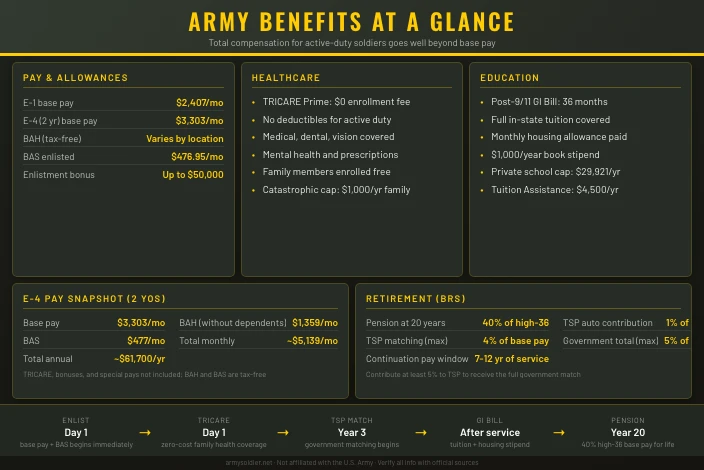
Army pay is more than a monthly paycheck. Between housing allowances, zero-cost healthcare, education funding, and a pension, active-duty total compensation typically runs $20,000 to $30,000 higher than base pay alone. Add tax-free allowances and free family healthcare and the gap between Army compensation and an equivalent civilian salary grows wider still. This guide covers every major benefit, who qualifies, and how the pieces fit together.
At a Glance
| Benefit | What You Get | Who Qualifies | Learn More |
|---|---|---|---|
| Base Pay | $2,407/mo (E-1) to $15,408/mo cap, set by grade and years of service | All active-duty soldiers | Army Pay Guide |
| BAH | Tax-free monthly allowance covering local housing costs, based on duty station, pay grade, and dependency status | Soldiers not in government quarters | Army Pay Guide |
| BAS | $476.95/mo (enlisted) or $328.48/mo (officers) in 2026, flat national rate | All active-duty soldiers | Army Pay Guide |
| TRICARE | Full medical, dental, vision, mental health, and prescriptions with zero premiums and zero deductibles for active duty | Active-duty soldiers and enrolled family members | TRICARE Guide |
| Post-9/11 GI Bill | Full in-state tuition, monthly housing allowance, and up to $1,000/year for books | Soldiers with qualifying active-duty service | GI Bill Guide |
| Retirement (BRS) | 40% of high-36 average base pay after 20 years, plus TSP matching up to 5% of base pay | All soldiers under the Blended Retirement System | Retirement Guide |
| Enlistment Bonus | Up to $50,000 for a 6-year contract in a qualifying MOS | Non-prior-service enlistees in SRIP-eligible jobs | Enlistment Bonus Guide |
Which Benefit Matters Most
The right answer depends on your goals and what you plan to do after service.
Education is the priority. The Post-9/11 GI Bill is the most financially valuable long-term benefit for most soldiers. Full in-state tuition at a public university costs nothing out of pocket. The GI Bill also pays a monthly housing allowance based on E-5 BAH rates at the school’s ZIP code, plus $1,000 per academic year for books.
Across four years at a public university, the combined value often exceeds $80,000 depending on location.
Supporting a family now. TRICARE is the most immediately valuable benefit if you have dependents. Active-duty soldiers and their family members pay nothing in premiums, face no annual deductibles, and owe no copays for in-network care. A comparable private-sector family health plan typically costs $500 to $900 per month in premiums alone, not counting copays and deductibles.
Long-term wealth building. The Blended Retirement System works best when you contribute to TSP from day one. The government contributes 1% of base pay automatically and matches your contributions dollar-for-dollar on the first 3% you put in, then 50 cents per dollar on the next 2%. Contribute 5% and you get the full government match.
Pair that with a 20-year pension paying 40% of your average top-36-month base pay for life and you have a wealth-building foundation that most civilian employers do not offer at the same career stage.
Early career, no dependents. If you are young, single, and enlisting for the first time, the enlistment bonus is often the most immediate financial win. High-demand MOS in signal, intelligence, special operations, and maintenance can qualify for $25,000 to $50,000 depending on contract length. That money arrives in installments over the first four years of service.
How Benefits Stack Together
Consider a Specialist (E-4) at two years of service stationed at Fort Sam Houston, Texas. Base pay in 2026 is $3,303 per month. BAH at Fort Sam runs $1,728 with dependents and $1,359 without. BAS adds another $476.95 per month. Neither BAH nor BAS is subject to federal income tax.
Total monthly compensation comes to roughly $5,508 with dependents or $5,139 without. Annualized, that works out to about $66,100 with dependents or $61,700 without, while also receiving full family healthcare for free.
Soldiers serving in a combat zone get a further tax advantage. Under the Combat Zone Tax Exclusion, enlisted soldiers pay no federal income tax on base pay for every month they serve in a designated combat zone. For an E-4 earning $3,303 a month, a 9-month deployment can save over $7,000 in federal taxes at a standard marginal rate.
Over a career, these advantages compound. Annual pay raises adjust base pay every January 1. BAH increases when you move to higher-cost duty stations or get promoted. Special pays for hazardous duty, flight operations, or foreign language skills stack on top.
Benefits Directory
These guides cover each benefit in detail. Start with the one that matches your current priority.
- Army Pay Guide: Base pay tables, BAH, BAS, and special pays for active-duty soldiers in 2026
- Enlistment Bonus Guide: How much you can earn, which MOS qualify, and how bonuses are structured and paid
- TRICARE Guide: Zero-cost health coverage for active-duty soldiers and their families
- GI Bill Guide: Tuition, housing allowance, and book stipend under the Post-9/11 GI Bill
- Retirement Guide: BRS pension, TSP matching, and long-term savings planning
Explore more Army guides covering paths to serve and test prep resources.