Army Pay Guide 2026
Army pay in 2026 starts at $2,407 per month for an E-1 Private and scales with every promotion and year of service. But base pay is only part of the picture. Housing allowances, food allowances, and special pays stack on top, and most allowances are not taxable income. This guide covers all the components, with 2026 figures from DFAS and official Army sources.
Base Pay
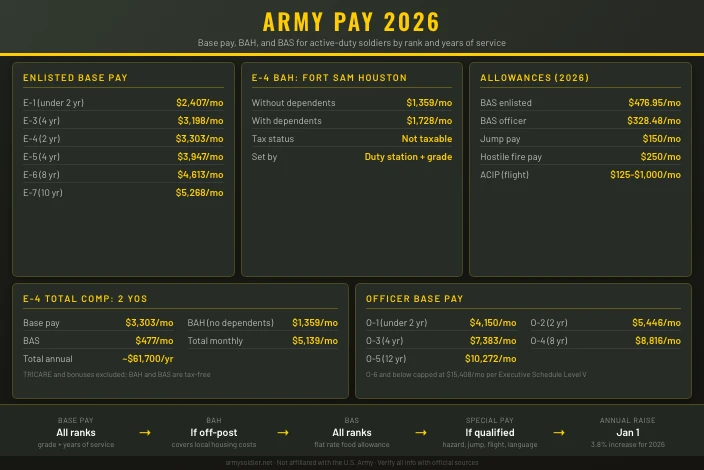
Base pay is set by two factors: your pay grade (rank) and years of service. Congress authorizes a pay raise every January 1. For 2026, the raise was 3.8% across all grades per the FY2026 National Defense Authorization Act.
Pay does not increase automatically month to month. Years of service cross certain thresholds that trigger higher pay within your current grade. Getting promoted to the next grade produces a larger jump than any within-grade step increase.
Enlisted Base Pay (Monthly, 2026)
| Grade | Rank | Under 2 yr | 2 yr | 8 yr | 12 yr |
|---|---|---|---|---|---|
| E-1 | Private (PV1) | $2,407 | $2,407 | – | – |
| E-2 | Private (PV2) | $2,698 | $2,698 | – | – |
| E-3 | Private First Class | $2,837 | $3,015 | – | – |
| E-4 | Specialist / Corporal | $3,142 | $3,303 | $3,816 | – |
| E-5 | Sergeant | $3,343 | $3,599 | $4,299 | $4,422 |
| E-6 | Staff Sergeant | $3,401 | $3,743 | $4,613 | $5,044 |
| E-7 | Sergeant First Class | $3,932 | $4,291 | $5,105 | $5,537 |
| E-8 | Master Sergeant / 1SG | – | – | $5,867 | $6,285 |
| E-9 | SGM / CSM | – | – | – | $7,346 |
Figures from DFAS 2026 military pay charts. E-8 earliest qualifying point is 8 years of service; E-9 earliest is 10 years (shown in 12-year column above). Verify exact figures at dfas.mil.
Officer Base Pay (Monthly, 2026)
| Grade | Rank | Under 2 yr | 4 yr | 8 yr | 12 yr |
|---|---|---|---|---|---|
| O-1 | Second Lieutenant | $4,150 | $5,222 | – | – |
| O-2 | First Lieutenant | $4,782 | $6,485 | – | – |
| O-3 | Captain | $5,534 | $7,383 | $8,126 | $8,788 |
| O-4 | Major | $6,295 | $7,881 | $8,816 | $9,888 |
| O-5 | Lieutenant Colonel | $7,295 | $8,894 | $9,461 | $10,272 |
| O-6 | Colonel | $8,751 | $10,245 | $10,725 | $10,784 |
O-6 and below are capped at $15,408/mo (Executive Schedule Level V, CY2026). The cap applies regardless of how many years beyond 30 a Colonel continues to serve.
Warrant Officer Base Pay (Monthly, 2026)
Warrant officers occupy a distinct pay tier between enlisted soldiers and commissioned officers. They serve as technical specialists in highly specialized fields and are appointed rather than commissioned at the W-1 grade.
| Grade | Rank | Under 2 yr | 2 yr | 6 yr | 10 yr |
|---|---|---|---|---|---|
| W-1 | Warrant Officer 1 | $4,057 | $4,494 | $5,152 | $5,786 |
| W-2 | Chief Warrant Officer 2 | $4,622 | $5,059 | $5,585 | $6,283 |
| W-3 | Chief Warrant Officer 3 | $5,223 | $5,441 | $5,971 | $6,911 |
| W-4 | Chief Warrant Officer 4 | $5,720 | $6,152 | $6,802 | $7,398 |
| W-5 | Chief Warrant Officer 5 | – | – | – | $10,170 |
W-5 pay begins at 20 years of service. Verify exact figures at dfas.mil : the same annual pay raise that applies to enlisted and commissioned officers applies to warrant officers.
Warrant officers receive BAH and BAS under the same rules as commissioned officers. There is no separate BAH tier for warrant officers; the rate depends on pay grade, duty station, and dependency status like any other soldier.
Housing Allowance (BAH)
BAH (Basic Allowance for Housing) covers your off-post housing costs when you do not live in government-provided quarters. It is not taxable income.
Three factors determine your BAH rate:
- Duty station: BAH is calculated for each military housing area (MHA). High-cost areas like Fort Belvoir near Washington, D.C. get much higher BAH than lower-cost installations in rural states.
- Pay grade: Higher grades receive larger BAH amounts.
- Dependency status: Having at least one dependent increases your BAH rate.
BAH is set to cover the median local housing cost for your grade and family situation. If you find cheaper housing, you keep the difference. If your rent runs higher than BAH, you cover the gap out of pocket.
BAH Examples (Fort Sam Houston, TX: 2026)
| Grade | Without Dependents | With Dependents |
|---|---|---|
| E-4 | $1,359/mo | $1,728/mo |
| E-5 | $1,500/mo | $1,869/mo |
| O-1 | $1,584/mo | $1,905/mo |
| O-2 | $1,827/mo | $2,091/mo |
| O-3 | $2,007/mo | $2,127/mo |
Use the BAH Rate Lookup tool at defense.gov to find exact rates for any duty station. Rates are updated annually and can change mid-year if Congress authorizes an adjustment. San Antonio BAH rates decreased slightly from 2025 due to local market adjustments; this reflects how responsive the system is to local housing markets.
Basic Allowance for Subsistence (BAS)
BAS is a flat monthly food allowance paid to all active-duty soldiers. In 2026, the rate is:
- Enlisted: $476.95 per month
- Officers: $328.48 per month
Like BAH, BAS is not taxable. The rate does not vary by rank within each category, duty station, or family size. The enlisted rate increased from $465.77 in 2025, a roughly 2.4% adjustment.
Soldiers who live and eat in government quarters or use post dining facilities may have BAS offset through a deduction. Soldiers who buy their own food off-post receive the full BAS amount.
Special and Incentive Pays
Several additional pays apply to soldiers in qualifying assignments or roles. These stack on top of base pay, BAH, and BAS.
| Pay Type | Who Qualifies | Approximate 2026 Rate |
|---|---|---|
| Hostile Fire / Imminent Danger Pay | Soldiers in designated combat or hazard zones | $250/mo |
| Airborne Pay (Jump Pay) | Qualified paratroopers in assigned jump positions | $150/mo enlisted |
| Aviation Career Incentive Pay (ACIP) | Rated aviators in qualifying flight positions | $125-$1,000/mo |
| Foreign Language Proficiency Pay (FLPP) | Soldiers tested and proficient in qualifying languages | Up to $500/mo |
| Special Duty Assignment Pay (SDAP) | Recruiters, drill sergeants, and other designated assignments | $75-$600/mo |
Verify current special pay rates with your finance office or at dfas.mil. Congress may authorize adjustments outside the annual pay raise cycle, and some pays have qualification and position requirements that change over time.
Combat Zone Tax Exclusion. Deployed soldiers serving in a designated combat zone pay no federal income tax on base pay for any month they spend time in the zone. One day in the zone qualifies you for the full month’s exclusion. For an E-5 at $3,599 per month at a 22% effective tax rate, a nine-month deployment saves over $7,000 in federal taxes. Officers receive a partial exclusion capped at the highest enlisted pay rate. Bonus installments paid while you are in the combat zone also qualify : a $15,000 first installment received during deployment may be entirely tax-free at the federal level.
Savings Deposit Program (SDP). Available to soldiers in designated combat zones, the SDP lets you deposit up to $10,000 in a government account at 10% annual interest, guaranteed. The rate is fixed regardless of broader market conditions. Funds are returned within 120 days of leaving the qualifying area. At $10,000 for a nine-month deployment, the SDP returns roughly $750 in interest : a guaranteed, risk-free rate unavailable in any comparable civilian savings instrument.
Total Compensation Example
An E-4 Specialist with two years of service stationed at Fort Sam Houston, Texas earns the following in 2026:
| Component | Monthly | Annual |
|---|---|---|
| Base Pay | $3,303 | $39,636 |
| BAH (without dependents) | $1,359 | $16,308 |
| BAS | $477 | $5,724 |
| Total | $5,139 | $61,668 |
With one dependent, BAH rises to $1,728, bringing total monthly compensation to $5,508 and annual compensation to roughly $66,096.
Neither BAH nor BAS is subject to federal income tax. That makes the effective purchasing power of those amounts higher than a civilian salary of the same dollar figure, since a civilian earning $61,668 pays federal income tax on the full amount while this soldier does not pay tax on the $22,032 that comes from allowances.
This example does not include TRICARE (zero-cost family healthcare), TSP government matching, enlistment bonuses, or any special pays. Each adds real value on top of these figures.
How Pay Scales Over a Career
Pay increases at two types of milestones: promotion to the next grade and longevity steps within your current grade. Promotions produce larger increases; longevity steps add smaller amounts as years of service accumulate.
An E-1 earns the same base pay regardless of time in service : the grade has no longevity steps. Promotion to E-2, E-3, and E-4 happen quickly in the first two years for soldiers who meet standards. An E-4 at four years earns $3,816, a $513 monthly increase over the E-4 rate at under two years, simply from accumulated time in grade without any promotion.
Officers see larger jumps at each promotion. An O-1 Second Lieutenant earns $4,150 on commissioning. Promotion to O-2 at roughly 18 months brings a minimum rate of $4,782. The O-3 Captain rate at four years jumps to $7,383 : over $900 above the O-2 rate at the same total experience point. BAH also adjusts with promotion since it scales by pay grade, adding to the total compensation increase.
Warrant officers follow the same structure with their own grade thresholds. The transition from WO1 to CW2 typically occurs between 8 and 10 years of service; CW3 and above require board selection. A CW3 at 14 years earns $7,398 in base pay : more than an O-3 Captain at eight years. Senior warrant pay at CW4 and CW5 exceeds most civilian IT management salaries outside major tech markets.
Blended Retirement System and TSP
The Blended Retirement System (BRS) applies to soldiers who entered service on or after January 1, 2018, and to earlier-entry soldiers who opted in during the 2018-2019 window. It combines a defined pension with mandatory government Thrift Savings Plan contributions.
Pension. After 20 years of qualifying service, BRS pays a lifetime monthly pension equal to 40% of the average base pay from your highest-earning 36 months of service. The legacy High-3 system paid 50% at 20 years; BRS pays less per year of service in exchange for giving soldiers portable TSP ownership they keep even if they separate before 20 years.
TSP matching. The government automatically deposits 1% of your base pay into your TSP account starting on day one. After 60 days of service, it matches your contributions dollar-for-dollar on the first 3% you put in, then 50 cents per dollar on the next 2%. Contribute 5% and you receive the full match. Contributions vest after two years.
For an E-4 at $3,303 per month who contributes 5%: the soldier puts in $165, the government matching contribution adds $132, and the combined account grows by $297 per month before investment returns. Over a 4-year enlistment, that totals over $14,000 in combined contributions: money the soldier keeps at separation whether or not they complete 20 years.
An O-3 Captain at four years of service at Fort Sam Houston earns base pay of $7,383, BAH of $2,007 without dependents, and BAS of $328. Monthly total comes to $9,718, $116,616 annualized, before special pays, TRICARE, or TSP matching. The tax exemption on BAH and BAS raises the effective purchasing power well above the nominal figure.
Soldiers who entered before BRS became mandatory and did not opt in remain under the legacy High-3 system. Your finance office can confirm which retirement system applies to you.
More Information
Verify all pay figures at dfas.mil. Use the BAH Rate Lookup tool to confirm rates for a specific duty station before making housing decisions.
For information on bonuses available at enlistment, see the enlistment bonus guide. For the full benefits picture, return to the Army benefits overview.