Army Enlistment Bonuses
The Army uses enlistment bonuses to fill jobs that are hard to staff. If your target MOS is on the current bonus list, you can negotiate a cash payment of up to $50,000 into your enlistment contract before you ship. This guide covers how the program works, which jobs currently qualify, how the money is paid, and what can cost you the bonus if things go wrong.
What an Enlistment Bonus Is
An enlistment bonus is a cash payment written into your enlistment contract. You agree to serve in a specific MOS for a set number of years, and the Army agrees to pay you a specified amount. The bonus is separate from base pay, BAH, and BAS.
Not every MOS carries a bonus. The Army publishes a bonus-eligible MOS list through its Selected Reserve Incentive Program (SRIP) for the reserves and a separate active-duty chart through Human Resources Command (HRC). These lists change quarterly as Army needs shift. A job that carries a bonus today may not in six months, and vice versa.
Which MOS Qualify
The Army concentrates bonus money on jobs with persistent recruiting challenges or critical shortages. As of the most recently published HRC bonus chart, high-demand active-duty jobs with bonus eligibility included:
- 12D (Diver)
- 13U (Field Artillery Firefinder Radar Operator)
- 14U (Air Defense Battle Management System Operator)
- 18X (Special Forces Candidate)
- 25S (Satellite Communication Systems Operator/Maintainer)
- 35M (Human Intelligence Collector)
- 35P (Cryptologic Linguist)
- 35W (Electronic Warfare Specialist)
- 68K (Medical Laboratory Specialist)
- 91M (Bradley Fighting Vehicle System Maintainer)
- 92R (Parachute Rigger)
- 94A (Land Combat Electronic Missile Systems Repairer)
- 94E (Radio and Communications Security Repairer)
- 94S (PATRIOT System Repairer)
- 94Y (Integrated Family of Test Equipment Operator/Maintainer)
This list is not exhaustive and it changes. Your recruiter has access to the current HRC bonus chart. Ask specifically which bonus-eligible jobs are available in your recruiting area before you commit to a contract.
Non-Prior Service vs Prior Service
The bonus program works differently depending on your background.
Non-Prior Service (NPS) applicants are enlisting for the first time. NPS enlistees are eligible for the full active-duty SRIP chart based on their chosen MOS and contract length. Some MOS have tiered amounts that also depend on language qualifications or ASVAB category.
Prior Service (PS) applicants previously served and are re-enlisting or joining a new component. PS enlistees qualify under a separate bonus list that is distinct from the NPS chart. The available jobs and amounts differ. Contact an Army Prior Service recruiter directly, or check the HRC website for the current PS chart.
Army Reserve recruits can qualify for the Army Reserve SRIP, which provides up to $13,000 in incentive money. Reserve SRIP covers different MOS than the active-duty chart.
How Much You Can Earn
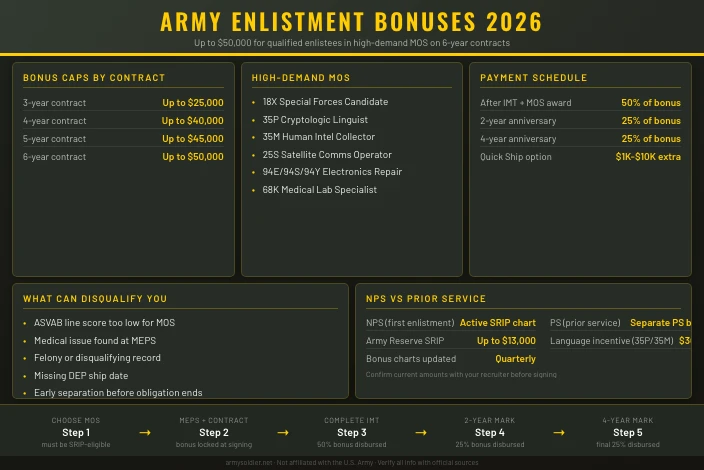
Bonus amounts are capped by contract length on the active-duty side. Longer contracts open higher maximums:
| Contract Length | Maximum Bonus |
|---|---|
| 3 years | $25,000 |
| 4 years | $40,000 |
| 5 years | $45,000 |
| 6 years | $50,000 |
Not every qualifying MOS offers the maximum. The actual amount for a given MOS may be lower than the cap. Some MOS use flat rates; others use a tiered structure based on shortage level or applicant category.
Language-specific incentives add more for certain MOS. The 35P (Cryptologic Linguist) in Korean and 35M (Human Intelligence Collector) in specific foreign languages can qualify for $30,000 on a 5-year contract or $45,000 on a 6-year contract for applicants in ASVAB categories I through IIIA.
Quick Ship bonuses are also available for some MOS. If you ship to Basic Combat Training within 30 days of contracting, you may receive an additional $1,000 to $10,000 depending on the MOS and current Army needs. Quick Ship money is separate from your enlistment bonus.
How Bonuses Are Paid
Enlistment bonuses are not paid in a single lump sum at the start of service. The Army uses an installment schedule:
- 50% paid after completing Initial Military Training (Basic and AIT or OSUT) and receiving your MOS
- 25% paid on your 2nd service anniversary
- 25% paid on your 4th service anniversary
Roughly half the money arrives after your training pipeline, which typically runs 6 to 12 months depending on your MOS school. The remainder pays out over the next two years.
This structure protects both sides. You are not obligated to stay past your contract, but the Army holds the remaining installments as an incentive to complete your service obligation. If you separate early, unearned installments are not paid.
Tax Treatment
Enlistment bonuses are taxable as ordinary income in the year each installment is received. The Army withholds federal income tax from each payment at the supplemental income rate, subject to your W-4 elections.
There is a significant exception. If an installment is paid while you are serving in a designated combat zone, that payment may qualify for the Combat Zone Tax Exclusion (CZTE), removing it from your federal taxable income entirely. The exclusion applies to any full or partial month you are in the combat zone, not the entire enlistment.
State income tax treatment varies. Some states exempt military bonus pay; others tax it as regular income. A military legal assistance office or a tax advisor familiar with military pay can help you plan.
What Can Disqualify You
A bonus is only valid if you complete the terms of your contract. Several things can cause you to forfeit it or be required to repay installments already received:
- ASVAB score too low for the contracted MOS. If your line scores do not meet the minimum for the job at MEPS, the contract cannot be written for that MOS.
- Medical disqualification at MEPS. A condition that surfaces during processing can end the enlistment before the contract is signed.
- Felony conviction or disqualifying criminal history. Background issues discovered during processing can close the door.
- Failure to ship within the Delayed Entry Program window. If you sign a DEP contract and miss your ship date, the bonus may be renegotiated or voided.
- Early separation. If you are discharged before completing your service obligation, the Army may seek recoupment of any installments already paid, prorated to time not served. This includes separations for misconduct, failure to meet standards, or approved early releases.
- MOS reclassification before obligation ends. Being moved out of the bonus MOS before your service obligation is complete can trigger recoupment.
Re-enlistment Bonuses
The Selective Reenlistment Bonus (SRB) program serves soldiers already serving who want to reenlist. SRB eligibility is tied to MOS criticality and reenlistment zone. The Army updated the SRB structure for 2026 to connect payouts more closely to performance and retention needs. Talk to your unit retention NCO to confirm current SRB amounts for your MOS and zone, since these are not published in a single public table.
Separately, the Blended Retirement System includes Continuation Pay, a one-time cash retention incentive paid between 7 and 12 years of service for Army active-component soldiers. Payouts range from 2.5x to 13x monthly basic pay. Accepting Continuation Pay requires committing to at least 3 more years of service.
More Information
Verify current bonus eligibility with your recruiter or at hrc.army.mil under the Enlistment Bonus Program section. Bonus charts are updated quarterly, so what is listed today may change before you sign.
For a full picture of Army compensation, see the Army pay guide or return to the Army benefits overview.
This site is not affiliated with the U.S. Army or any government agency. Verify all information with official Army sources before making enlistment or career decisions.