11B Infantryman vs 19D Cavalry Scout
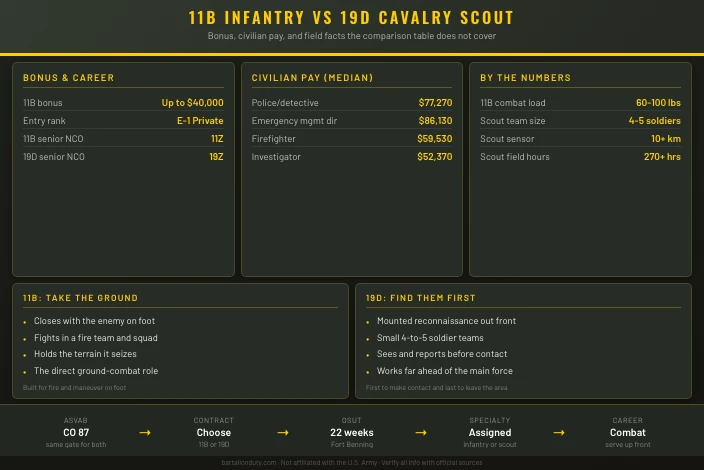
Both are front-line ground-combat jobs with the same low ASVAB bar, but they fight in different ways. The 11B Infantryman closes with the enemy on foot, while the 19D Cavalry Scout finds the enemy first through reconnaissance.
Quick Comparison
| Decision point | 11B Infantryman | 19D Cavalry Scout |
|---|---|---|
| Core role | Engages enemy forces in close combat, executes patrols and ambushes, secures terrain, and operates as part of a fire team and squad. | Performs mounted and dismounted reconnaissance to locate enemy forces, identify terrain, and report battlefield conditions. Scouts are first to make contact and last to leave. |
| Test gate | ASVAB. No security clearance required for the standard assignment. | ASVAB. No security clearance required at entry. |
| Score summary | Combat (CO) line score of 87 minimum. AFQT 31 (diploma) or 50 (GED). | Combat (CO) line score of 87 minimum. AFQT 31 (diploma) or 50 (GED). |
| Training path | A single 22-week One Station Unit Training (OSUT) course at Fort Benning, Georgia, then straight to the first unit. | A 22-week One Station Unit Training (OSUT) course at Fort Benning, Georgia: about 10 weeks of basic soldiering, then 12 weeks of scout skills. |
| Work setting | Garrison home station, multi-week field rotations at training centers, and forward operating or patrol bases in any climate on deployment. | Motor pools and observation posts in garrison, mounted in Bradley, Stryker, or JLTV, with multi-week field rotations and forward bases on deployment. |
| Deployment pattern | Roughly 9 to 12 months deployed, then 18 to 24 months at home station. High-readiness units can deploy within 96 hours. | Roughly 9 months deployed, then 18 to 24 months at home station. Active-duty scouts deploy about once every 24 to 36 months. |
| Best fit | People who thrive on physical challenge, train hard without being told, and want the most traditional front-line ground-combat role the Army offers. | People who like being outside, working with machines, and making decisions without supervision, and who want a tactical front-line reconnaissance role. |
| Less ideal if | People who need a predictable schedule, want a job that maps to a civilian license, or have chronic joint, back, or knee problems. | People who need a predictable schedule, dislike outdoor extremes, have chronic joint issues, or are uncomfortable with weapons and combat. |
If you want to take and hold ground in the direct fight, start with the 11B Infantryman profile. If you want to be the eyes that find the enemy before the fight, start with the 19D Cavalry Scout profile.
Qualification Gates
The gates are the same on paper. Both need a Combat (CO) line score of 87, one of the lowest in the Army, and neither requires a security clearance. The difference is not the score but the mission, so the choice comes down to how you want to fight, not what you can qualify for.
Either way, a strong ASVAB keeps your options open. Use our ASVAB study guide to clear the bar with room to spare and pick the combat job you want.
Work Environment
The 11B works on foot inside a fire team and squad, closing the last distance to an objective and holding the ground it takes. Days swing between garrison training, multi-week field rotations, and deployments to forward and patrol bases.
The 19D works mounted, in scout vehicles like the Bradley, Stryker, or JLTV, often as a 4-to-5-person team watching a sector alone. Scouts are built to see first and report, not to seize and hold.
Training Path
The pipeline is the same length for both: a 22-week One Station Unit Training (OSUT) course at Fort Benning, Georgia, starting with the basic soldier skills every combat soldier learns.
The specialties split in the second half. The 11B drills marksmanship, battle drills, and squad tactics, while the 19D learns reconnaissance, surveillance, and scout gunnery.
Which One Fits You
Choose the 11B if you want to be in the direct fight and take ground on foot. Choose the 19D if you would rather move fast, work in a small mounted team, and find the enemy before the main force arrives.
Both jobs are physical, deploy often, and reward soldiers who stay calm under stress. The honest question is whether you want to make contact or stay hidden long enough to report it.
The same test opens both doors. Lock in your ASVAB score, talk with a recruiter, and compare other Army career guides before you commit.