17A vs 17B vs 17D: Which Army Cyber Officer Specialty Fits You
All three cyber officer fields begin in the same Army branch with shared baseline training and clearance requirements, but their missions diverge. Some officers conduct cyber operations, others fight in the electromagnetic spectrum, and others develop the tools used by both.
The three fields are 17A, 17B and 17D. Most cyber lieutenants enter through 17A, while a smaller number are selected directly for 17D training. The 17B field comes later, after qualification in 17A, so the initial route can shape an officer’s work for years.
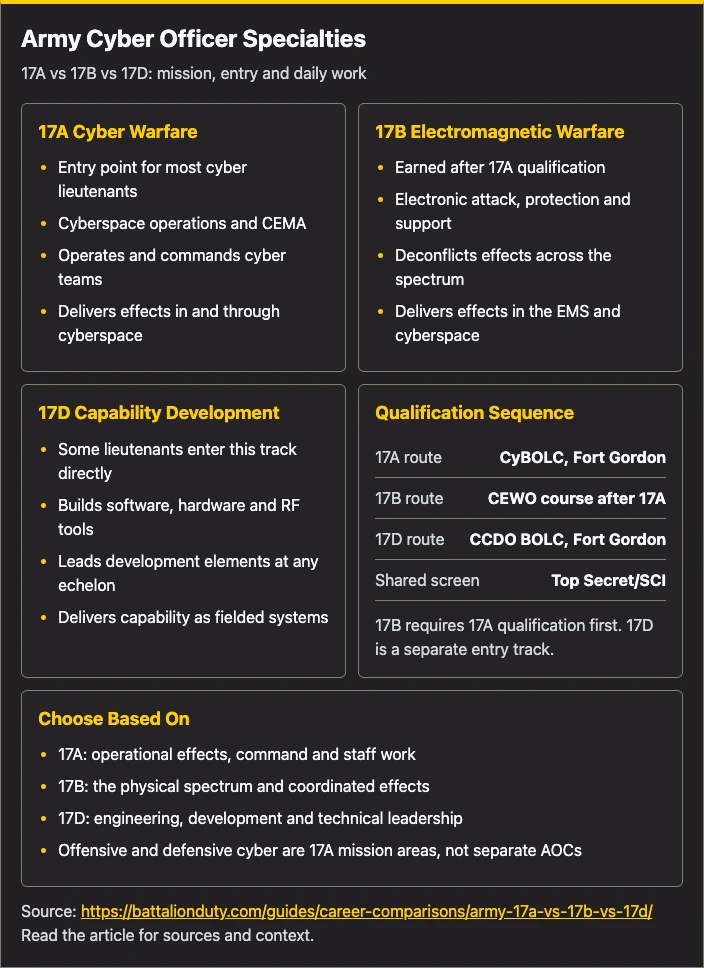
17A Cyber Warfare
- Entry point for most cyber lieutenants
- Cyberspace operations and CEMA
- Operates and commands cyber teams
- Delivers effects in and through cyberspace
17B Electromagnetic Warfare
- Earned after 17A qualification
- Electronic attack, protection and support
- Deconflicts effects across the spectrum
- Delivers effects in the EMS and cyberspace
17D Capability Development
- Some lieutenants enter this track directly
- Builds software, hardware and RF tools
- Leads development elements at any echelon
- Delivers capability as fielded systems
Qualification Sequence
- 17A route
- CyBOLC, Fort Gordon
- 17B route
- CEWO course after 17A
- 17D route
- CCDO BOLC, Fort Gordon
- Shared screen
- Top Secret/SCI
17B requires 17A qualification first. 17D is a separate entry track.
Choose Based On
- 17A: operational effects, command and staff work
- 17B: the physical spectrum and coordinated effects
- 17D: engineering, development and technical leadership
- Offensive and defensive cyber are 17A mission areas, not separate AOCs
Source: https://battalionduty.com/guides/career-comparisons/army-17a-vs-17b-vs-17d/
Read the article for sources and context.
On this page
The three AOCs side by side
| Decision point | 17A Cyber Warfare Officer | 17B Cyber Electromagnetic Warfare Officer | 17D Cyber Capability Development Officer |
|---|---|---|---|
| Core mission | Cyber work and cyber electromagnetic work | Electronic warfare and spectrum work | Software, hardware and tool building |
| How you enter | Standard route. Most lieutenants take CyBOLC for 17A | Earned after 17A. Selected lieutenants take the CEWO course | Some lieutenants are picked for the 17D CCDO course instead |
| Training path | Cyber Basic Officer Leader Course at Fort Gordon | 17B CEWO course, after 17A CyBOLC | 17D CCDO BOLC at Fort Gordon |
| Daily work | Planning and running cyber effects for a commander | Coordinating jamming, spectrum protection and collection | Leading teams that build tools and systems |
| Works most closely with | Cyber mission teams and maneuver staffs | Electronic warfare soldiers, spectrum managers, maneuver units | Engineers, developers, contractors and program offices |
| Typical setting | Operations center, sensitive compartmented information facility | Operations center, tactical operations center, field units | Development facility, program office, laboratory |
| Best fit for | Officers who want effects and command | Officers who want technical work tied to the battlefield | Officers who want to build things and lead technical teams |
Offensive and defensive cyber are mission areas within 17A rather than separate fields, which is why the table compares three specialties rather than five.
17A: the operational base
As the largest field and operational base of the branch, 17A covers the planning and coordination of cyber defense, cyber intelligence and reconnaissance, and cyber attack. Cyber Warfare Officers lead teams conducting these missions at Army and joint levels and explain the resulting effects to commanders without technical backgrounds.
Most new cyber lieutenants attend the 17A Cyber Basic Officer Leader Course (CyBOLC), which teaches the foundation shared across the branch rather than the specialized work that separates the three fields.
So 17A is the default route for a new officer. Almost everyone in the branch walks it first.
The work supports a commander’s plan on an operational timeline, with success measured by what the unit can accomplish as a result. Officers seeking command assignments tend to favor 17A because its career pattern resembles other operational branches, but with a technical mission.
The tradeoff is breadth: a 17A officer can build deep expertise in one technical area, but must seek assignments that develop it rather than expecting specialization by default.
17B: the spectrum fight
The 17B field builds on 17A with electronic attack, electronic protection and electronic support. Cyber Electromagnetic Warfare Officers integrate these effects with cyber operations because the electromagnetic spectrum is shared and contested rather than controlled by a single unit.
The entry sequence requires 17A qualification before the 17B CEWO course. Some lieutenants attend immediately after CyBOLC, others are selected later, and captains assigned to a 17B position must complete the course before reporting.
Much of a CEWO’s daily work involves preventing interference with friendly systems. Because jamming affects everything in a frequency band, the officer must know where friendly emitters are located and what nearby units are doing before confirming that an effect will not disrupt the formation it is meant to protect.
This work suits officers who like the physical problem: antennas, waveforms and propagation, and equipment that puts effects into the real world rather than only into networks. If your interest stops at software, another field fits better.
17D: the builders
The 17D engineering field focuses on designing and delivering software, hardware, radio-frequency and other technical systems. Cyber Capability Development Officers serve as developers in development elements at any echelon.
Unlike 17B, 17D does not require an initial 17A qualification. Selected lieutenants enter the CCDO course directly instead of the 17A course. They generally serve in 17D positions, although the branch may assign them to 17A or 17B slots when needed.
The development process resembles civilian engineering, from requirements and design through building, testing, security accreditation and fielding. Military systems, however, must work in deployed conditions, pass accreditation and remain supportable for years after delivery.
Officers who want to keep building fit here best. They must also be happy leading engineers. This is not command of soldiers in the field. The teams are small, the timelines are long, and the output is a system rather than an action.
How the assignments actually differ
The branch’s published duty-position lists show where the fields differ. Lieutenant assignments overlap substantially: all three include company executive officer, platoon leader, and section, element or crew lead.
The technical positions differ. The 17A list includes analytic support officer, interactive operator and exploitation analyst; the 17D list adds basic developer, while the 17B list adds none of these. A new CEWO therefore develops through shared leadership assignments before later spectrum-specific training rather than starting in a distinct first job.
Branch guidance emphasizes leadership experience in the operational force after BOLC. Some lieutenants take highly technical positions and others broaden through staff assignments, but this guidance applies across the branch rather than to only one specialty.
At captain level, key developmental positions for both 17A and 17B include company commander and CEWO. The 17A list also includes support team lead, mission element or section lead, and analytic support officer. Officers must spend at least eighteen months in a key developmental assignment, and the branch encourages captains to pursue these jobs across the three fields.
Broadening, and the long career
Broadening is a branch-wide career principle. The source describes key developmental and developmental assignments for cyber captains and notes that broadening can expand their knowledge and skills, without prescribing a separate route for each field.
Two rules shape career progression. First, key developmental credit transfers among cyber fields at the officer’s current rank and grade; even captains filling major-coded positions receive credit at their own grade. Second, successful performance in those assignments supports career growth and consideration for promotion to major, with performance in one or more qualifying jobs carrying particular weight.
The fields are therefore less rigid in assignments than their separate labels suggest: officers can receive developmental credit across specialties. Training requirements remain distinct, however. A 17B assignment still requires CEWO qualification, and an officer assigned to an untrained field must complete the appropriate transition course.
Where the paths actually diverge
Entry sequence is a central difference. Most officers begin in 17A and qualify for 17B only after learning the branch’s operational foundation, while selected 17D officers enter their development track directly and start building technical depth in their first assignment.
The courses reflect those entry routes. The 17A course establishes a foundation in cyber operations, network exploitation and planning; the CEWO course adds electronic warfare to that foundation; and the CCDO course builds on programming and systems experience to cover the development lifecycle.
At field grade, key developmental credit remains transferable across the 17-series specialties. Eighteen months in a qualifying assignment counts at the same grade regardless of its field code, allowing a 17D officer to take an operational 17A slot or a 17A officer to take a development position without losing credit.
The assignment patterns still differ. Officers in 17A and 17B rotate through operational commands and staffs, while 17D officers more often work in development offices, program offices and acquisition positions. The operational fields offer more tactical command opportunities; 17D offers more sustained proximity to technology development.
The market after service splits sharply. 17D skills map onto software and systems engineering, where pay is strong and hiring is ongoing. By contrast, 17B skills fit a narrower market in electronic warfare programs and defense contracting that leans on a clearance. 17A skills map onto cyber work and intelligence jobs. All three offer paths to civilian work, but the range of jobs differs.
Which one fits you
Choose 17A if you want to run operations in the broadest, most accessible cyber field, with a career pattern similar to other Army officer branches but centered on technical missions.
Choose 17B if you prefer the physical spectrum to network operations and enjoy coordinating effects without disrupting friendly systems. You must also accept that 17A qualification comes first.
Choose 17D if you want to develop systems rather than operate them. The career resembles engineering management more than tactical command, and selection is made by the branch rather than by preference alone. Express interest early and support it with actual programming or engineering experience.
The honest summary is that the Army needs all three. The choice is less about which is better. It is about the work you want to be doing at forty. Read the profiles before you commit: 17A Cyber Warfare Officer, 17B Cyber Electromagnetic Warfare Officer, and 17D Cyber Capability Development Officer.
If you have not commissioned yet, the first question is whether Cyber is open to you at all. The branch is competitive. The path to a commission decides which fields are realistic. Officers who commission through OCS also need a General Technical score of 110. Our ASVAB for OCS guide covers that.
All three fields require a Top Secret clearance with access to sensitive compartmented information. The investigation is part of accession and represents a major eligibility hurdle, not a formality.