17C Cyber Operations Specialist vs 17E Electronic Warfare Specialist
Both jobs sit in the Army’s cyber branch and both need a Top Secret clearance, but they fight in different domains. The 17C Cyber Operations Specialist works in networks and code, while the 17E Electronic Warfare Specialist works in the electromagnetic spectrum.
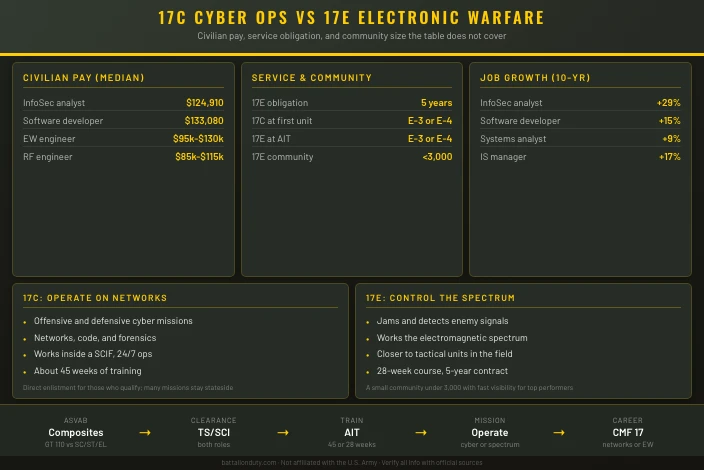
Quick Comparison
| Decision point | 17C Cyber Operations Specialist | 17E Electronic Warfare Specialist |
|---|---|---|
| Core role | Plans and runs cyberspace operations: defends Army networks, conducts authorized offensive cyber missions, performs digital forensics and malware analysis, and advises commanders on the cyber threat. | Plans and runs electronic warfare across electronic attack, protection, and support: jams enemy communications, detects emitters, and advises commanders on the electromagnetic spectrum. |
| Test gate | ASVAB plus Top Secret/SCI clearance eligibility. | ASVAB plus Top Secret/SCI clearance eligibility. |
| Score summary | General Technical (GT) 110 minimum and Skilled Technical (ST) 112 minimum. AFQT 31 (diploma) or 50 (GED). | Surveillance & Communications (SC) 105, Skilled Technical (ST) 105, and Electronics (EL) 105 minimums. AFQT 31 (diploma) or 50 (GED). |
| Training path | 10-week BCT, then about 45 weeks of AIT: a 25-week course at Corry Station in Pensacola, FL, and a 20-week phase at Fort Gordon, GA. | 10-week BCT, then a 28-week AIT at Fort Gordon, GA, one of the longer enlisted courses in the Army. |
| Work setting | Almost entirely inside a Sensitive Compartmented Information Facility (SCIF) with no personal phones, running 24/7 operations on rotating 12-hour and night shifts. | A cyber and electromagnetic activities (CEMA) section in a secure workspace in garrison, and tactical operations centers or vehicle-mounted EW systems in the field, with shift work in deployed spectrum monitoring. |
| Deployment pattern | Many missions run from CONUS SCIFs with no overseas travel. Cyber Protection Team deployments run 6 to 9 months to the Middle East, Europe, or the Pacific. | Brigade combat team units deploy every 24 to 36 months for 9 to 12 months; cyber and electronic warfare elements may deploy more often. |
| Best fit | Curious, detail-oriented people with real interest in computers or networking who can handle shift work, ambiguity, and permanent restrictions on discussing their work. | Analytically sharp people with a strong math and science foundation and real interest in electronic systems who can hold a TS/SCI clearance and brief commanders clearly. |
| Less ideal if | People who need predictable 9-to-5 hours, dislike long stretches of desk work, or cannot pass a Top Secret/SCI investigation. | People who want geographic stability, are unsure about a five-year service obligation, or have financial or foreign-contact issues that block a TS/SCI clearance. |
If you want to operate on networks and systems, start with the 17C Cyber Operations Specialist profile. If you want to jam, detect, and control the spectrum, start with the 17E Electronic Warfare Specialist profile.
Qualification Gates
Both require a Top Secret/SCI clearance, but the ASVAB gates differ. The 17C wants a General Technical (GT) 110 and a Skilled Technical (ST) 112. The 17E is unusual: it needs three composites at 105 at once, in Surveillance & Communications, Skilled Technical, and Electronics.
Those three EW composites lean hard on electronics and physics, so the prep is different even though both jobs are technical. Build the base with our ASVAB study guide before you choose a lane.
Work Environment
The 17C works almost entirely inside a SCIF, running 24/7 cyber operations on rotating shifts, often with no overseas travel at all. The job is networks, code, and analysis on classified systems.
The 17E works closer to the field. You sit in a unit’s cyber and electromagnetic activities section in garrison, then move to tactical operations centers or vehicle-mounted EW systems on exercises and deployments.
Training Path
The 17C pipeline is one of the longest in the cyber field: after Basic, about 45 weeks of training split between Pensacola and Fort Gordon.
The 17E pipeline is shorter but still long for the Army: a 28-week course at Fort Gordon, among the longer enlisted schools. The 17E also carries a five-year service obligation.
Which One Fits You
Choose the 17C if you want to operate on networks and you are drawn to code, forensics, and cyber missions. Choose the 17E if you want to work the spectrum, like hands-on electronics, and want to be closer to a tactical unit.
The 17E community is small, under 3,000 soldiers, which can mean fast visibility for strong performers. Both paths build clearances and skills that pay well outside the Army.
Either way, the test comes first. Lock in your ASVAB score, ask a recruiter which composites you need, and compare other Army career guides before you commit.