17C Cyber Operations Specialist vs 25D Cyber Network Defender
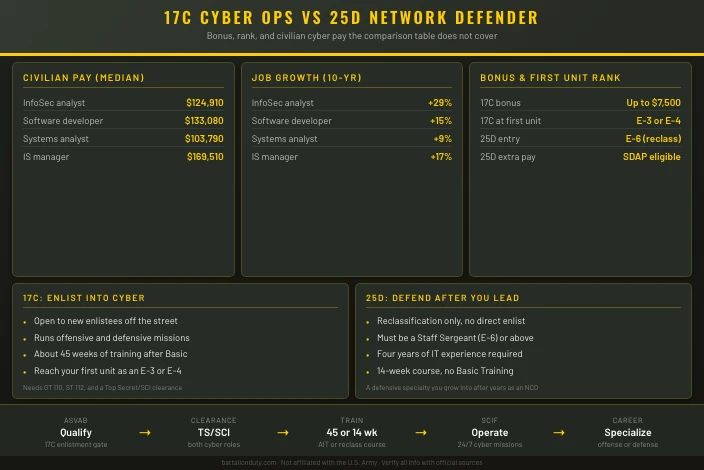
Both jobs defend Army networks, but they sit at opposite ends of the cyber career timeline. The 17C Cyber Operations Specialist runs offensive and defensive missions as a direct-enlistment job, while the 25D Cyber Network Defender is a defense-focused specialty you can only reach after years as an NCO.
Quick Comparison
| Decision point | 17C Cyber Operations Specialist | 25D Cyber Network Defender |
|---|---|---|
| Core role | Plans and runs cyberspace operations: defends Army networks, conducts authorized offensive cyber missions, performs digital forensics and malware analysis, and advises commanders on the cyber threat. | Defends Army networks from intrusion: monitors for attacks, analyzes threats, responds to security incidents, runs vulnerability assessments, and manages defensive cybersecurity infrastructure. |
| Test gate | ASVAB plus Top Secret/SCI clearance eligibility. | Reclassification only. Requires Staff Sergeant (E-6) or above, four years of IT/IA experience, a commander recommendation, and a Top Secret clearance. Not open to direct enlistment. |
| Score summary | General Technical (GT) 110 minimum and Skilled Technical (ST) 112 minimum. AFQT 31 (diploma) or 50 (GED). | General Technical (GT) 105 minimum and Skilled Technical (ST) 105 minimum. Reclassification path, so no enlistment AFQT applies. |
| Training path | 10-week BCT, then about 45 weeks of AIT: a 25-week course at Corry Station in Pensacola, FL, and a 20-week phase at Fort Gordon, GA. | A 14-week reclassification course at Fort Gordon, GA. No BCT, since candidates are already serving soldiers. |
| Work setting | Almost entirely inside a Sensitive Compartmented Information Facility (SCIF) with no personal phones, running 24/7 operations on rotating 12-hour and night shifts. | Network operations centers, SCIFs, and secure server rooms, with field command posts when deployed on a Cyber Protection Team. Shift work is common. |
| Deployment pattern | Many missions run from CONUS SCIFs with no overseas travel. Cyber Protection Team deployments run 6 to 9 months to the Middle East, Europe, or the Pacific. | Most units deploy every 24 to 36 months, with shorter cycles for Cyber Protection Teams. Soldiers usually work from fixed facilities in the Middle East, Europe, or the Pacific. |
| Best fit | Curious, detail-oriented people with real interest in computers or networking who can handle shift work, ambiguity, and permanent restrictions on discussing their work. | Experienced IT or signal NCOs who are analytical under pressure, strong at documentation, and want defensive cyber depth with a clear civilian payoff. |
| Less ideal if | People who need predictable 9-to-5 hours, dislike long stretches of desk work, or cannot pass a Top Secret/SCI investigation. | Soldiers who want direct enlistment, outdoor or physical work, or frequent variety, or who will not keep strict security discipline. |
If you want to enlist straight into cyber, start with the 17C Cyber Operations Specialist profile. If you are already an IT-experienced NCO who wants to specialize in network defense, start with the 25D Cyber Network Defender profile.
Qualification Gates
The entry paths could not be more different. Anyone who qualifies can enlist for the 17C, which needs a General Technical (GT) score of 110 and a Skilled Technical (ST) score of 112, plus eligibility for a Top Secret/SCI clearance. The 25D is reclassification only: you must already be a Staff Sergeant (E-6) with four years of IT experience and a commander’s recommendation.
Both roles live behind a clearance, so the background investigation matters as much as the test. Lock in the academic side first with our ASVAB study guide, since a strong line score is what gets a new recruit into the 17C pipeline at all.
Work Environment
Both jobs work inside a SCIF, a secure room with no personal phones and strict access control. The 17C runs around-the-clock operations on rotating 12-hour and night shifts. The 25D works from network operations centers and secure server rooms, moving to a field command post when deployed on a Cyber Protection Team.
The deployment picture is lighter than most combat jobs. Many 17C missions run from stateside SCIFs with no travel at all, and 25D units typically deploy every 24 to 36 months to fixed facilities overseas.
Training Path
The 17C pipeline is long. After 10-week Basic, you spend about 45 weeks in advanced training, split between a 25-week course at Corry Station in Pensacola and a 20-week phase at Fort Gordon. Most soldiers reach their first unit as an E-3 or E-4 because the schooling takes so long.
The 25D skips almost all of that. Because every candidate is already a serving soldier, there is no Basic Training, just a 14-week reclassification course at Fort Gordon.
Which One Fits You
Choose the 17C if you want to enlist straight into cyber and run both offensive and defensive missions from the start of your career. Choose the 25D if you are already an experienced IT or signal NCO who wants to go deep on network defense.
For most new applicants, the 17C is the only one of the two you can actually sign for. The 25D is a goal you grow into after you have the rank and the experience.
Either way, a strong ASVAB opens the door. Build your ASVAB score first, then talk with a recruiter, and browse more Army career guides while you decide.