18B Special Forces Weapons Sergeant vs 18D Special Forces Medical Sergeant
Both are Green Beret specialties earned on the same Special Forces pipeline, but they pull on opposite aptitudes. The 18B Special Forces Weapons Sergeant masters every weapon on the team, while the 18D Special Forces Medical Sergeant is the most medically trained enlisted soldier in the Army.
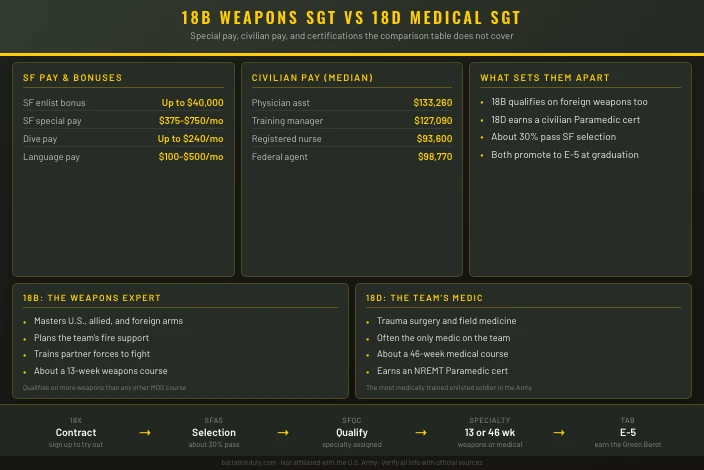
Quick Comparison
| Decision point | 18B Special Forces Weapons Sergeant | 18D Special Forces Medical Sergeant |
|---|---|---|
| Core role | Operates and maintains U.S., allied, and foreign weapons, plans fire support, and trains partner forces as a core member of a 12-person Operational Detachment-Alpha. | Provides trauma surgery, emergency, dental, and veterinary care for ODA teams and partner forces, builds field medical facilities, and trains others in medicine. |
| Test gate | ASVAB, plus a 50-meter swim assessment in uniform and Secret clearance eligibility. Reached through the 18X contract and the SF Qualification Course. | ASVAB, plus a 50-meter swim assessment in uniform and Secret clearance eligibility. Reached through the 18X contract and the SF Qualification Course. |
| Score summary | General Technical (GT) 110 minimum and Combat (CO) 100 minimum. AFQT 31 (diploma) or 50 (GED). | General Technical (GT) 110 minimum and Skilled Technical (ST) 100 minimum. AFQT 31 (diploma) or 50 (GED). |
| Training path | A 13-week weapons course within the Special Forces Qualification Course, after the shared SF pipeline and before language training and Robin Sage. | A roughly 46-week medical course (SOCM), the longest MOS course in the Army, within the Special Forces Qualification Course after the shared SF pipeline. |
| Work setting | Weapons-qualification ranges, medical and communication training, and joint exercises at the Group in garrison, then small forward operating bases or host-nation facilities when deployed. | A medical facility and team room at the Group compound, civilian Level 1 trauma centers during clinical rotations, and forward bases or partner clinics on deployment. |
| Deployment pattern | Higher tempo than conventional units, with 6-to-12-month deployments and frequent 30-to-90-day partner-force training trips. | Roughly 3 to 6 months deployed, then 6 to 12 months home, with frequent 2-to-6-week partner-force training trips. |
| Best fit | Self-directed, technically curious people who want to master every weapons system, teach foreign forces, and operate with high autonomy. | Science-oriented, self-disciplined people who want the most advanced enlisted medical training in the Army and can handle a two-to-three-year pipeline. |
| Less ideal if | People who prioritize geographic stability, regular family schedules, or a clearly defined daily routine, or who cannot accept that pipeline failure means the Army reassigns their MOS. | People who need a stable schedule or a supervised clinical setting, or who cannot accept MOS reassignment if they wash out of any pipeline phase. |
If you want to be the team’s weapons expert, start with the 18B Special Forces Weapons Sergeant profile. If you want to be its trauma medic, start with the 18D Special Forces Medical Sergeant profile.
Qualification Gates
You do not pick either job at enlistment. Both are assigned during the Special Forces Qualification Course after you sign the 18X contract, pass selection, and clear the 50-meter swim and Secret clearance. The split is in the test scores: the 18B needs a General Technical (GT) 110 and a Combat (CO) 100, while the 18D needs a GT 110 and a Skilled Technical (ST) 100.
The ST score is the lever for a medical slot, and the CO score points toward weapons. Score high across the board with our ASVAB study guide so the pipeline, not your test, decides your specialty.
Work Environment
Day to day, the two specialties work side by side on the same 12-person team. Both spend garrison time on ranges and in joint exercises at the Group, then deploy to austere forward operating bases and partner-force locations.
The difference is what each one owns on the team. The 18B is responsible for the team’s weapons and fire support, while the 18D is the only person who can run trauma care, surgery, and field medicine when no hospital exists.
Training Path
The pipeline length is what truly separates these two. After the shared Special Forces pipeline, the 18B completes a 13-week weapons course, qualifying on more U.S. and foreign weapons than any other MOS course.
The 18D path is far longer. Its medical course, called SOCM, runs about 46 weeks, the longest MOS course in the Army, and graduates leave with a civilian NREMT Paramedic certification.
Which One Fits You
Choose the 18B if you are drawn to weapons, fire support, and teaching partner forces to fight. Choose the 18D if you want the hardest enlisted medical training in the military and the job of keeping a team alive far from help.
Both wear the same Green Beret and both promote to Sergeant (E-5) at graduation. The real question is which skill you want to be the team’s expert in.
Both start with the same contract and the same test. Lock in your ASVAB score, ask a Special Operations recruiter about the 18X path, and compare other Army career guides before you commit.