18X Special Forces Candidate vs 11B Infantryman
Both contracts lead to Army ground combat, but they are very different bets. The 11B Infantryman gives you a guaranteed combat job on day one, while 18X is a tryout for Special Forces that most candidates do not finish.
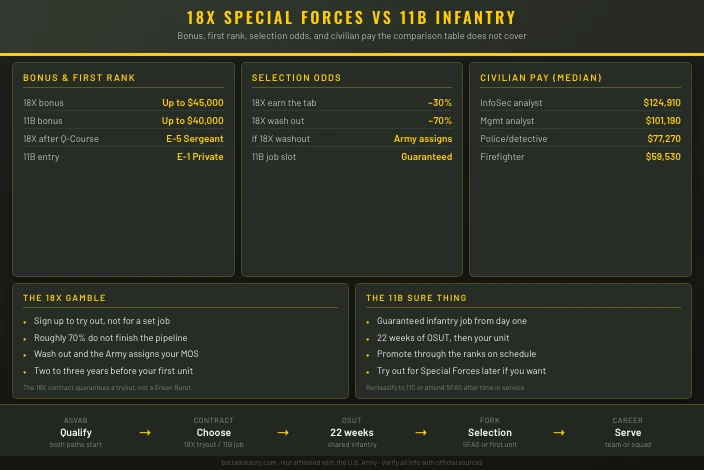
Quick Comparison
| Decision point | 18X Special Forces Candidate | 11B Infantryman |
|---|---|---|
| Core role | Enlistment contract on a direct path to Special Forces Assessment and Selection. Graduates earn one of four Green Beret specialties: 18B, 18C, 18D, or 18E. | Engages enemy forces in close combat, executes patrols and ambushes, secures terrain, and operates as part of a fire team and squad. |
| Test gate | ASVAB, plus a 50-meter swim assessment and Secret clearance eligibility. | ASVAB. No security clearance required for the standard assignment. |
| Score summary | General Technical (GT) 110 minimum and Combat (CO) 100 minimum. AFQT 31 (diploma) or 50 (GED). | Combat (CO) line score of 87 minimum. AFQT 31 (diploma) or 50 (GED). |
| Training path | Two to three years. Infantry OSUT at Fort Benning, Airborne School, Special Forces Assessment and Selection at Camp Mackall, the Qualification Course at Fort Bragg, SERE, and Robin Sage. | A single 22-week One Station Unit Training (OSUT) course at Fort Benning, Georgia, then straight to the first unit. |
| Work setting | Structured training sites during the pipeline, team rooms at your Group in garrison, and austere forward bases, safe houses, or partner-force camps when deployed. | Garrison home station, multi-week field rotations at training centers, and forward operating or patrol bases in any climate on deployment. |
| Deployment pattern | Higher tempo than conventional units. Roughly 3 to 6 months deployed, then 6 to 12 months home, with frequent 2-to-6-week training trips to partner nations. | Roughly 9 to 12 months deployed, then 18 to 24 months at home station. High-readiness units can deploy within 96 hours. |
| Best fit | Self-motivated people with sustained mental toughness who want to operate at the highest level of ground combat and can handle ambiguity, language learning, and years of hard training. | People who thrive on physical challenge, train hard without being told, and want the most traditional front-line ground-combat role the Army offers. |
| Less ideal if | People who need job security and predictability. Washing out of selection means the Army assigns your next job, and the pipeline costs two to three years with high attrition. | People who need a predictable schedule, want a job that maps to a civilian license, or have chronic joint, back, or knee problems. |
If you want a guaranteed spot in the close fight, start with the 11B Infantryman profile. If you want to chase the Green Beret and accept the risk of reassignment, start with the 18X Special Forces Candidate profile.
Qualification Gates
The ASVAB gates both jobs, but the score bar is not the same. The 11B needs a Combat (CO) line score of 87, one of the lowest in the Army. The 18X demands a General Technical (GT) score of 110 and a Combat (CO) score of 100, plus eligibility for a Secret clearance and a 50-meter swim test in uniform.
Age narrows it further. The 11B takes recruits from 17 to 39, while the 18X runs 19 to 32, with reclassification possible up to 36.
That score gap is the first real fork. A weak ASVAB can lock you out of 18X before your fitness ever matters, while the same result might still qualify you for 11B. Build the academic side early with our ASVAB study guide so the test never becomes the reason you miss the contract you want.
Work Environment
The 11B works in three settings: garrison at a home station, multi-week field rotations at training centers, and deployed patrol bases in any climate. The job centers on the fire team, squad, and platoon, and junior soldiers follow orders before they earn the freedom to make calls.
The 18X path looks different because the first two to three years are mostly training. After the pipeline, qualified Green Berets work from team rooms at their Group, then deploy to austere forward bases, safe houses, or partner-force camps. A 12-person team runs with high autonomy, often far from conventional support, with decisions pushed down to the lowest level.
Training Path
The 11B trains once. You complete a single 22-week One Station Unit Training (OSUT) course at Fort Benning, Georgia, then ship straight to your first unit as a qualified Infantryman.
The 18X path is the longest initial commitment in the Army. Plan for two to three years from enlistment to the Green Beret. The pipeline stacks Infantry OSUT, Airborne School, Special Forces Assessment and Selection at Camp Mackall, the Qualification Course at Fort Bragg, SERE, and a final unconventional-warfare exercise called Robin Sage.
Only about 30% of candidates who start the pipeline finish it.
Which One Fits You
Choose the 11B if you want a guaranteed combat role and you are ready to earn responsibility through the ranks. Choose the 18X if you are willing to gamble two to three years on one of the hardest selection programs in the military for a chance at a Special Forces team.
The risk is the true divider. Wash out of selection as an 18X and the Army assigns your next job for you. Sign for 11B and you know exactly what you are getting.
Either way, the test comes first. Lock in your ASVAB score before anything else, then talk with a recruiter about current contract availability. You can also compare other Army career guides before you commit.