19D Cavalry Scout vs 19K M1 Armor Crewmember
Both jobs live in the Army’s Armor branch and start with the same Fort Benning training, but one hunts information and the other delivers firepower. The 19D Cavalry Scout runs reconnaissance to find the enemy, while the 19K M1 Armor Crewmember fights from a 70-ton Abrams tank.
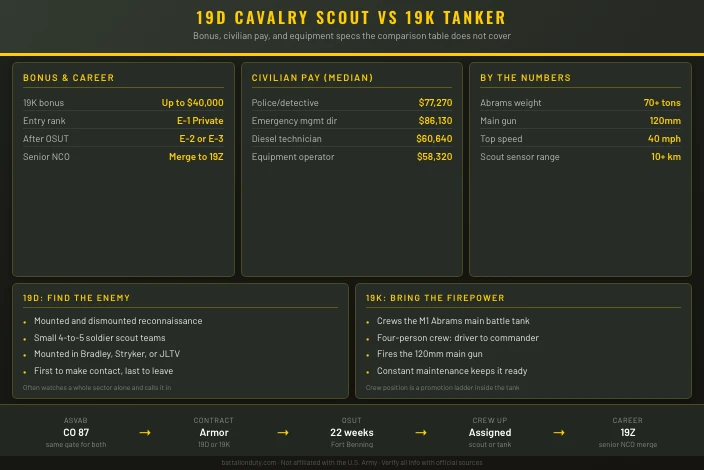
Quick Comparison
| Decision point | 19D Cavalry Scout | 19K M1 Armor Crewmember |
|---|---|---|
| Core role | Performs mounted and dismounted reconnaissance to locate enemy forces, identify terrain, and report battlefield conditions. Scouts are first to make contact and last to leave. | Operates, maintains, and fights the M1A2 Abrams main battle tank as one of a four-person crew, firing the 120mm main gun and mounted machine guns. |
| Test gate | ASVAB. No security clearance required at entry. | ASVAB. No security clearance required at entry; a maximum height of 6 feet 1 inch is enforced. |
| Score summary | Combat (CO) line score of 87 minimum. AFQT 31 (diploma) or 50 (GED). | Combat (CO) line score of 87 minimum. AFQT 31 (diploma) or 50 (GED). |
| Training path | A 22-week One Station Unit Training (OSUT) course at Fort Benning, Georgia: about 10 weeks of basic soldiering, then 12 weeks of scout skills. | A 22-week One Station Unit Training (OSUT) course at Fort Benning, Georgia: 10 weeks of basic soldiering, then 12 weeks on the Abrams, gunnery, and maneuver. |
| Work setting | Motor pools and observation posts in garrison, mounted in Bradley, Stryker, or JLTV, with multi-week field rotations and forward bases on deployment. | Motor pools and maintenance bays in garrison, range complexes in the field, and tactical positions on deployment, where interior temperatures can reach 130 degrees. |
| Deployment pattern | Roughly 9 months deployed, then 18 to 24 months at home station. Active-duty scouts deploy about once every 24 to 36 months. | Roughly 9 to 12 months deployed, then 24 to 36 months at home station, with 30-day rotations through the National Training Center. |
| Best fit | People who like being outside, working with machines, and making decisions without supervision, and who want a tactical front-line reconnaissance role. | Mechanically inclined people comfortable in confined spaces who thrive in a tight four-person crew and want heavy firepower with a clear promotion ladder. |
| Less ideal if | People who need a predictable schedule, dislike outdoor extremes, have chronic joint issues, or are uncomfortable with weapons and combat. | People over 6 feet 1 inch, who dislike confined spaces or extreme heat, need a predictable schedule, or have chronic back or knee problems. |
If you want to be the eyes of the force out front, start with the 19D Cavalry Scout profile. If you want to crew the Army’s main battle tank, start with the 19K M1 Armor Crewmember profile.
Qualification Gates
The entry bar is the same for both. Each needs a Combat (CO) line score of 87, one of the lower thresholds in the Army, and neither requires a security clearance to start. The 19K adds one physical gate the 19D does not: a maximum height of 6 feet 1 inch, because taller soldiers do not fit inside the tank.
The score is easy to hit, so the work is what filters people. Get your line score locked with our ASVAB study guide so you can pick the armor job you actually want.
Work Environment
The 19D works from observation posts and scout vehicles like the Bradley, Stryker, or JLTV, often as a 4-to-5-person team watching a sector alone. Scouts spend long stretches outside, watching and reporting before anyone else makes contact.
The 19K works inside the Abrams as one of a four-person crew. The tank is loud, cramped, and hot, with summer interior temperatures that can reach 130 degrees, and much of the job is the constant maintenance that keeps 70 tons combat-ready.
Training Path
Both pipelines run the same length: a 22-week One Station Unit Training (OSUT) course at Fort Benning, Georgia, with about 10 weeks of basic soldiering up front.
The back 12 weeks split by specialty. The 19D learns reconnaissance, surveillance, and scout gunnery, while the 19K learns to drive, load, and fire the Abrams and to maneuver as a crew.
Which One Fits You
Choose the 19D if you want to operate out front with a small team and make decisions on your own. Choose the 19K if you want heavy firepower and the tight crew bond of a tank.
The two paths actually converge at the top. At the senior enlisted level, both the 19D and 19K merge into the same 19Z Armor Senior Sergeant role.
The same test opens both. Lock in your ASVAB score, talk with a recruiter about armor contracts, and compare other Army career guides before you decide.