25B IT Specialist vs 17C Cyber Operations Specialist
Both jobs work in Army technology, but one keeps the networks running and the other goes on the attack. The 25B IT Specialist installs and maintains the systems units depend on, while the 17C Cyber Operations Specialist runs offensive and defensive cyber missions.
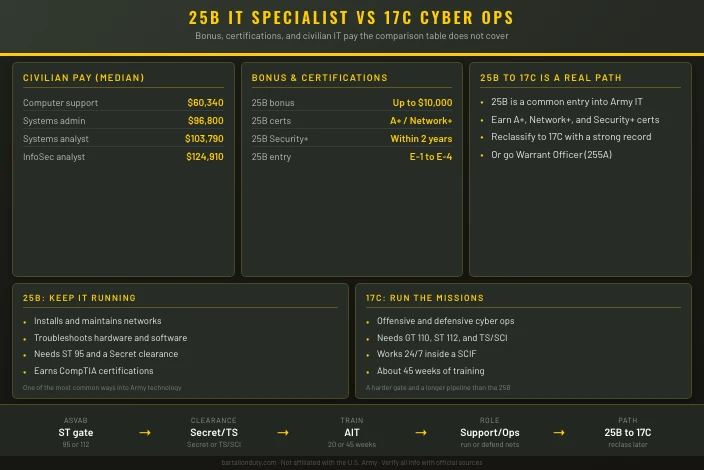
Quick Comparison
| Decision point | 25B IT Specialist | 17C Cyber Operations Specialist |
|---|---|---|
| Core role | Installs, configures, and maintains Army computers and networks, troubleshoots hardware and software, manages user accounts, and enforces cybersecurity policy on classified and unclassified networks. | Plans and runs cyberspace operations: defends Army networks, conducts authorized offensive cyber missions, performs digital forensics and malware analysis, and advises commanders on the cyber threat. |
| Test gate | ASVAB plus Secret clearance eligibility. | ASVAB plus Top Secret/SCI clearance eligibility. |
| Score summary | Skilled Technical (ST) line score of 95 minimum. AFQT 31 (diploma) or 50 (GED). | General Technical (GT) 110 minimum and Skilled Technical (ST) 112 minimum. AFQT 31 (diploma) or 50 (GED). |
| Training path | 10-week BCT, then a 20-week AIT at Fort Gordon, GA. About 30 weeks total. | 10-week BCT, then about 45 weeks of AIT: a 25-week course at Corry Station in Pensacola, FL, and a 20-week phase at Fort Gordon, GA. |
| Work setting | Server rooms, network operations centers, and offices in garrison, and tactical command posts and tents in the field and on deployment. | Almost entirely inside a Sensitive Compartmented Information Facility (SCIF) with no personal phones, running 24/7 operations on rotating 12-hour and night shifts. |
| Deployment pattern | Deploys with the assigned unit roughly every 24 to 36 months for 9 to 12 months, commonly to the Middle East, Europe, or the Pacific. | Many missions run from CONUS SCIFs with no overseas travel. Cyber Protection Team deployments run 6 to 9 months to the Middle East, Europe, or the Pacific. |
| Best fit | Curious, organized people who like troubleshooting under pressure and want paid IT training, industry certifications, and a Secret clearance that transfers well. | Curious, detail-oriented people with real interest in computers or networking who can handle shift work, ambiguity, and permanent restrictions on discussing their work. |
| Less ideal if | People who dislike extended computer work, need a predictable schedule, want an outdoor job, or struggle with attention to detail. | People who need predictable 9-to-5 hours, dislike long stretches of desk work, or cannot pass a Top Secret/SCI investigation. |
If you want broad IT and networking work you can enlist for now, start with the 25B IT Specialist profile. If you want cyber operations as the mission, start with the 17C Cyber Operations Specialist profile.
Qualification Gates
The bar is much lower for the 25B. It needs a Skilled Technical (ST) score of 95 and only a Secret clearance. The 17C needs a General Technical (GT) score of 110 and a Skilled Technical (ST) score of 112, plus a Top Secret/SCI clearance, which is a far harder gate.
Because the 25B is easier to qualify for, many soldiers start there and reclassify into 17C later. Build your line scores first with our ASVAB study guide so either door stays open.
Work Environment
The 25B works in server rooms, network operations centers, and offices, then sets up tactical network gear in tents and command posts on deployment. The job is keeping systems and users running day to day.
The 17C works almost entirely inside a SCIF, on 24/7 cyber operations with rotating shifts. Where the 25B keeps the network alive, the 17C uses access to that kind of network to run missions.
Training Path
The 25B trains for about 30 weeks: a 10-week Basic and a 20-week course at Fort Gordon, Georgia, built around CompTIA A+ and Network+ certifications.
The 17C path is much longer. After Basic, it runs about 45 weeks of training across Pensacola and Fort Gordon, reflecting how much more specialized the cyber-operations job is.
Which One Fits You
Choose the 25B if you want a practical IT career, industry certifications, and a job you can enlist straight into. Choose the 17C if cyber operations are the goal and you can clear the higher scores and the Top Secret investigation.
The two are not either-or for life. The 25B is one of the most common paths into Army technology, and reclassifying into 17C is a recognized next step once you have the record for it.
Both start with the ASVAB. Lock in your ASVAB score, ask a recruiter about the 25B and 17C requirements, and compare other Army career guides before you decide.