31B Military Police vs 31D CID Special Agent
Both jobs enforce the law for the Army, but one puts you on patrol now and the other makes you a felony investigator later. The 31B Military Police soldier is a direct-enlistment patrol role, while the 31D CID Special Agent is an accession-only job you reach with experience or a degree.
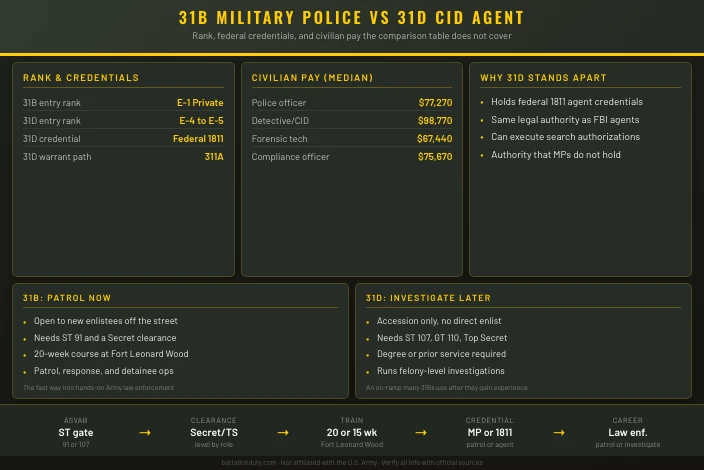
Quick Comparison
| Decision point | 31B Military Police | 31D CID Special Agent |
|---|---|---|
| Core role | Patrols Army installations, responds to emergencies, investigates crimes, processes evidence, and guards detainees. On deployment, shifts to area security, route clearance, and convoy escort. | Plans and conducts independent felony-level investigations (violent crime, fraud, cybercrime, drug trafficking) and carries federal special-agent credentials. |
| Test gate | ASVAB and Secret clearance eligibility. A valid state driver's license is required before training. | Not open at enlistment. Requires in-service reclassification or the CID direct-accession program (bachelor's degree), plus a Top Secret (SSBI) clearance. |
| Score summary | Skilled Technical (ST) line score of 91 minimum. AFQT 31 (diploma) or 50 (GED). | Skilled Technical (ST) 107 minimum and General Technical (GT) 110 minimum. AFQT 31 (diploma) or 50 (GED). |
| Training path | About 20 weeks of One Station Unit Training at Fort Leonard Wood, Missouri, combining basic and police training in one location. | A 15-week CID Special Agent Course at Fort Leonard Wood; direct-accession civilians first complete the 20-week 31B course, for about 35 weeks total. |
| Work setting | Patrol vehicle and MP station on rotating 8-to-12-hour shifts in garrison, and checkpoints, convoy routes, and forward bases on deployment. | A CID office with interview rooms and evidence storage, business-casual or civilian dress, and an unmarked sedan, plus crime scenes and protective details in the field. |
| Deployment pattern | Roughly 9 to 12 months deployed, then 24 to 36 months at home station. MP companies attached to brigade combat teams may deploy more often. | Roughly 9 to 12 months deployed on a 24-to-36-month cycle. Agents work felony cases in theater regardless of environment. |
| Best fit | People who want hands-on law enforcement right away, stay level-headed under stress, write well, and plan a civilian or federal law enforcement career. | Analytical, detail-oriented people who write well, manage their own caseload, want federal law-enforcement credentials, and hold a qualifying degree or prior service. |
| Less ideal if | People who dislike confrontation, need predictable hours, want a desk job, or have a record that blocks a Secret clearance. | People who prefer physical work, struggle with writing, need a predictable schedule, or have financial or legal issues that block a Top Secret SSBI. |
If you want hands-on police work straight out of training, start with the 31B Military Police profile. If you want to run felony investigations with federal credentials, start with the 31D CID Special Agent profile.
Qualification Gates
The two roles sit at very different points of a career. The 31B is open to new enlistees, needs a Skilled Technical (ST) score of 91 and a Secret clearance, and asks for a valid driver’s license before training. The 31D is not open at enlistment: it requires an ST of 107 and a GT of 110, a Top Secret (SSBI) clearance, and either prior service or a bachelor’s degree through the direct-accession program.
The 31B is where most people start, and for some it becomes the on-ramp to 31D later. Either path begins with the ASVAB, so build your line scores with our ASVAB study guide first.
Work Environment
The 31B works patrol: a vehicle and an MP station, rotating through 8-to-12-hour shifts in garrison, then checkpoints and convoy routes on deployment. The job is physical, public, and confrontational by nature.
The 31D works cases. A CID office looks like a detective bureau, with interview rooms, evidence storage, business-casual or civilian dress, and an unmarked sedan instead of a patrol car. The work is analytical and paperwork-heavy, built around making a case that holds up in court.
Training Path
The 31B trains once: about 20 weeks of One Station Unit Training at Fort Leonard Wood, Missouri, combining basic and police training in one place.
The 31D builds on top of that. The core school is the 15-week CID Special Agent Course, also at Fort Leonard Wood, and civilians entering through direct accession complete the 20-week police course first, for about 35 weeks total. Graduates earn federal special-agent credentials.
Which One Fits You
Choose the 31B if you want to be doing real law enforcement within a year and like working on your feet. Choose the 31D if you want to run complex investigations, you write well, and you can meet the rank, degree, and clearance bar.
For most people the honest path is 31B first. It gets you into Army policing fast and can set up a move to CID once you have the experience.
Both start with the test. Lock in your ASVAB score, talk with a recruiter about the MP and CID paths, and compare other Army career guides before you decide.