35F Intelligence Analyst vs 35M Human Intelligence Collector
Both jobs feed Army intelligence, but one builds the picture at a desk and the other gets it straight from people. The 35F Intelligence Analyst fuses reports into a threat assessment, while the 35M Human Intelligence Collector gathers raw information through interrogations and source meetings.
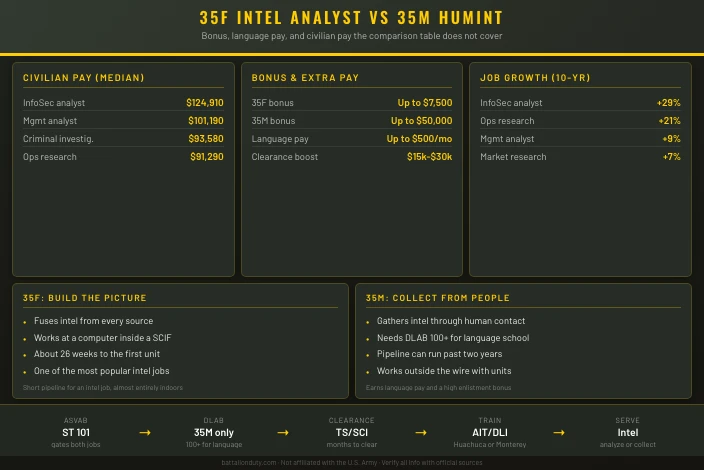
Quick Comparison
| Decision point | 35F Intelligence Analyst | 35M Human Intelligence Collector |
|---|---|---|
| Core role | Fuses intelligence from all sources (HUMINT, SIGINT, imagery, open source), produces threat briefings, maintains classified databases, and tells commanders what the enemy is likely to do next. | Collects intelligence through direct human contact: interrogations, source debriefings, document and battlefield screening, then reports what human sources reveal that machines cannot. |
| Test gate | ASVAB plus a Top Secret/SCI clearance investigation. | ASVAB plus the Defense Language Aptitude Battery (DLAB) for language training, and a Top Secret/SCI clearance investigation. |
| Score summary | Skilled Technical (ST) line score of 101 minimum. AFQT 31 (diploma) or 50 (GED). | Skilled Technical (ST) 101 minimum and DLAB 100 or higher for a language assignment. AFQT 31 (diploma) or 50 (GED). |
| Training path | 10-week BCT, then about 16 weeks of AIT at Fort Huachuca, AZ. Roughly 26 weeks total. | 10-week BCT, then 36 to 64 weeks of language school at the Presidio of Monterey, CA (if language-assigned), and 20 weeks of AIT at Fort Huachuca, AZ. The full pipeline can exceed two years. |
| Work setting | SCIFs, headquarters intelligence shops, and tactical operations centers, almost entirely indoors at a computer on classified networks. | SCIFs, tactical collection sites, and partner-nation facilities, often working outside the wire with combat units on deployment. |
| Deployment pattern | Roughly 9 to 12 months deployed, then 24 to 36 months at home station, working from brigade or battalion operations centers. | Roughly 9 to 12 months deployed, then 24 to 36 months at home station. Collectors with special operations or rapid-deployment units go more often. |
| Best fit | Detail-oriented, analytical people who enjoy solving puzzles with incomplete information, write and brief well, and want strong civilian transfer through a TS/SCI clearance. | Natural readers of people who are curious about other cultures and languages, comfortable talking to strangers under pressure, and willing to sit through a long training pipeline. |
| Less ideal if | People who need constant physical activity and hate desk work, struggle with writing, or have financial, drug, or foreign-contact issues that block a TS/SCI clearance. | People with no interest in foreign languages, who need a predictable schedule, who are uncomfortable with moral ambiguity, or who cannot pass a TS/SCI clearance. |
If you want to analyze intelligence from every source, start with the 35F Intelligence Analyst profile. If you want to collect it face to face, start with the 35M Human Intelligence Collector profile.
Qualification Gates
Both jobs need the same Skilled Technical (ST) score of 101 and a Top Secret/SCI clearance, so the background investigation is a real gate for either one. The 35M adds one more hurdle: the Defense Language Aptitude Battery (DLAB), where a score of 100 or higher opens language training.
The clearance can take months, and a weak ASVAB stops you before it even starts. Build the academic side with our ASVAB study guide so the line score is never the reason you miss an intel contract.
Work Environment
The 35F works almost entirely indoors. You sit at a computer inside a SCIF or a tactical operations center, building threat products on classified networks, which sets this job apart from most of the Army.
The 35M works in the opposite direction. You operate outside the wire with combat units, meeting sources and screening people at collection sites and partner-nation facilities.
Training Path
The 35F pipeline is short for an intelligence job: 10-week Basic and about 16 weeks of advanced training at Fort Huachuca, Arizona, for roughly 26 weeks total.
The 35M pipeline is one of the longest in the Army. If you are assigned a language, you add 36 to 64 weeks at the Defense Language Institute in Monterey before a 20-week course, and the full path can run past two years.
Which One Fits You
Choose the 35F if you like solving puzzles with incomplete information and want to start the job within a year. Choose the 35M if you want to work with people and languages and you are willing to spend years in training to do it.
Both careers ride on a clearance that transfers well to civilian work. A TS/SCI alone can add tens of thousands of dollars to a starting salary on the outside.
The ASVAB comes first for both. Lock in your ASVAB score, ask a recruiter about the DLAB if the 35M interests you, and compare other Army career guides before you commit.