68W Combat Medic vs 68C Practical Nursing Specialist
Both jobs put you in Army medicine, but one treats casualties in the dirt and the other treats patients in a hospital bed. The 68W Combat Medic works trauma in the field, while the 68C Practical Nursing Specialist gives bedside care in Army clinics and wards.
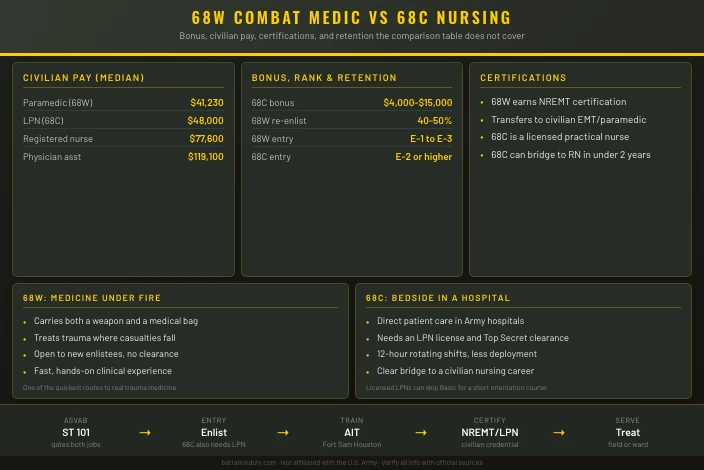
Quick Comparison
| Decision point | 68W Combat Medic | 68C Practical Nursing |
|---|---|---|
| Core role | Treats casualties under fire, runs sick call in garrison, manages medical supplies, and plans casualty evacuation. Carries both a weapon and a medical bag. | Provides direct patient care under physician and RN supervision in Army hospitals and clinics: vital signs, medications, wound care, documentation, and patient education. |
| Test gate | ASVAB. No security clearance required for most assignments. | ASVAB plus a state LPN license (or an Army path to it) and a Top Secret clearance. |
| Score summary | Skilled Technical (ST) 101 minimum and General Technical (GT) 107 minimum. AFQT 31 (diploma) or 50 (GED). | Skilled Technical (ST) 101 minimum and General Technical (GT) 107 minimum. |
| Training path | 10-week BCT, then 16 to 18 weeks of AIT at Fort Sam Houston, TX, covering trauma care, anatomy, and field medicine. | BCT can be waived for licensed LPNs, who attend a 2-to-4-week orientation instead, then 10 to 14 weeks of 68C AIT at Fort Sam Houston or a MEDCOM facility. |
| Work setting | Battalion aid stations and clinics in garrison, aid stations embedded with combat units in the field, and forward bases on deployment. | Army hospitals and clinics on 12-hour rotating shifts in garrison, aid stations in the field, and field or coalition hospitals on deployment. |
| Deployment pattern | Roughly 9 to 12 months deployed, then about two years at home station. High-readiness and special operations units deploy more often. | At least one major deployment in a four-year enlistment, and every 18 to 24 months when tempo is high, for 9 to 12 months each. |
| Best fit | Self-directed people who stay calm under fire, want real clinical experience fast, and plan to use the skills as a bridge to a civilian healthcare career. | Detail-oriented people who want hands-on patient care daily, plan on a civilian nursing career, and can handle rotating shifts and relocation. |
| Less ideal if | People who need a predictable schedule, cannot handle severe trauma or death, or have physical limits on carrying heavy loads in the field. | People who need a fixed schedule or real autonomy, cannot handle blood or sustained patient trauma, or cannot flex around shifts and deployments. |
If you want to treat casualties where they fall, start with the 68W Combat Medic profile. If you want clinical patient care and a direct line to a nursing career, start with the 68C Practical Nursing Specialist profile.
Qualification Gates
Both jobs ask for the same line scores: a Skilled Technical (ST) score of 101 and a General Technical (GT) score of 107. The barrier to entry is where they part ways. The 68W is open to new enlistees and needs no clearance, while the 68C requires a state LPN license (or an Army path to one) and a Top Secret clearance.
That license requirement makes the 68C a narrower door. Hit the ASVAB target first with our ASVAB study guide, since the line scores gate both jobs before anything else.
Work Environment
The 68W is the only Army job where you carry both a weapon and a medical bag. You run sick call in garrison, then treat trauma under fire on deployment, switching between pulling security and stopping a bleed.
The 68C works in a steadier setting. You give patient care on 12-hour rotating shifts in Army hospitals and clinics, and you deploy to field or coalition hospitals rather than to a patrol.
Training Path
The 68W trains every soldier the same way: 10-week Basic, then 16 to 18 weeks of advanced training at Fort Sam Houston, Texas, in trauma care and field medicine.
The 68C path bends around your license. A soldier who already holds an LPN license can skip Basic for a short two-to-four-week orientation, then move into 10 to 14 weeks of nursing training.
Which One Fits You
Choose the 68W if you want fast, hands-on trauma experience and can stay calm while treating casualties under fire. Choose the 68C if you want steady clinical work and a clear bridge to a civilian nursing career.
Both paths build real medical skills that transfer to civilian jobs. The 68W carries an NREMT certification into the EMT and paramedic world, and the 68C can finish a registered nursing degree in under two years after service.
The ASVAB gates both. Build your ASVAB score first, talk with a recruiter about the license and clearance steps, and browse more Army career guides before you choose.