Active vs Reserve Civil Affairs Officer: Which Route Fits You
Both Civil Affairs routes start the same way. You commission into some other branch, serve an initial tour, and then ask to transfer. What separates them is what happens after the transfer, and what the Army expects you to bring.
The two component specialties are 38S for the Active Component and 38A for the Reserve. The FY27 Civil Affairs chapter of DA Pam 600-3 distinguishes them by component and mission.
38S officers work in hostile, contested, denied or politically sensitive environments. 38A officers support conventional units and make civil knowledge useful to their planning. Neither one takes a direct commission at the lieutenant level.
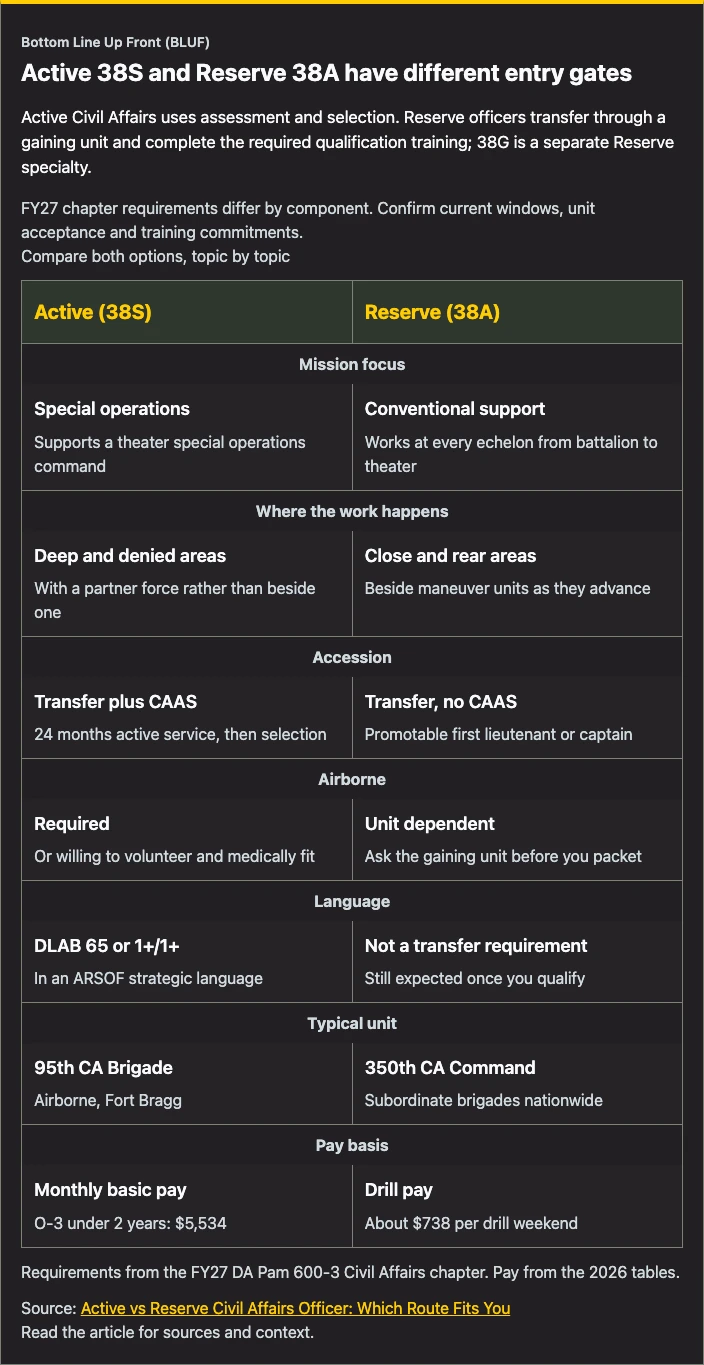
Active Civil Affairs uses assessment and selection. Reserve officers transfer through a gaining unit and complete the required qualification training; 38G is a separate Reserve specialty.
FY27 chapter requirements differ by component. Confirm current windows, unit acceptance and training commitments.
| Active (38S) | Reserve (38A) |
|---|---|
| Mission focus | |
| Special operationsSupports a theater special operations command | Conventional supportWorks at every echelon from battalion to theater |
| Where the work happens | |
| Deep and denied areasWith a partner force rather than beside one | Close and rear areasBeside maneuver units as they advance |
| Accession | |
| Transfer plus CAAS24 months active service, then selection | Transfer, no CAASPromotable first lieutenant or captain |
| Airborne | |
| RequiredOr willing to volunteer and medically fit | Unit dependentAsk the gaining unit before you packet |
| Language | |
| DLAB 65 or 1+/1+In an ARSOF strategic language | Not a transfer requirementStill expected once you qualify |
| Typical unit | |
| 95th CA BrigadeAirborne, Fort Bragg | 350th CA CommandSubordinate brigades nationwide |
| Pay basis | |
| Monthly basic payO-3 under 2 years: $5,534 | Drill payAbout $738 per drill weekend |
Requirements from the FY27 DA Pam 600-3 Civil Affairs chapter. Pay from the 2026 tables.
Source: Active vs Reserve Civil Affairs Officer: Which Route Fits You
Read the article for sources and context.
On this page
What each component does with Civil Affairs
Active duty Civil Affairs is a special operations force. A 38S officer supports a designated theater special operations command and builds partner capability, setting conditions for conventional forces that arrive later. The work happens in small teams, in denied areas, and with a partner force rather than beside one.
Reserve Civil Affairs is a conventional-force capability at every echelon from battalion to theater. A 38A officer develops the civil networks that let a maneuver force consolidate gains as it advances. The Reserve force is the larger of the two, and it is built to sustain a long conflict rather than to open one.
| Question | Active (38S) | Reserve (38A) |
|---|---|---|
| What the officer supports | A theater special operations command | Conventional units, battalion to theater |
| Where the work happens | Deep and denied areas, with partner forces | Close and rear areas, alongside maneuver units |
| Force size and purpose | Small, built to deploy fast and set conditions | Larger, built to sustain a long conflict |
| Who integrates the advice | SOF and joint special operations staffs | Conventional planners and civil-military operations cells |
| Typical unit | 95th Civil Affairs Brigade (Airborne) | 350th Civil Affairs Command and subordinate brigades |
The distinction matters more than it looks. A 38S officer is often the only person in the room who has assessed a partner government up close. A 38A officer is often the only person in a brigade who can turn that kind of assessment into something a maneuver commander can act on during planning.
The accession difference, side by side
Both routes begin with a branch transfer from another competitive category branch. The requirements diverge after that.
| Requirement | Active (38S) | Reserve (38A) |
|---|---|---|
| Minimum service | 24 months of active federal commissioned service by application approval | A successful initial tour as a small-unit leader |
| Grade at transfer | Company grade officer in another branch | Captain or promotable first lieutenant |
| Selection event | Civil Affairs Assessment and Selection, then ARSOF CCC and CAQC | No assessment and selection. CCC and CAQC through Reserve scheduling |
| Airborne | Qualified, or willing to volunteer and medically fit | Depends on the unit of assignment |
| Language | DLAB 65 or a 1+/1+ DLPT score in an ARSOF strategic language | Not listed among the branch transfer qualifications |
| Clearance | Secret, and eligible for TS/SCI | Valid clearance, and eligible for TS access |
| Processing | Special Operations Recruiting Battalion, target year groups by MILPER | USARC G1 request through IPPS-A |
Three things in that table deserve more than a glance.
The active route has a hard clock. You need 24 months of active federal commissioned service by the date your application is approved, and you apply inside a target year group announced by military personnel message. Miss the window and you need an exception to policy routed through the chain of command to the Civil Affairs proponent.
The Reserve route has no assessment and selection course, but it has a gate of a different kind. The gaining unit has to accept you. The FY27 chapter is explicit that unit leadership must recruit and accept only officers who meet the branch qualifications, because the Reserve assigns and then trains.
A willing officer with an unwilling unit is not a transfer.
The Reserve route also expects a promotable first lieutenant or captain. That is later than most people assume, and it is why Reserve Civil Affairs tends to draw officers who already have a few years of service behind them.
How the qualification sequence runs
Once a seat or a unit accepts you, the two routes stop looking similar. The active sequence is fixed and the Reserve sequence bends around a civilian schedule.
The FY27 chapter sets the active order. The Civil Affairs Future Readiness Officer at Human Resources Command schedules each step, and the officer is assigned to a Civil Affairs unit only after all of them:
- Civil Affairs Assessment and Selection.
- The Basic Airborne Course, if the officer is not already qualified.
- The ARSOF Captains Career Course or an equivalent.
- The Civil Affairs Qualification Course.
One detail in that list is easy to misread. The chapter says an officer is transferred to the Civil Affairs branch for management as an untrained officer once a class seat for assessment and selection is accepted. The specialty code itself is awarded only when the training is complete, so the sequence decides when you are a qualified Civil Affairs officer, not the transfer.
The Reserve path runs the other way around. You are accepted by a unit first. Then you complete the Captains Career Course, attending only phases II and III if you are already MEL 6 qualified in another branch, and finish with the qualification course through Reserve scheduling.
Nothing in the chapter requires a selection event before that coursework.
What the Reserve route does not ask for
This is where rumor does the most damage, because people repeat the active requirements as if they applied to both components.
You do not attend Civil Affairs Assessment and Selection on the Reserve route. CAAS is an active component gate, and it evaluates physical performance, written communication and cultural adaptability under stress. Reserve officers go straight to the qualification course through Reserve scheduling.
You are not required to be airborne qualified before you transfer. The FY27 chapter lists parachute qualification for 38A as depending on the unit of assignment. That is not the same as optional, and it is not the same as universal.
Ask the unit.
You are not required to hold a language score to transfer. The DLAB and DLPT thresholds sit in the 38S accession standards. Reserve branch transfer qualifications list BOLC, CCC, a clearance, promotable grade and medical standards.
Language still helps your career, and the branch expects officers to keep the skill once they have it.
What the Reserve route does ask for that people miss is the Captains Career Course. A Reserve officer who is already MEL 6 qualified attends only phases II and III of the Civil Affairs captains course to earn the qualification. An officer who has not completed CCC has more to do than the transfer packet suggests.
Where 38G fits, and where it does not
Military government officers are a third Civil Affairs specialty, and they are not a third route for a lieutenant.
38G is a Reserve-only specialty for captains through colonels. Entry runs through a selection panel in every case, whether the officer transfers from another branch or comes from a civilian occupation by direct commission. The qualification is a master’s degree aligned to one of the five functional specialty areas, at least 48 months of civilian work in a related focus area gained after that degree, and a clearance.
A 38G officer does not command Civil Affairs units. The specialty exists so a 38A or 38S commander has access to someone who has actually run a piece of government, and the chapter says the 38G works with a 38S or 38A who integrates that expertise into operations.
If you are a civilian with deep governance, public health, utilities or emergency management experience, the 38G military government specialty is the page to read next. If you are a junior officer looking for a branch, 38G is not open to you yet.
Pay, time and the commitment gap
Active and Reserve pay are not two versions of the same number, and comparing a monthly figure to a drill weekend is how people talk themselves into the wrong decision.
An active duty O-3 with less than two years of service earns $5,534 a month in basic pay for 2026, before allowances. A Reserve O-3 in the same grade earns about $738 for a standard drill weekend, which is four drill periods, plus annual training paid at the daily rate. These rounded examples use the 2026 officer basic-pay table.
The Reserve figure pays for four drill periods, not a month of full-time service.
The benefit structure follows the same split. Active duty allowances depend on entitlement and circumstances, with housing and subsistence separate from basic pay. Qualifying active service also carries TRICARE coverage and a retirement path under the applicable retirement system.
Eligible drilling Reserve members can buy TRICARE Reserve Select, with a 2026 member-only premium of $57.88 per month. Reserve retired pay is points-based and generally begins at age 60, with a reduced eligibility age possible for qualifying service.
The time commitment differs by more than the pay does. Reserve service is one weekend a month and two weeks a year on paper. Civil Affairs adds qualification courses, language sustainment, interagency exercises and pre-mobilization training on top, so applicants should request the gaining unit’s actual annual training calendar and expected school periods before estimating the time away from civilian work.
Which route fits you
Before comparing the two routes as career choices, compare the commitments you can meet. An officer seeking the active route must be prepared for its selection and qualification sequence, not just attracted to the mission. An officer seeking the Reserve route must identify a compatible unit and make room for schooling as well as ordinary unit training.
Fit schooling around civilian work
Consider a serving officer who has a stable civilian job and can attend monthly drills but has little flexibility for resident courses. A nearby Reserve unit may make routine travel manageable, but proximity does not shorten the required military education. The useful next conversation is about course dates, any credit for already completed education, and the periods for which the officer will need leave from civilian employment.
Check the active transfer window
Now consider an active duty officer approaching a transfer window. The questions are eligibility within the announced year group, readiness for assessment and selection, and the sequence of follow-on training. A Reserve unit’s willingness to accept a different officer does not establish that this officer qualifies for active Civil Affairs or can bypass its selection event.
These examples are planning scenarios, not accounts of particular applicants. They show why the word “transfer” hides different practical decisions. One route centers on a selection and training sequence; the other begins with a gaining organization and then requires the officer to complete the applicable qualification.
Plan the commitment after qualification
The same distinction matters after qualification. Ask the active career manager about the expected assignment path, and ask the Reserve unit about its actual training and mobilization requirements. Neither the branch chapter nor a general recruiting description establishes a fixed deployment schedule for an individual officer.
For a Reserve applicant, request the next training calendar and identify which events are additional to monthly drills. For an active applicant, confirm when a branch transfer, course reservation and assignment become effective. Written dates and conditions are more useful for planning than an informal assurance that the route should work.
Weigh the two career choices
Choose active duty if you want the special operations mission and you are willing to compete for it. That means an assessment and selection course you can fail, airborne training, a language requirement you have to maintain, and a career concentrated at Fort Bragg with frequent deployments. The reward is work that few officers in any branch get to do.
Choose the Reserve if you want Civil Affairs without leaving the career you already built. That means finding a unit willing to take you, waiting until you are a promotable first lieutenant or captain, and carrying a second job’s worth of duty days. The reward is a mission that overlaps directly with civilian work in government, development and emergency management.
Do not choose the Reserve because someone told you it is the easy way into Civil Affairs. The transfer is less selective than CAAS, but the qualification course, the language expectations and the mobilization cycle are real.
What to do next
If you are already commissioned, ask your branch manager and your unit leadership about the current target year group and whether a Civil Affairs unit near you will accept a transfer packet. The FY27 chapter sets the requirements. The military personnel message sets the window.
If you have not commissioned yet, the decision comes earlier than Civil Affairs. The branch you commission into is the branch you will transfer from, so read the officer paths guide and the active versus Reserve comparison before you choose. OCS candidates also need a General Technical score of 110, and our ASVAB for OCS guide covers how to reach it.
For the single-specialty detail behind this comparison, read the 38A Civil Affairs officer profile. For the broader component question, the active duty versus Reserve versus Guard comparison covers the differences this page leaves out.