Army Intelligence Disciplines for Officers: HUMINT, SIGINT, GEOINT and CI
An officer does not choose an intelligence discipline at commissioning. Military Intelligence officers begin as 35A, and the August 2026 Military Intelligence chapter says the gaining unit’s mission decides which single-source discipline an officer is trained in.
That detail surprises people who assume HUMINT, SIGINT and GEOINT are separate officer career fields. They are disciplines an officer acquires, not branches an officer joins.
This page covers how that works, what each discipline asks of an officer, and how to build a record across more than one.
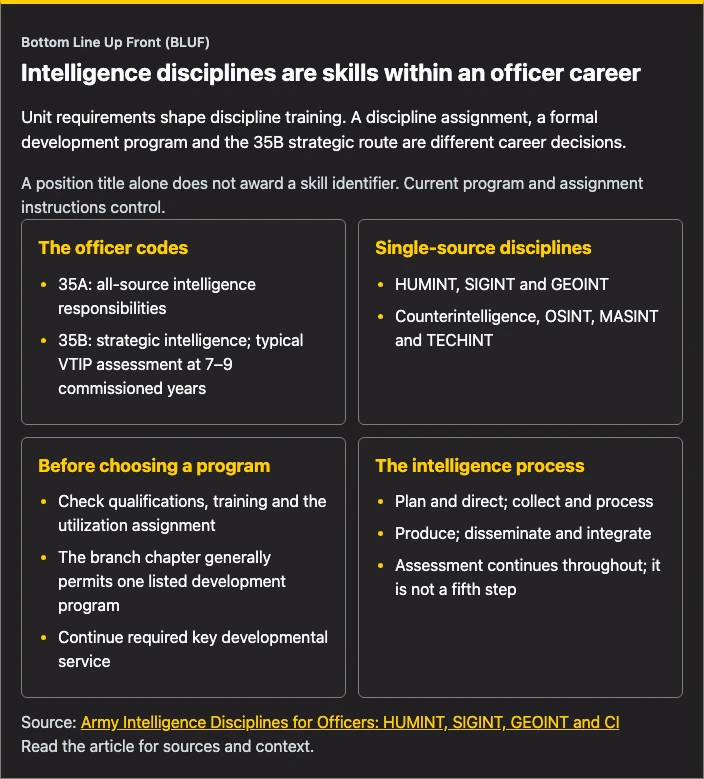
Unit requirements shape discipline training. A discipline assignment, a formal development program and the 35B strategic route are different career decisions.
A position title alone does not award a skill identifier. Current program and assignment instructions control.
The officer codes
- 35A: all-source intelligence responsibilities
- 35B: strategic intelligence; typical VTIP assessment at 7–9 commissioned years
Single-source disciplines
- HUMINT, SIGINT and GEOINT
- Counterintelligence, OSINT, MASINT and TECHINT
Before choosing a program
- Check qualifications, training and the utilization assignment
- The branch chapter generally permits one listed development program
- Continue required key developmental service
The intelligence process
- Plan and direct; collect and process
- Produce; disseminate and integrate
- Assessment continues throughout; it is not a fifth step
Source: Army Intelligence Disciplines for Officers: HUMINT, SIGINT, GEOINT and CI
Read the article for sources and context.
On this page
The two officer codes and the disciplines beneath them
Military Intelligence has two officer areas of concentration. Officers begin as 35A Intelligence Officer, and a smaller number are assessed later into 35B Strategic Intelligence.
Everything else is a discipline or a complementary capability. The chapter lists single-source disciplines, then a second set of capabilities that depend on the unit and the circumstances.
| Group | What belongs in it |
|---|---|
| Officer AOCs | 35A Intelligence Officer, 35B Strategic Intelligence Officer |
| Single-source disciplines | Counterintelligence, GEOINT, HUMINT, MASINT, OSINT, SIGINT, TECHINT |
| Complementary capabilities | Biometrics, cyberspace, document and media exploitation, electromagnetic warfare, forensics, identity activities, space |
| Analysis | Intelligence analysis and exploitation |
That structure explains a common confusion. A lieutenant who spends three years in a SIGINT battalion is not a SIGINT officer in the way a signal officer is a signal officer. The officer holds 35A and carries skill identifier training the unit needed.
What each discipline asks of an officer
The disciplines differ in what they collect and how the officer leads the effort. The short version below describes the work, not a course list.
| Discipline | What the officer does with it |
|---|---|
| HUMINT, information from people | Sets collection requirements, manages source operations within legal limits, and leads the soldiers who conduct them |
| SIGINT, foreign signals | Plans collection, manages the interface with national agencies, and turns reporting into usable intelligence |
| GEOINT, imagery and geospatial data | Directs collection and production, and integrates terrain and imagery into the commander’s picture |
| Counterintelligence, threat from foreign intelligence | Directs investigations and force protection support, and advises the command on the threat |
| OSINT, publicly available information | Sets requirements, judges source reliability, and integrates the product with classified reporting |
| MASINT, sensor measurement and signature | Directs technical collection and interprets what the sensors measured |
| TECHINT, foreign equipment and technology | Coordinates exploitation and turns technical findings into threat understanding |
The chapter’s warning about skill identifiers matters here. A discipline is assigned because a unit needs it, so an officer may serve in one for a tour and then move to another.
How officers actually acquire a discipline
Three routes exist, and they look different on a record.
The first is assignment. The gaining unit’s mission determines the relevant discipline training. Award of a skill identifier still depends on the applicable qualification requirements; an assignment title alone does not establish that every qualification has been completed.
The second is a formal program. The chapter names several, each tied to a specific identifier and a utilization assignment afterward.
- Army Intelligence Development Program, counterintelligence track, skill identifier 3E, two years at Fort George G. Meade
- Army Intelligence Development Program, cyber track, two years at Fort George G. Meade
- Junior Officer Cryptologic Career Program, skill identifier 3W, twelve months of technical training with the National Security Agency
- Junior Officer Geospatial Intelligence Program, twenty-four months ending in skill identifier S1D, with six months at the National Geospatial-Intelligence Agency college
The third is graduate education, which applies to strategic intelligence rather than to a single source. The 35B strategic intelligence profile covers that route.
The chapter allows an officer to participate in only one of these programs as a rule. That constraint is worth knowing before volunteering for the first one offered.
What officers do that collectors do not
Enlisted soldiers in the same disciplines collect, process and report. Officers plan, resource and answer for the result.
The chapter frames that through the intelligence warfighting function’s tasks: support to force generation, support to situational understanding, information collection, and support to targeting. An officer’s discipline knowledge is the tool used to do those four things.
The practical difference shows up in a staff meeting. A collector answers whether the reporting is good. The officer answers what the command should collect next, what it is worth spending on, and what the commander may safely assume.
| Enlisted in the discipline | Officer over the discipline | |
|---|---|---|
| Daily focus | Collect, process and report | Set requirements, resource collection, answer for the product |
| Typical position | Analyst, collector or operator | S2, collection manager or discipline lead |
| Career marker | Technical depth in one discipline | Breadth across disciplines by field grade |
For the enlisted side of the same disciplines, read the 35F versus 35G versus 35L comparison.
Assignment patterns that build breadth
The chapter’s captain key developmental assignments are where breadth begins. Captains serve at least twelve months in one of four roles: battalion or squadron S2, company or Security Force Assistance Brigade commander, brigade or group assistant S2, or target officer.
Each of those jobs sits next to a different discipline. A target officer works closely with GEOINT and SIGINT. A battalion S2 integrates whatever the battalion can get.
Majors then move to division and corps assignments, where the chapter expects a balance of division, echelon above corps, and joint work. That mix is how an officer learns to weigh disciplines against each other.
Where the complementary capabilities fit
The second list in the chapter covers capabilities that belong to a unit rather than to a discipline. They are worth knowing because they appear in assignments and in requirements.
- Biometrics and identity activities, which answer who a person is
- Document and media exploitation, which answers what captured material contains
- Forensics, which answers what happened to an object or a person
- Electromagnetic warfare and cyberspace, which act on the environment rather than only observing it
- Space, which moved into its own basic branch in June 2026
An officer who understands how those capabilities feed a requirement will write better collection plans than one who treats them as somebody else’s lane.
A separate path: the MIECP
The Military Intelligence Excepted Career Program, nicknamed GREAT SKILL, is a Department of the Army G-2 program for officers conducting sensitive and strategic intelligence operations.
It is not a discipline and not a skill identifier. Every assignment in it is key developmental, and officers are managed by the Special Management Division for the length of their career rather than following the standard assignment cycle.
The chapter says MIECP officers serve in progressive, repetitive assignments of increasing responsibility that fall outside the traditional career path. The chapter explains that classified evaluations identify an officer’s MIECP affiliation under AR 614-115. That is a rule for recording membership, not a description of candidate selection; ask the responsible personnel office about current selection procedures rather than inferring them from an evaluation rule.
If you are offered this path, treat it as a career decision rather than a tour. The work is closer to national operations than to a battalion staff.
The process an officer actually runs
Discipline knowledge only matters because it feeds a cycle. The chapter describes the Army intelligence process as four steps:
- Plan and direct.
- Collect and process.
- Produce.
- Disseminate and integrate.
Five activities continue across all four: synchronize, conduct intelligence operations, perform analysis and exploitation, analyze, and assess.
An officer’s discipline decides where in that cycle they are strongest. A SIGINT officer is deepest in collection management, and a GEOINT officer is deepest in processing and production.
Assessment continues throughout the process; it is not a separate fifth step or an activity reserved for CI officers. Discipline expertise contributes where the requirement calls for it, while officers remain responsible for integrating the result with other reporting.
That is also why the branch pushes officers across assignments. An officer who has only ever worked one step cannot plan the whole cycle.
Choosing depth or breadth
Depth pays off in a discipline-heavy assignment, where the officer who knows the collection system and the agencies behind it is worth more than a generalist. Breadth pays off at battalion and brigade level, where the officer has to integrate everything at once.
The chapter’s structure suggests the Army wants both, sequenced. Company-grade years buy depth through unit-driven skill training. Field-grade years demand breadth across echelons.
If you are choosing now, pick the assignment that puts you closest to a requirement you will have to answer for. The skill identifier follows the work.
How to compare an assignment with a program
A discipline name tells an applicant less than the actual position description. Before volunteering, identify the supported headquarters, the collection or analysis responsibility and the training attached to the billet. A SIGINT-related staff job, for example, need not have the same duties or preparation as a cryptologic development program.
The branch chapter separates ordinary assignments from programs with a defined training and utilization sequence. A program can require time away from the normal unit cycle, followed by work that uses the newly acquired skill. Compare the full sequence rather than just the school name or the location of its first course.
Cryptologic and geospatial program commitments
For the Junior Officer Cryptologic Career Program, the chapter describes twelve months of specialized technical training followed by work-center tours, and then a utilization assignment. Calling it only a twelve-month course would leave out much of the commitment. Ask the program office to confirm the current sequence and availability before making family or career plans around it.
The Junior Officer Geospatial Intelligence Program is described as a twenty-four-month program with an academic period, operational tours and GEOINT certifications. Those details explain why it is more than attendance at a single school. Its purpose is to develop an officer who can lead GEOINT work, not simply to add a credential to a record.
The chapter generally limits selected officers to one of the listed programs. That makes the choice consequential, but it does not mean an officer can never learn another discipline through later assignments. A named development program and ordinary branch experience are different forms of preparation.
A worked example: one requirement, several disciplines
Suppose a staff needs to assess whether a transport route can support a planned operation. GEOINT can help describe the terrain and visible infrastructure, while other reporting may address threats or activity along the route. Publicly available material can add context, but it must be judged for reliability rather than accepted because it is easy to obtain.
This is an illustrative planning problem, not a claim about a particular operation. The officer’s work begins by defining what the commander needs to know and when the answer is needed. The staff can then identify which sources can answer each part, where access or collection limits apply, and what remains uncertain.
An officer who knows only one collection method may frame every gap as a request for more of that method. An officer who understands several disciplines can compare their strengths and limitations. The goal is a supported assessment that answers the requirement, including the information that is still missing.
The example also explains why discipline knowledge does not transfer command authority over every source. Collection responsibilities, permissions and reporting arrangements depend on the assignment and applicable rules. Technical familiarity helps an officer ask better questions; it does not remove those limits.
Questions to ask before pursuing a specialty
Start with the position or program you can actually pursue. Ask what qualifications are required before arrival, what training the organization will arrange and which identifier, if any, successful completion can award. This separates a genuine development opportunity from an assumption based on a unit’s mission.
Next, ask how the assignment fits required branch development. The chapter requires officers to complete key developmental work at each grade even while building discipline expertise. A technically appealing assignment should therefore be considered alongside the officer’s remaining leadership and education requirements.
Finally, confirm the utilization obligation and the likely timing of a return to the normal assignment cycle. The public chapter supplies a career framework, but it is not a vacancy list or an individual school reservation. Use the current program announcement and the responsible personnel office for those decisions.
An interest in HUMINT or SIGINT is a useful starting point for that conversation, but it is not evidence of an available billet. Ask for the position’s actual responsibilities and required qualifications before comparing it with another opportunity. This keeps a preference for a discipline separate from a commitment the Army has actually offered.
More information
Your branch manager controls assignment to the programs listed above, and the Military Intelligence proponent at the Intelligence Center of Excellence owns the current discipline and identifier rules.
- Branch basics, commissioning and pay: 35A Military Intelligence officer profile
- The later-career strategic route: 35B strategic intelligence officer
- Commissioning options before any of this applies: how to become an officer