Army Signal vs Cyber vs FA26: Which Officer Route Fits You
Signal officers lead Army communications, Cyber officers conduct cyberspace and electromagnetic operations, and FA26 officers engineer network and data systems. Signal and Cyber are basic branches; FA26 is a functional area of the Signal Regiment. The entry routes differ, but qualified civilians can apply to direct commission into FA26 without first serving as Signal or Cyber officers.
The Signal branch builds and defends the Army’s communications. The Cyber branch fights in and through cyberspace. FA26, Data Network Engineering, engineers the Army’s portion of the DoD Information Network as a functional area of the Signal Regiment.
If you are choosing between them, the question is not which is more technical. All three are technical. The question is whether you want to run networks, fight in them, or engineer them.
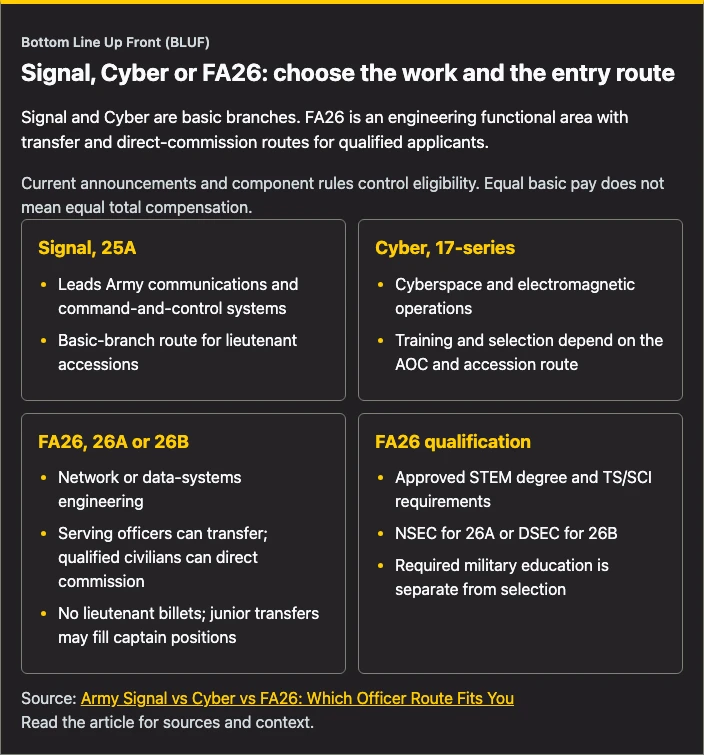
Signal and Cyber are basic branches. FA26 is an engineering functional area with transfer and direct-commission routes for qualified applicants.
Current announcements and component rules control eligibility. Equal basic pay does not mean equal total compensation.
Signal, 25A
- Leads Army communications and command-and-control systems
- Basic-branch route for lieutenant accessions
Cyber, 17-series
- Cyberspace and electromagnetic operations
- Training and selection depend on the AOC and accession route
FA26, 26A or 26B
- Network or data-systems engineering
- Serving officers can transfer; qualified civilians can direct commission
- No lieutenant billets; junior transfers may fill captain positions
FA26 qualification
- Approved STEM degree and TS/SCI requirements
- NSEC for 26A or DSEC for 26B
- Required military education is separate from selection
Source: Army Signal vs Cyber vs FA26: Which Officer Route Fits You
Read the article for sources and context.
On this page
Three routes, two branches and a functional area
Signal and Cyber are basic branches, which means officers commission into them. Signal officers hold AOC 25A. Cyber officers hold one of the 17-series AOCs.
FA26 is different in kind. It is a functional area of the Signal Regiment with its own AOCs, and the FA26 chapter is explicit that it has no lieutenant positions at all.
That single fact changes everything about how you enter it. FA26 is not an ordinary lieutenant branching option. Serving officers can transfer, and qualified applicants can seek direct appointment into captain-or-higher billets through the Army Direct Commission Program.
| Route | What it is | Officer code |
|---|---|---|
| Signal | A basic branch of the Army, part of the Signal Regiment | 25A |
| Cyber | A basic branch that fights in and through cyberspace | 17A, 17B, 17D |
| FA26 | A functional area of the Signal Regiment for network and data engineering | 26A, 26B, then 26Z at colonel |
What each route actually does
The missions differ more than the technology does.
| Route | The mission in one line | Where the work sits |
|---|---|---|
| Signal | Install, operate and defend the Army’s communications networks and mission command systems | Every echelon, from battalion to theater |
| Cyber | Conduct and enable cyberspace operations, including defense and electromagnetic warfare | Cyber organizations and joint cyberspace commands |
| FA26 | Engineer the Army portion of the DoD Information Network as one end-to-end network, from the strategic core to the tactical edge | Enterprise, regional and theater network organizations |
The FA26 chapter describes the mission as leading teams of technical soldiers, warrant officers and civilians, and managing complex information technology projects. That is engineering leadership rather than either of the other two.
How officers get into each route
Entry is where the three routes diverge hardest.
| Route | Entry | What it requires |
|---|---|---|
| Signal | Commission into the branch | Standard officer accession, then the Signal basic officer course |
| Cyber | Commission, then qualify | CyBOLC for 17A, the CEWO qualification course for 17B after 17A, direct selection for some 17D |
| FA26 | Transfer by VTIP or direct commission | Four-year STEM degree, and a transfer window that opens as a captain |
The FA26 chapter sets out these entry distinctions:
- There are no lieutenant positions. Junior first lieutenants who transfer early fill captain positions.
- VTIP boards run semi-annually to annually, not on a fixed annual date.
- A four-year STEM degree is required, against the accepted STEM degree memorandum rather than any technical degree.
- Direct commissioning exists for qualified civilians, and constructive credit is available.
- Reserve and National Guard accession has its own rules.
The chapter also notes that nominative assignments, such as the White House Communications Agency or the 75th Ranger Regiment, should be filled after 24 months in a non-nominative assignment.
The FA26 difference, in plain terms
The July 2026 FA26 career chapter distinguishes a position’s grade from the route used to enter the field. There are no lieutenant positions, although first lieutenants selected for early transfer may fill captain positions. That does not close the route to civilians: the same chapter expressly permits direct commissioning.
For a cadet or OCS candidate, Signal and Cyber are the relevant basic-branch choices in this comparison. For an experienced civilian engineer, the question is different: whether a direct-commission board will recognize the degree, technical work and leadership experience needed for FA26. Neither route guarantees selection or a preferred assignment.
A serving officer considering transfer should compare the engineering career with the command and staff work in the current branch. FA26 officers retain leadership responsibilities, but their development centers on technical assignments rather than following the same assignment sequence as a 25A officer.
What the daily work looks like
Signal: A Signal officer at battalion level runs the communications shop and answers to a commander who needs the network up. The work is part operations, part acquisition, part personnel.
Cyber: A Cyber officer works in a team that plans or conducts cyberspace operations, often alongside national agencies and under authorities that constrain what the team may do.
FA26: An FA26 officer manages engineering projects and technical teams, often across installations and theaters, with a schedule measured in fielding cycles rather than battle drills.
None of those is more senior than the others at the same grade. They are different jobs with different customers.
Pay is the same on all three routes
Officer pay is set by grade and years of service, not by branch or functional area. A captain in Signal, a captain in Cyber and a captain in FA26 at the same grade and service time earn the same basic pay.
What differs is what an assignment adds. Language pay applies where a proficiency is tested, and deployment pays apply in qualifying locations. Special and incentive pays depend on separate eligibility and current service policy; an AOC title alone is not an offer of extra pay.
Equal grade and service time establish equal basic pay, not necessarily equal total compensation. Compare the same duty status and location, then check any actual incentive agreement separately.
What to do before you choose
If you are pursuing a standard lieutenant commission, compare Signal and Cyber through the available branching process. An experienced civilian considering direct commissioning should also investigate FA26. A technical degree helps, and the officer paths guide covers the routes that lead to either branch.
For FA26 the STEM degree is the filter that matters most, and it applies before any board sees the file. The chapter treats a four-year STEM degree against the accepted memorandum as an entry ticket rather than a preference.
If you already serve, ask your branch manager for the current VTIP window. FA26 boards run semi-annually to annually, so there is no single annual date to plan around.
Which route fits which interest
- Choose Signal if you want to command communications soldiers early and see your work in every operation the Army runs.
- Choose Cyber if you want to operate in cyberspace and are comfortable with authorities, legal limits and joint structures.
- Consider FA26 if you want engineering leadership and meet the degree and technical requirements for transfer or direct commissioning.
Two cautions are worth stating. Cyber and FA26 both select rather than accept, so interest alone does not get you there. And FA26’s STEM requirement filters candidates before any board sees them.
Before commissioning, distinguish a basic-branch application from a direct-commission application. Signal and Cyber are the basic-branch options here; eligible experienced civilians may also apply for FA26 direct commissioning. The officer paths guide covers the commissioning routes that lead to either.
Where the enlisted comparison ends
This page compares officer routes. The enlisted version of the same question is a different one, because enlisted soldiers enter a military occupational specialty rather than a branch.
If you are weighing the enlisted fields, read the cyber versus signal MOS comparison. It covers ASVAB scores, training pipelines and clearance differences that do not apply to officers.
For the branch detail behind this comparison, read the Signal officer profile and the Cyber officer profile. For the AOC differences inside Cyber, the 17A versus 17B versus 17D comparison covers them.
What qualification requires after selection
Required courses and officer codes
Selection does not complete FA26 qualification. AOC 26A officers qualify through the Network Systems Engineering Course (NSEC), while 26B officers qualify through the Data Systems Engineering Course (DSEC). Officers without the required prior captains-course preparation also need the applicable Signal Captains Career Course.
The distinction between 26A and 26B matters before an applicant builds a packet. Network Systems Engineering focuses on secure communications infrastructure, network architecture and connectivity. Data Systems Engineering focuses on data services, servers, databases and the systems that let users store, process and share information.
Experience and security eligibility
An applicant’s preference is one consideration in AOC designation, alongside academic background, certifications and the Army’s needs. A person with strong software and database experience should explain that work directly rather than assume all technical experience leads to the same FA26 assignment. A person with a network-engineering background should do the same for infrastructure design, integration and troubleshooting.
The FA26 chapter also requires eligibility for and maintenance of TS/SCI access. It states that direct-commission candidates who fail to obtain the required clearance or complete required military education may be allocated to another branch according to Army needs. Technical selection, security eligibility and course completion are therefore separate gates.
Course credit and scheduling
Constructive course credit is available for relevant knowledge gained through education, training or experience. It is an application for recognition of equivalent preparation, not an automatic exemption based on years in industry. Ask which specific course might be credited and who must approve the request before planning time away from work.
Designation also creates a training-planning obligation. The FA26 chapter says selected officers transfer from their basic branch to begin qualification within twelve months of designation. A serving applicant should therefore discuss release from the current assignment and course scheduling before treating selection as a distant career option.
Ask how the proposed course sequence fits the first utilization assignment. Approval of constructive course credit, where available, and assignment to a billet are separate administrative decisions. Keep the written decisions together so that a changed school reservation does not become an assumption that a qualification requirement disappeared.
Three applicants, three different next steps
College student: Consider a college student who wants to lead communications soldiers soon after commissioning. Signal is the direct basic-branch comparison with Cyber, and the student should examine the actual branch-selection requirements. FA26 can remain a later goal, but it is not a lieutenant billet the student can simply select on the same basis.
Civilian engineer: Now consider an experienced civilian engineer who already manages network or data projects. That person should examine the FA26 direct-commission criteria before assuming an initial tour in another branch is compulsory. The packet must show the technical qualifications and leadership experience the Army seeks, and the offered grade and component depend on the approved appointment.
Serving officer: Finally, consider a serving first lieutenant or captain who prefers engineering to the current assignment sequence. The relevant question is the current VTIP eligibility and application window, including any early-transfer exception. Existing military experience helps describe the officer’s record, but it does not replace the STEM-degree or clearance requirements.
These examples describe how to frame an application decision, not predictions of selection. Each applicant still needs the current announcement and a review of the actual record. A favorable conversation with a recruiter or branch manager is not a board result.
Comparing Active, Reserve and Guard opportunities
An officer route is only useful if it exists in the component the applicant intends to join. The FA26 chapter includes separate Army Reserve and National Guard development guidance and describes component-specific direct-commission management. An active-duty application window should not be assumed to cover a Guard appointment or a Reserve vacancy.
For a part-time applicant, the practical questions include where the authorized billet is located, whether a gaining organization has accepted the applicant, and how resident qualification courses fit with civilian employment. A civilian technical career may provide relevant experience, but it does not remove military training or readiness obligations. Confirm the actual unit and course plan rather than using a generic drill-weekend description as the whole commitment.
For an active-duty applicant, compare the assignment pattern after qualification as well as the initial course. The chapter places FA26 officers in network and data-engineering roles across tactical and enterprise organizations. A preference for a particular city, agency or elite unit is not a substitute for understanding those ordinary assignments.
Before choosing, write down the work you want to lead, the component you can commit to, the qualifications you already hold and the training still required. Then compare that list with the current branch or direct-commission instructions. This makes the decision about an attainable path rather than about which title sounds most technical.
More information
The Chief of Signal, who commands the Signal School at the Cyber Center of Excellence at Fort Gordon, is the proponent for all Signal career fields including FA26. The Office of the Chief of Signal officer division handles FA26 transfer questions.