Active Duty vs Army Reserve: How to Choose
The core tradeoff is simple: full commitment versus part-time service. Active Duty means the Army is your full-time job. Reserve and National Guard means you drill one weekend a month, spend two weeks a year on annual training, and keep your civilian life the rest of the time.
Both paths serve. Both provide real benefits. The right choice depends on what you want from service – and what you are not willing to give up.
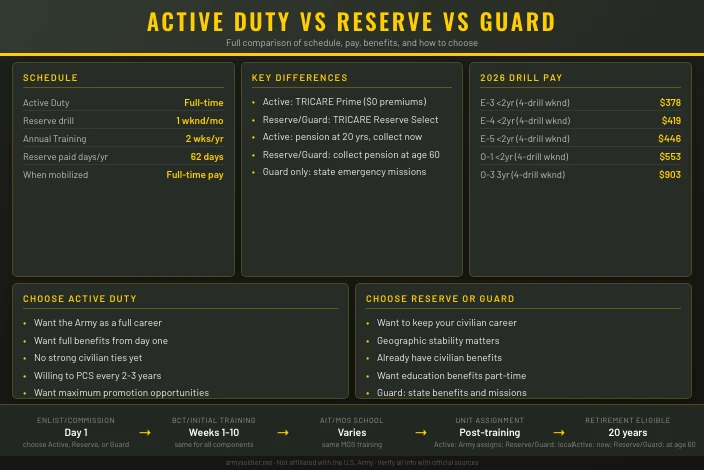
The comparison at a glance
| Active Duty | Army Reserve | Army National Guard | |
|---|---|---|---|
| Schedule | Full-time, 24/7 commitment | 1 weekend/month + 2 weeks/year | 1 weekend/month + 2 weeks/year |
| Base pay | Full monthly pay | Drill pay only (unless mobilized) | Drill pay only (unless activated) |
| Housing | BAH or on-post housing | None unless on orders | None unless activated |
| Healthcare | TRICARE Prime, $0 premiums | TRICARE Reserve Select (premiums apply) | TRICARE Reserve Select (premiums apply) |
| Retirement | 20 years, collect at any age | 20 qualifying years, collect at age 60 | 20 qualifying years, collect at age 60 |
| GI Bill | Post-9/11 GI Bill (Chapter 33) | MGIB-SR or Post-9/11 via deployment | MGIB-SR or Post-9/11 via deployment |
| Deployment | Regular rotation cycles | Periodic federal mobilization | State missions + federal mobilization |
| Career flexibility | Limited – Army assigns your duty station | High – keep civilian career | High – keep civilian career |
| Geographic stability | Low – PCS moves every 2 to 3 years | High – unit location is local | High – unit location is in your state |
Active Duty
Active Duty means full-time military service. You are a soldier around the clock. Your housing, healthcare, and food allowances are paid by the Army. Your entire career moves on Army timelines.
What full-time service looks like
You report to your duty station every workday. Training cycles, field exercises, deployments, and unit requirements fill the schedule. When the Army needs your unit somewhere, you go.
Most Active Duty soldiers move every 2 to 3 years through a Permanent Change of Station (PCS) move. The Army assigns you to installations based on your MOS, your unit’s needs, and available positions. You can submit preferences, and the Army considers them, but the final decision is the Army’s.
The pace is demanding. Field exercises, deployment rotations, and physical training are the rhythm of active service. There is a structure to daily life that some soldiers find clarifying and others find restrictive.
Pay and total compensation
Active Duty soldiers earn full monthly base pay based on rank and years of service. E-1 starts at $2,407 per month in 2026. E-4 with 2 years earns $3,303. O-1 starts at $4,150.
On top of base pay, you receive:
- Basic Allowance for Housing (BAH) – varies by location and dependency status. An E-4 at Fort Sam Houston receives $1,359 without dependents or $1,728 with dependents in 2026.
- Basic Allowance for Subsistence (BAS) – $476.95/month for enlisted, $328.48 for officers in 2026.
- TRICARE Prime healthcare at no cost for you and your family.
- 30 days paid leave per year.
- Access to on-post commissary, PX, gyms, and recreational facilities.
Total compensation for an E-4 in a mid-cost location commonly exceeds $60,000 per year in base pay, housing, subsistence, and the value of zero-cost healthcare.
Who Active Duty fits best
Active Duty is the right choice if you want to make the Army your career, want full benefits from day one, are willing to move and deploy as assigned, and do not have strong ties to a specific city or civilian career that you cannot pause or end.
Army Reserve
The Army Reserve is a federal organization under U.S. Army Reserve Command (USARC). Reserve soldiers drill with their local units one weekend a month and complete a two-week Annual Training period each year. The rest of the time, they live their civilian lives.
What part-time service looks like
A standard drill weekend runs Saturday and Sunday. Each day counts as two drill periods (called Unit Training Assemblies or UTAs), so a weekend counts as four drills. Over a year, that is 48 drill periods plus 14 days of Annual Training – 62 total paid days of service at minimum.
When the Army needs Reserve units, soldiers can be mobilized to active duty. Mobilization orders activate full-time pay and benefits for the duration. Historically, many Reserve soldiers have served extended tours in support of overseas operations.
Drill pay
Drill pay uses the same base pay scale as Active Duty, divided by 30 to get a daily rate. An E-4 with less than 2 years earns $418.93 for a standard 4-drill weekend in 2026. An O-3 with 3 years earns $902.72 per weekend.
When mobilized, Reserve soldiers receive the same full monthly base pay, BAH, BAS, and benefits as Active Duty soldiers for the length of the orders.
Healthcare for Reserve soldiers
Reserve soldiers not on active duty orders can enroll in TRICARE Reserve Select (TRS). TRS is a premium-based health plan with 2026 premiums of $57.88 per month for member-only coverage or $286.66 per month for member and family. This is substantially less than most civilian employer plans but more than the $0 Active Duty TRICARE Prime.
When mobilized to active duty, Reserve soldiers shift to TRICARE Prime automatically.
Reserve retirement
Reserve retirement uses a points-based system. Each drill period earns one retirement point. Active duty days also earn one point per day. You need 20 qualifying years, where a qualifying year requires at least 50 retirement points.
Unlike Active Duty, Reserve retirees do not collect their pension until age 60. However, that collection age can be reduced by 90 days for every 90 consecutive days of qualifying active duty service, with a minimum collection age of 50.
The pension formula is the same 2.5% per year concept as Active Duty but applied against equivalent years calculated from your total points. Most Reserve retirees receive a smaller pension than Active Duty retirees because they accumulate fewer points per year.
Education benefits
Reserve soldiers have two main GI Bill paths:
- Montgomery GI Bill – Selected Reserve (Chapter 1606): Available while serving in the Selected Reserve. Provides $493 per month for up to 36 months of education (2026 rate). Does not require a deployment.
- Post-9/11 GI Bill (Chapter 33): Requires qualifying active duty service (Title 10 orders, 90 or more aggregate days after September 10, 2001). Many Reserve soldiers earn this through deployments. The benefit tier scales from 40% at 90 days of service up to 100% at 36 months. At 100%, it covers full in-state tuition, a monthly housing allowance, and up to $1,000 in annual book stipend.
Federal Tuition Assistance is also available to drilling Reserve soldiers at the same rates as Active Duty: $250 per semester hour, up to $4,500 per year.
Army National Guard
The National Guard has a dual mission that the Army Reserve does not. Guard soldiers serve their state under the authority of the governor and can be activated for state emergencies – natural disasters, civil unrest, border operations – in addition to federal deployments under presidential authority.
State vs federal control
This is the most important structural difference between the Guard and Reserve. The Army Reserve is entirely a federal entity under Title 10 authority. The National Guard operates under Title 32 (state) authority when serving the governor, and shifts to Title 10 (federal) when federally mobilized.
In practical terms, Guard soldiers may be called up for floods, hurricanes, or wildfires within their state, while Reserve soldiers are mobilized only for federal missions.
State-level benefits
Many states offer additional benefits for Guard members that the Army Reserve does not provide:
- State tuition waivers or tuition assistance programs (varies widely by state)
- State income tax exemptions for military pay
- State-level bonuses and enlistment incentives
Check your state’s Adjutant General website for current state benefits. They vary significantly from state to state.
Schedule, pay, and federal benefits
The drill schedule, federal base pay rates, federal education benefits, TRICARE Reserve Select access, and retirement system work the same as the Army Reserve. Both components receive the same federal drill pay. The Guard’s state benefits layer on top of the federal foundation.
What most people miss when comparing these paths
Reserve and Guard retirement starts at age 60, not 20 years of service
Active Duty soldiers who complete 20 years of service can retire immediately and begin collecting a pension the same month they separate. Reserve and Guard soldiers who complete 20 qualifying years must wait until age 60 to collect. That is a meaningful gap if you retire from your reserve service at 40.
Healthcare gap for Reserve and Guard
Active Duty soldiers and their families have zero-cost healthcare on day one. Reserve and Guard soldiers pay TRS premiums when not mobilized. If you leave a civilian job with employer-provided healthcare to serve part-time, you will need to budget for those TRS premiums or find alternative civilian coverage.
GI Bill chapter differences
Active Duty soldiers typically qualify for the Post-9/11 GI Bill (Chapter 33) at the 100% level after 36 months of active service. Reserve and Guard soldiers typically start with Chapter 1606 and earn Post-9/11 eligibility through deployment days. The housing allowance under Chapter 33 can be worth $1,000 to $2,000 per month in many markets – that difference matters when you are choosing between Reserve-only service and mixed Reserve-with-deployment service.
PCS moves vs geographic stability
Active Duty soldiers move. The Army decides where. If you own a house, have a spouse with a career, or have school-age children, PCS moves are a significant life disruption. Reserve and Guard soldiers stay at their home units. You train locally, and you deploy when mobilized.
When to choose Active Duty
Active Duty makes the most sense when:
- You want the Army as your full career, not a supplement to a civilian one.
- You want the full benefits package immediately – housing, healthcare, steady pay.
- You are early in your career with no strong civilian ties yet.
- You want the full range of Army assignments, schools, and promotion opportunities.
- You are willing to move every few years and deploy as assigned.
When to choose Reserve or National Guard
Reserve or Guard service makes the most sense when:
- You want to serve but also want to build a civilian career, finish a degree, or run a business.
- Geographic stability matters – you want to stay in your city or state.
- You already have civilian employment with benefits you want to keep.
- You want part-time income and education benefits without a full-time commitment.
- State benefits in your state are strong (Guard) or your unit has a mission set you find compelling (Reserve).
The part-time path is not a lesser version of service. Many soldiers build 20-year careers in the Reserve or Guard, deploy multiple times, and retire with both a military pension and a civilian career or business. The tradeoffs are real, but so are the options.
More information
Review current pay tables, benefit rates, and mobilization policies at army.mil and usar.army.mil. National Guard state-level benefits are listed at nationalguard.com and your state’s Adjutant General website.
Explore more on the Paths to Serve hub, including Enlisted vs Officer if you have not yet decided which type of commission or enlistment fits your goals.
This site is not affiliated with the U.S. Army or any government agency. Verify all information with official Army sources before making enlistment or career decisions.