Army Enlisted vs Officer: Which Path Is Right for You
The fundamental difference between enlisted and officer is not about intelligence or worth. It is about role. Enlisted soldiers are technical specialists and the backbone of execution. Officers lead people and manage missions at multiple levels. Warrant officers sit in a third lane: they are the deep technical experts, the people who know their specialty better than almost anyone in the Army.
All three paths serve the same institution. The right choice depends on what kind of work you want to do – and how much you want to lead versus how much you want to master a specific craft.
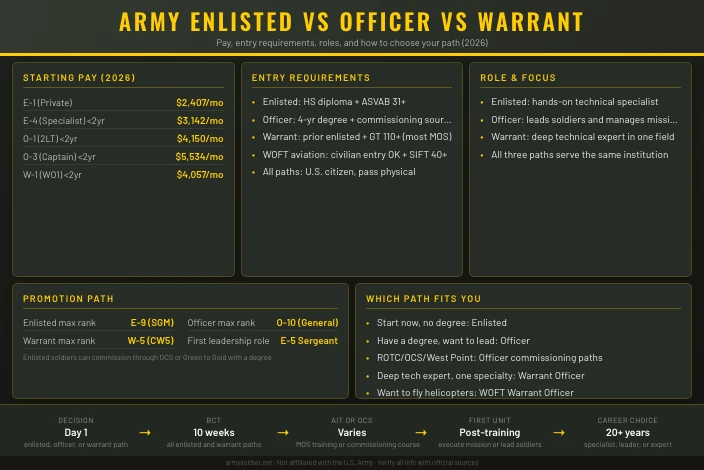
The three paths at a glance
| Enlisted | Officer | Warrant Officer | |
|---|---|---|---|
| Entry requirement | High school diploma or GED, ASVAB 31+ | Bachelor’s degree + commissioning source | Varies: prior enlisted for most MOS, civilian entry for some |
| Starting pay (2026) | E-1: $2,407/mo | O-1: $4,150/mo | W-1: $4,057/mo |
| Role | Technical specialist, team member | Leader of soldiers and missions | Deep technical expert |
| Time to first day | 6 to 12 weeks (BCT + AIT) | 12 to 24 months (degree, OCS/ROTC, commissioning) | 1 to 3 years (enlistment, experience, WOCS) |
| Promotion path | E-1 through E-9 (Specialist to Sergeant Major) | O-1 through O-10 (2LT to General) | W-1 through W-5 |
| Max rank | E-9 (Sergeant Major of the Army) | O-10 (General) | W-5 (Chief Warrant Officer 5) |
| Education required | High school diploma minimum | Four-year degree required | Varies; GT score 110+ required |
Enlisted
The enlisted force is the Army. Sergeants lead squads. Staff Sergeants run section-level operations. Sergeant Majors advise commanders at the highest levels. Every officer who has ever led a successful mission did it with enlisted soldiers doing the actual work.
The enlisted path
You enlist after meeting the minimum requirements: a high school diploma (or GED), meeting physical standards, and scoring at least 31 on the AFQT portion of the ASVAB. The minimum AFQT gets you eligible. Scoring higher gives you more MOS options and, in competitive specialties, a stronger package.
Once you ship to Basic Combat Training (BCT) – 10 weeks at one of several Army installations – you move to Advanced Individual Training (AIT) for your specific MOS. AIT can range from 4 weeks for some combat roles to 52 weeks or more for technical and medical specialties.
After training, you go to your first unit and start building experience. Most first-term soldiers serve at the E-3 to E-4 level. Promotion to E-5 (Sergeant) is the first leadership milestone, where you take your first NCO leadership position and are responsible for soldiers below you.
The NCO career path
The Non-Commissioned Officer (NCO) corps is where most of the Army’s leadership experience lives. The path from E-5 to E-9 runs through progressively larger units, more soldiers, and more complex responsibilities.
| Rank | Title | Typical responsibility |
|---|---|---|
| E-5 | Sergeant (SGT) | Team leader (4 to 5 soldiers) |
| E-6 | Staff Sergeant (SSG) | Squad leader (8 to 10 soldiers) |
| E-7 | Sergeant First Class (SFC) | Platoon Sergeant (30+ soldiers) |
| E-8 | Master Sergeant (MSG) / First Sergeant (1SG) | Senior staff NCO or company top NCO |
| E-9 | Sergeant Major (SGM) / Command Sergeant Major (CSM) | Senior advisor to commanders at battalion level and above |
Enlisted soldiers who want to commission later have strong options. OCS (Officer Candidate School) accepts enlisted applicants with a bachelor’s degree. The Green to Gold program allows active duty enlisted soldiers to finish a degree and commission through ROTC. Both paths are discussed at the end of this guide.
Enlisted pay (2026)
| Rank | Less than 2 years | 3 years | 6 years |
|---|---|---|---|
| E-1 (Private) | $2,407 | $2,407 | – |
| E-2 (Private 2) | $2,698 | $2,698 | – |
| E-3 (Private First Class) | $2,837 | $3,198 | – |
| E-4 (Specialist/Corporal) | $3,142 | $3,483 | $3,816 |
| E-5 (Sergeant) | $3,343 | $3,776 | $4,109 |
These are base pay figures from DFAS. Soldiers also receive BAH (varies by location), BAS ($476.95/month for enlisted), and zero-cost TRICARE healthcare on Active Duty.
Officer
Officers lead. At the small-unit level, a lieutenant leads a platoon of 30 to 40 soldiers. As careers progress, officers take command of companies, battalions, brigades, and divisions, and eventually advise national-level policy. The scope of responsibility grows significantly with each promotion.
Commissioning paths
All commissioned officers must hold a four-year bachelor’s degree before they commission. The degree does not need to be in a military-related field, though STEM degrees can strengthen applications for technical branches.
ROTC (Reserve Officers’ Training Corps): The largest source of commissioned officers. ROTC programs are embedded in colleges and universities across the country. Cadets complete military training alongside their degree and commission upon graduation. Scholarship options are available.
OCS (Officer Candidate School): A 12-week course at Fort Moore, Georgia. Open to college graduates (civilian or enlisted) who meet the requirements. Most officers who commission after working in the civilian world use this path.
USMA (United States Military Academy at West Point): A four-year degree program that produces commissioned officers. Extremely competitive admissions. Graduates receive a Bachelor of Science and commission as second lieutenants.
Direct Commission: Used for medical, legal, chaplain, and other professional specialty officers. Requires an advanced degree (MD, JD, etc.) in the relevant field. No prior military service required for some programs.
Officer branches
After commissioning, officers select or are assigned to a branch (the Army calls them branches, not MOS). Branch determines your career track and the units you serve in. Common branches include Infantry (IN), Field Artillery (FA), Aviation (AV), Military Intelligence (MI), Signal (SC), and Medical.
Officers are expected to develop both tactical skill in their branch and the leadership ability to manage larger formations as they advance. The Army invests significantly in officer education through the Captain’s Career Course, Command and General Staff College, and the Army War College.
Officer pay (2026)
| Rank | Less than 2 years | 3 years | 6 years |
|---|---|---|---|
| O-1 (2nd Lieutenant) | $4,150 | $5,222 | – |
| O-2 (1st Lieutenant) | $4,782 | $6,272 | $6,618 |
| O-3 (Captain) | $5,534 | $6,770 | $7,737 |
Officers also receive BAH (officer rates are higher than enlisted for the same location), BAS ($328.48/month), and zero-cost TRICARE.
Warrant Officer
Warrant officers are the Army’s technical experts. They are not generalist leaders the way commissioned officers are – they go deep in one specialty and stay there throughout their career. In Army aviation, warrant officers fly the aircraft. In intelligence, they manage the most complex collection systems. In cyber, they operate at the technical edge of Army operations.
How to become a warrant officer
Most warrant officer candidates must have prior enlisted experience in the MOS they are applying for. The path runs through WOCS (Warrant Officer Candidate School) at Fort Novosel, Alabama – a 5-week course that produces W-1 appointments.
For aviation, the path is different. The Warrant Officer Flight Training (WOFT) program accepts civilian applicants with no prior military service. Candidates must score at least 40 on the SIFT test and pass a Class 1A flight physical, along with the standard WOCS prerequisites.
Non-waiverable requirements for WOCS include:
- U.S. citizenship
- High school diploma or GED
- GT score of 110 or higher (ASVAB General Technical composite)
- Eligible for a Secret security clearance
- SIFT score of 40+ for aviation candidates
Warrant officer pay (2026)
| Rank | Less than 2 years | 2 years | 6 years |
|---|---|---|---|
| W-1 (Warrant Officer 1) | $4,057 | $4,494 | $5,152 |
| W-2 (Chief Warrant Officer 2) | $4,622 | $5,059 | $5,585 |
| W-3 (Chief Warrant Officer 3) | $5,223 | $5,441 | $5,971 |
Warrant officers receive the same housing and healthcare benefits as other Active Duty soldiers.
Why choose warrant officer
The warrant officer path suits soldiers who want to master a specific technical domain without the administrative and command obligations of commissioned officer career tracks. Warrant officers typically stay in their specialty for 20 or more years. Many Army helicopter pilots have entire careers as warrant officers, flying and leading aviation crews without ever commanding battalions or managing budgets the way commissioned officers do.
Which path fits you
Use this decision framework based on what you actually want:
Choose enlisted if:
- You want to start serving now, without waiting for a degree.
- You want hands-on, technical work as the primary focus of your daily service.
- You prefer mastering a specific job before deciding whether to lead.
- You are open to commissioning later through OCS or Green to Gold after gaining experience.
Choose officer if:
- You already have a degree or are close to finishing one.
- You want to lead people and manage complex operations from the start.
- You are interested in the full breadth of Army leadership and policy at higher levels.
- You are willing to change units and locations more often in exchange for broader responsibility.
Choose warrant officer if:
- You want to become the deepest technical expert in a specific field.
- You want a defined specialty track without the broad command obligations of commissioned officers.
- You are drawn to Army aviation and want to fly as a career.
- You have (or are building) the enlisted background the warrant MOS requires.
Can you switch paths
Yes – in multiple ways.
Enlisted to commissioned officer: Enlisted soldiers with a bachelor’s degree can apply to OCS. Active Duty soldiers can apply to the Green to Gold program and commission through ROTC while finishing a degree at full Active Duty pay.
Enlisted to warrant officer: Typically requires reaching E-5 or above and qualifying in the relevant MOS, plus meeting all WOCS prerequisites. Aviation is the main exception – WOFT accepts civilians directly.
Officer to warrant officer: Rare, but technically possible for aviation branch where flight performance is the primary currency. More common to see the reverse, where a warrant officer finishes a degree and commissions.
Switching paths is not a failure. Many NCOs who eventually commission credit their enlisted time as the foundation that made them more effective officers.
More information
For commissioning program specifics and application timelines, talk to an Army officer recruiter (for OCS and direct commission) or a college ROTC program office. Enlistment requirements and MOS line scores are confirmed through an Army recruiter and DA Pam 611-21.
Explore more on the Paths to Serve hub, including Active vs Reserve if you have not decided between full-time and part-time service.
This site is not affiliated with the U.S. Army or any government agency. Verify all information with official Army sources before making enlistment or career decisions.