How to Become an Army Warrant Officer
Warrant officers are technical specialists. Where commissioned officers are generalists who move between leadership and staff roles, warrant officers dig deep into a specific MOS specialty and spend most of their career as the Army’s recognized experts in that field. They advise commanders, operate complex systems, and train the soldiers who work under them. A CW4 or CW5 warrant officer may know more about their domain than anyone else at a brigade or division level.
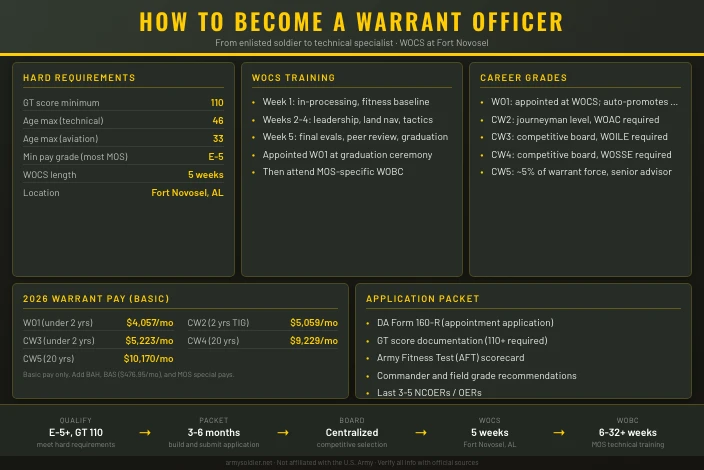
Most warrant officer candidates are prior-enlisted soldiers who already know their craft. The path runs through an application packet, a selection board, and five weeks at the Warrant Officer Candidate School (WOCS) at Fort Novosel, Alabama.
What a Warrant Officer Actually Does
The difference between a warrant officer and a commissioned officer is not just about rank. It’s about role. Commissioned officers (O-1 through O-10) are expected to lead and command at progressively higher levels. They typically change jobs and branches every two to three years as part of a deliberate career broadening strategy. Warrant officers stay in their lane.
Warrant officers are technical experts by design. A 153A Rotary Wing Aviator flies for most of their career and becomes a master of their aircraft system. A 350F Special Forces Intelligence warrant officer becomes a deep expert in human intelligence and all-source analysis. A 255A Information Services Technician maintains Army network infrastructure and advises commanders on communications architecture. The depth of expertise is the point.
Appointment vs. commission: Warrant officers are appointed by warrant, not commissioned in the traditional sense. W-1 (Warrant Officer 1) is appointed by warrant of authority approved by the Secretary of the Army. CW2 through CW5 are technically commissioned warrant officers, but they remain distinct from the O-grade commissioned officer corps.
Who Qualifies
Most technical warrant officer MOS require prior enlisted service. Aviation (Warrant Officer Flight Training, or WOFT) is one notable exception – civilians with no military service can apply directly.
Non-waiverable requirements:
- U.S. citizen (no exceptions)
- GT score of 110 or higher (General Technical ASVAB composite; no waivers authorized)
- High school diploma or GED
- Eligible for Secret security clearance (interim clearance acceptable at WOCS entry)
Age limits:
- Maximum age 46 for most technical MOS (at time of appointment to WO1)
- Maximum age 33 for aviation (WOFT candidates)
- Waivers are considered case by case, but aviation age limits are strict
Pay grade:
- Most MOS require E-5 (Sergeant) or higher
- Some MOS accept E-4 applicants, particularly those rated as promotable
- Aviation (WOFT) accepts civilians with no prior service
Time in service (active duty):
- Typically 5 to 12 years TIS for active component
- Reserve and Guard candidates have different windows depending on the MOS and state
- High-demand MOS may accept candidates outside standard windows with a waiver
Aviation-specific requirements:
Aviation candidates must pass a Class 1A flight physical (the most demanding medical standard in the Army) and score 40 or higher on the SIFT (Selection Instrument for Flight Training). The SIFT tests spatial reasoning, math, reading comprehension, and basic aviation knowledge. Candidates who score below 40 may retake the SIFT once after a 180-day wait. A passing score cannot be retaken.
The Application Packet
WOCS does not have open enrollment. You apply through a competitive packet process, and a centralized selection board reviews applications and determines who gets a seat.
A typical application packet includes:
- DA Form 160-R (Application for Appointment)
- Official ASVAB scores showing GT of 110 or higher
- Current Army Fitness Test (AFT) score card
- Commander’s recommendation letters (typically from your CO and at least one field grade officer)
- NCOER / OER evaluations (last three to five rating periods)
- Medical clearance (DA Form 3158-R physical)
- Security clearance investigation initiation documentation
- Official photo in dress uniform
- Personal statement (board narrative)
- College transcripts (if applicable)
- Aviation candidates also submit SIFT scores and flight physical results
Your packet is scored by the selection board based on your test scores, evaluations, recommendations, and overall soldier record. Boards for aviation MOS are particularly competitive. Some technical MOS have lower packet competition but still require a solid soldier record.
Talk to your career counselor and chain of command well before you intend to submit. Building a strong packet takes several months. Commanders who are uninvested in the process can slow packet completion significantly.
Warrant Officer Candidate School (WOCS)
WOCS is a five-week resident course at Fort Novosel, Alabama, run by the U.S. Army Warrant Officer Career College (WOCC). It is the entry gate for all warrant officers except Special Forces, who attend the SF Warrant Officer Technical and Tactical Certification Course (SF-WOTTC) at Fort Liberty, NC.
What WOCS trains:
WOCS is not a technical school. It doesn’t teach you your MOS. It trains you to be an officer. The curriculum focuses on leadership development, officership, military ethics, Army history, problem-solving, land navigation, and tactical exercises. Candidates rotate through leadership positions within the candidate chain of command, which means you’ll lead your peers and be evaluated on it.
The five weeks follow a structured progression:
- Week 1: Reception, in-processing, initial fitness assessment, orientation. The shock of transition from NCO to candidate.
- Weeks 2-4: Core training in leadership, officership, ethics, land navigation, and tactical exercises. Candidate-led strategy increases during this phase. You’ll spend time in the field and rotate through leadership billets.
- Week 5: Final evaluations, peer reviews, written assessments, and graduation preparation.
Graduation ceremony is held at the U.S. Army Aviation Museum on Fort Novosel. At graduation, candidates are appointed to WO1. Families are invited and the ceremony is formal.
Reserve component WOCS:
Reserve and Guard candidates have an alternative: a two-phase course conducted over drill weekends spanning approximately five months, with a 15-day culminating phase during annual training. This is often conducted through authorized Regional Training Institutes (RTIs), though some Reserve candidates attend the five-week resident course at Fort Novosel instead.
Warrant Officer Basic Course (WOBC)
Immediately after WOCS, every WO1 attends a Warrant Officer Basic Course (WOBC) at the branch school responsible for their MOS. WOBC is the technical training that WOCS deliberately does not cover.
WOBC length varies significantly by MOS:
- Most technical WOBC courses run 6 to 26 weeks
- Aviation WOBC at Fort Novosel is 32 weeks or longer, covering aircraft systems, flight operations, and including actual flight training
WO1s must complete WOBC within two years of appointment. WOBC completion is required for promotion to CW2.
The location of WOBC depends on MOS:
- Medical warrant officers attend at Fort Sam Houston, TX
- Intelligence warrant officers attend at Fort Huachuca, AZ
- Aviation warrant officers remain at Fort Novosel, AL
- Signal and cyber warrant officers attend at Fort Eisenhower, GA
Career Progression: WO1 Through CW5
Warrant officers have five grades. Promotion through the lower grades is largely automatic; promotion to the higher grades is competitive.
| Grade | Title | Promotion Method | Typical Total Service |
|---|---|---|---|
| W-1 | Warrant Officer 1 (WO1) | Appointed at WOCS graduation | 5-12 years (prior enlisted) |
| W-2 | Chief Warrant Officer 2 (CW2) | Automatic after 2 years TIG + WOBC completion | 7-14 years |
| W-3 | Chief Warrant Officer 3 (CW3) | Competitive selection board | 12-20 years |
| W-4 | Chief Warrant Officer 4 (CW4) | Competitive selection board | 17-26 years |
| W-5 | Chief Warrant Officer 5 (CW5) | Highly competitive board | 22-30+ years |
WO1 to CW2 is automatic. Meet the time in grade (two years as W-1), complete WOBC, and have no disqualifying issues – you promote. After that, competition increases with each grade.
CW5 appointments are limited to approximately 5% of the active-duty warrant officer population. At this grade, warrant officers serve as senior technical advisors at battalion, brigade, division, and Department of the Army staff levels. They’re not just practitioners; they shape how the Army develops doctrine and trains the next generation in their specialty.
Professional Military Education for Warrant Officers
Warrant officers have a parallel PME ladder alongside commissioned officers:
- WOBC – taken as WO1; MOS-specific technical qualification
- WOAC (Warrant Officer Advanced Course) – for CW2s preparing for CW3 positions; non-resident + resident phases at the branch school
- WOILE (Warrant Officer Intermediate Level Education) – for CW3 and CW4; 48-hour distance learning plus 5-week resident phase at the WOCC, Fort Novosel; MOS-immaterial leadership development
- WOSSE (Warrant Officer Senior Service Education) – for CW4 and CW5; 48-hour distance learning plus 4-week resident phase at the WOCC, Fort Novosel; strategic-level development
Missing PME requirements will slow or stop promotion. Build PME into your long-term plan early.
Service Obligations After WOCS
Service obligations start after you complete your initial training pipeline (WOCS + WOBC or flight school), not when you attend WOCS itself:
- Technical warrant officers: 6-year active duty service obligation (ADSO) after WOBC completion
- Aviation warrant officers: 10-year ADSO after completing flight school
These are on top of any time you’ve already served. A soldier with eight years of enlisted service who becomes a 153A aviator will owe 10 additional years after flight school, potentially serving 20+ years total.
Pay and Benefits
Warrant officers are paid on the warrant officer pay scale, separate from both the enlisted and officer scales. In 2026, a WO1 with under two years of warrant service earns $4,057 per month in basic pay. A CW2 with two years in grade earns $5,059 per month. A CW4 at 20 years earns $9,229 per month.
Add to that housing allowance (BAH), food allowance (BAS of $476.95 per month for 2026), and any special pays tied to their MOS (flight pay for aviators, hazardous duty pay where applicable). Total compensation substantially exceeds base pay alone.
More Information
WOCS and warrant officer accession information is available at goarmy.com. The Army Warrant Officer Career College publishes course information at armyuniversity.edu/wocc. Recruiting information for Warrant Officer Flight Training (WOFT) is at recruiting.army.mil.
This site is not affiliated with the U.S. Army or any government agency. Verify all information with official Army sources before making enlistment or career decisions.
For more on serving in the Army, see the Paths to Serve hub. Soldiers considering a warrant officer path typically have several years of enlisted service first; if you’re just starting out, read How to Enlist. Officers interested in the comparison between the officer and warrant officer tracks can review How to Become an Officer.