How to Become an Army Officer
Army officers lead soldiers, manage resources, and bear responsibility for mission outcomes. They hold commissions issued by the President and confirmed by Congress. Most enter as Second Lieutenants (O-1) and spend their careers in progressively larger leadership and staff roles. How you earn that commission determines your timeline, education requirements, and in some cases, your branch assignment.
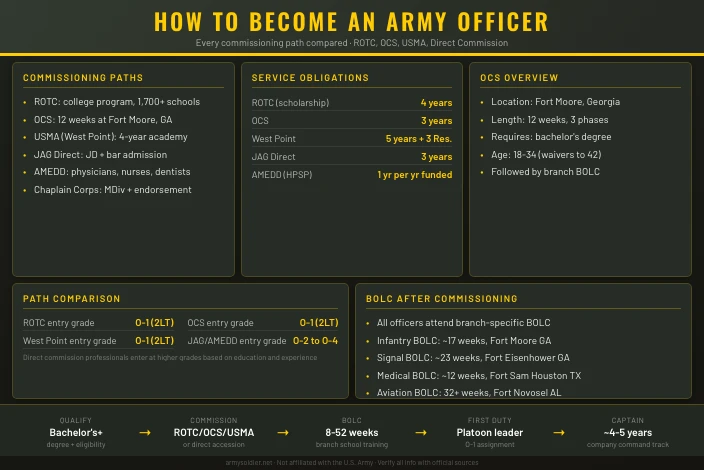
There are four main paths to a commission: the Reserve Officers’ Training Corps (ROTC), Officer Candidate School (OCS), the U.S. Military Academy (USMA or West Point), and direct commission programs for professionals in law, medicine, and chaplaincy.
ROTC: Reserve Officers’ Training Corps
ROTC is the largest source of Army officers. The program runs at over 1,700 colleges and universities through a network of host and partnership schools. Students complete military science coursework alongside their regular degree program and earn a commission upon graduation.
How it works:
The first two years of ROTC (the “Basic Course”) are typically optional and non-binding. You attend class, do some physical training, and learn basic military skills. You’re not committed to anything yet. The last two years (the “Advanced Course”) require a formal contract. You take on more demanding leadership training, complete a four-week Leadership Assessment Course (LDAC) at Fort Knox the summer before your senior year, and graduate with your degree and a commission simultaneously.
Scholarships:
ROTC offers merit-based scholarships ranging from 2-year to 4-year awards that cover tuition, fees, a book stipend, and a monthly living stipend. The four-year scholarship is the most competitive. You can apply as a high school senior or after starting college. Scholarship recipients must serve on active duty after graduation; non-scholarship cadets can pursue either active duty or Reserve/Guard service.
Branch selection:
Near the end of your senior year, you submit branch preferences. The Army uses a centralized algorithm that weighs your OML (Order of Merit List) ranking among your peers against Army needs. Top-ranked cadets typically get their first or second choice. Lower-ranked cadets may receive a branch that wasn’t their preference.
Timeline: 4 years of college plus LDAC the summer before senior year. Commission upon graduation.
Service obligation: 4 years active duty for scholarship recipients (or as specified in your contract). Non-scholarship cadets who serve on active duty typically have a 3-year obligation. Reserve/Guard service carries different obligations.
OCS: Officer Candidate School
OCS at Fort Moore, Georgia is the primary commissioning path for people who already hold a bachelor’s degree and want to commission without going through ROTC or West Point. It’s also the path for prior-enlisted soldiers who earn a degree and want to become officers.
Eligibility:
- Bachelor’s degree from an accredited institution (any major)
- U.S. citizen
- Age 18 to 34 (waivers available to 42 for some circumstances)
- Pass Army Fitness Test (AFT) standards
- No felony convictions; character screening required
How it works:
OCS is a 12-week course divided into three phases. Phase I (Basic) covers foundational officership, Army customs, physical fitness, and land navigation. Phase II (Intermediate) adds tactical leadership, decision-making under stress, and peer leadership evaluations. Phase III (Advanced) culminates in a field training exercise where candidates perform as platoon leaders in evaluated scenarios. Candidates who don’t meet standards can be recycled (repeat a phase) or dismissed. Attrition is real, though most committed candidates who arrive in good physical shape complete the course.
After OCS graduation and commissioning, officers attend Basic Officer Leader Course (BOLC), which is branch-specific training at the school responsible for their branch. A newly commissioned Infantry officer attends Infantry BOLC at Fort Moore. A Medical officer attends BOLC at Fort Sam Houston.
Timeline: 12 weeks of OCS, followed by BOLC (8 to 52 weeks depending on branch).
Service obligation: 3 years active duty.
USMA: United States Military Academy (West Point)
West Point in West Point, New York is a four-year federal service academy that combines a rigorous college education with military officer development. Graduates earn a Bachelor of Science degree and a commission as an Army Second Lieutenant.
Admissions:
Admission is extremely competitive. Applicants must receive a nomination from a congressional representative, senator, or other nominating authority before the Academy can offer an appointment. Nominations are separate from the academic application. Most applicants get their nomination from their U.S. House representative or one of their two U.S. senators. A small number of nominations come from the President, Vice President, and other sources.
Academic requirements are similar to highly selective universities: strong SAT/ACT scores, class rank, and extracurricular leadership. Athletic participation is strongly represented in the admitted class, though it’s not required.
What West Point provides:
All costs are covered – tuition, room, board, uniforms, and medical care. Cadets receive a monthly stipend ($1,600 to $1,900 in recent years) from which books, equipment, and personal expenses are deducted. No tuition debt.
The four-year program includes summers at training exercises, internships, and leadership schools. Academics cover both traditional liberal arts and STEM disciplines, and all cadets complete a minimum number of engineering courses regardless of major.
Timeline: 4 years at West Point. Commission at graduation.
Service obligation: 5 years active duty after graduation, plus 3 years in the Reserve.
Direct Commission: Law, Medicine, and Chaplaincy
Professionals with advanced degrees in certain fields can earn a commission without attending a commissioning source like OCS or ROTC. Direct commission programs exist for lawyers, physicians, dentists, nurses, veterinarians, optometrists, and chaplains.
Judge Advocate General (JAG) Corps:
Lawyers commission directly as First Lieutenants (O-2) or higher, depending on experience. Requirements include a Juris Doctor (JD) from an ABA-accredited law school and bar admission or eligibility in at least one state. The Funded Legal Education Program (FLEP) allows active-duty enlisted soldiers and officers to attend law school on Army funding in exchange for an extended service obligation.
After direct commission, JAG officers attend the Judge Advocate Officer Basic Course before their first assignment.
Army Medical Department (AMEDD):
The Army Medical Department commissions physicians, dentists, nurses, veterinarians, optometrists, and medical specialists. Officers typically commission at O-3 (Captain) or higher based on education and experience. Physicians commission as Captain (O-3) or Major (O-4) depending on specialty.
AMEDD programs include:
- Health Professions Scholarship Program (HPSP): The Army pays medical, dental, or other professional school tuition in full plus a monthly stipend. In return, officers owe one year of active duty for each year of scholarship support, with a two-year minimum. This is the most common path for physicians and dentists.
- Direct accession: Fully trained professionals can commission directly, typically after completing residency.
- Interservice Physician Assistant Program (IPAP): Enlisted soldiers and officers can apply to become physician assistants through Army-funded training.
Chaplain Corps:
Chaplains must hold a Master of Divinity or equivalent advanced theological degree and be ordained or endorsed by an approved religious organization. They commission through the Chaplain Candidate Program or direct commission, depending on whether they’re still in school or already credentialed.
Timeline Comparison
| Path | Education Required | Program Length | Entry Grade | Service Obligation |
|---|---|---|---|---|
| ROTC | Bachelor’s (concurrent) | 2-4 years | O-1 (2LT) | 3-4 years |
| OCS | Bachelor’s (prior) | 12 weeks | O-1 (2LT) | 3 years |
| USMA | None (earned at USMA) | 4 years | O-1 (2LT) | 5 years |
| JAG Direct | JD + bar | 5 weeks JAOBC | O-2 (1LT)+ | 3 years |
| AMEDD (HPSP) | Medical school (funded) | 4+ years | O-3 (CPT)+ | 1 year/year funded |
| AMEDD (Direct) | MD/DO + residency | N/A | O-3 (CPT)+ | Varies |
| Chaplain | MDiv + endorsement | Varies | O-1 (2LT) | 3 years |
BOLC: Basic Officer Leader Course
Every newly commissioned Army officer, regardless of how they commissioned, attends a Basic Officer Leader Course (BOLC) at their branch school before their first duty assignment. BOLC length varies:
- Infantry BOLC (Fort Moore, GA): approximately 17 weeks
- Signal BOLC (Fort Eisenhower, GA): approximately 23 weeks
- Medical BOLC (Fort Sam Houston, TX): approximately 12 weeks (followed by specialty training)
- Aviation BOLC (Fort Novosel, AL): 32+ weeks including flight school
BOLC teaches branch-specific skills and fills in gaps that different commissioning sources leave. An OCS graduate and a ROTC graduate both arrive at BOLC with slightly different knowledge bases; BOLC normalizes the cohort for their first platoon leader assignments.
Key Differences Between Paths
The path you choose shapes more than just how you get commissioned. It shapes your peer network, your branch preferences, and sometimes your culture fit.
| Path | Typical Entrant | Branch Access | Peer Network |
|---|---|---|---|
| ROTC | 18-23, current college student | All branches | Large, diverse, campus-based |
| OCS | 22-34, degree in hand | All branches, often high-need | Smaller, often prior-enlisted |
| West Point | 17-23, high school/early college | All branches, strong preference | Tight, lifelong “Long Gray Line” |
| Direct Commission | Licensed professional (MD, JD, etc.) | AMEDD, JAG, Chaplain only | Specialized cohort |
ROTC graduates make up the majority of active-duty officers and tend to be well-distributed across all branches. OCS graduates are often older, more likely to be prior-enlisted, and frequently commissioned into branches that need officers quickly. West Point graduates have a tight peer network and a reputation that follows them throughout their career. Direct commission officers enter with professional expertise but often spend their first year adapting to military culture and hierarchy.
A few practical differences are worth knowing before you choose:
- Age matters at OCS. The hard cutoff is 34, with waivers available to 42. If you’re 30 with a degree and want to serve, OCS is often the only viable path.
- Scholarships vs. no scholarships. West Point covers all costs with no tuition debt. ROTC offers scholarships that can cover four years of college. OCS assumes you already have a degree and pays nothing toward it.
- Branch selection timing differs. ROTC cadets select branches near graduation using an OML ranking. OCS graduates often learn their branch assignment late in the 12-week course. West Point graduates follow a similar OML process to ROTC.
- Prior service credit. Prior-enlisted soldiers who commission through OCS may receive time-in-service credit that affects their initial pay grade and date of rank, though they still enter at O-1.
None of these paths is objectively better. The right one depends on where you are in your education, what age you’re entering, and whether you’re already a professional in a field the Army needs. Officers who commission through different paths generally perform and promote at similar rates once they’re a few years into their careers.
More Information
Verify current program availability and eligibility at goarmy.com and hrc.army.mil. West Point admissions information is at westpoint.edu. AMEDD accession information is at goarmy.com/amedd.
This site is not affiliated with the U.S. Army or any government agency. Verify all information with official Army sources before making commissioning or career decisions.
For more on service options, see the Paths to Serve hub. If you’re still deciding between serving as an enlisted soldier or an officer, read How to Enlist. Enlisted soldiers seeking a technical leadership track may also want to read How to Become a Warrant Officer.