How to Enlist in the Army
Enlisting in the Army means signing a contract with the federal government to serve for a set period, typically two to six years on active duty. The process takes most people between 30 and 90 days from first contact with a recruiter to shipping out to Basic Combat Training (BCT). Some recruits take longer if they need waivers, have a delayed ship date, or are waiting for a specific MOS slot to open. Here’s what each step involves and what to expect.
Eligibility Requirements
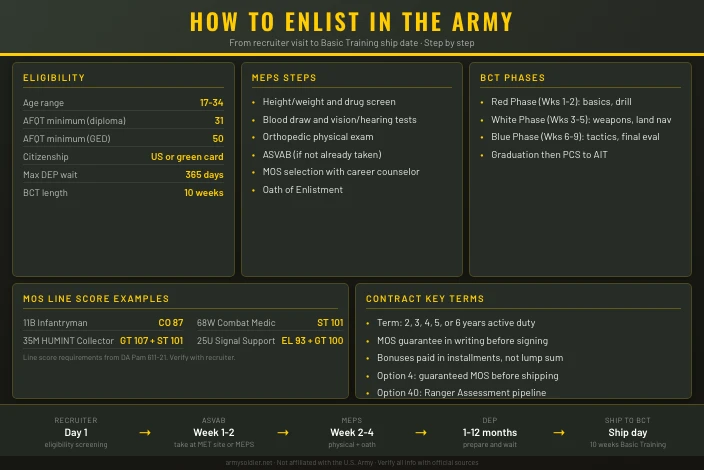
Before you walk into a recruiting station, you need to meet the Army’s baseline requirements. Some of these are hard cutoffs with no exceptions. Others have a waiver process.
Age: 17 to 34 years old. Applicants who are 17 need parental consent. The Army can grant waivers for some applicants up to age 39 depending on the MOS and component.
Citizenship: U.S. citizens or legal permanent residents (green card holders) may enlist. Non-citizens must have lived in the U.S. continuously and hold a valid, unexpired green card.
Education:
- High school diploma holders can qualify with an AFQT score of 31 or higher.
- GED holders need an AFQT score of 50 or higher and are subject to additional eligibility requirements.
- College credits and degrees do not affect basic eligibility but can affect entry pay grade and bonus amounts.
ASVAB / AFQT: The Armed Forces Qualification Test (AFQT) is a subset of the ASVAB that measures basic academic aptitude. The minimum AFQT to enlist is 31 for diploma holders and 50 for GED holders. Individual MOS jobs have separate line score requirements beyond the AFQT floor.
Medical: You must pass a physical examination at a Military Entrance Processing Station (MEPS). Disqualifying conditions include certain chronic medical issues, prior surgery complications, and mental health history. Many conditions are waiverable; your recruiter or MEPS physician will advise you on your specific situation.
Character: You cannot have a felony conviction. Certain misdemeanors, drug use history, and financial problems may require a moral waiver. The Army reviews these case by case.
Taking the ASVAB
The ASVAB is a timed, multi-subject aptitude test. You can take it at a MEPS, a Military Entrance Test (MET) site, or at some high schools. MEPS scores are official and required for enlistment. MET site scores may require confirmation testing at a MEPS before they count.
The test covers nine core subtests:
- General Science (GS)
- Arithmetic Reasoning (AR)
- Word Knowledge (WK)
- Paragraph Comprehension (PC)
- Mathematics Knowledge (MK)
- Electronics Information (EI)
- Auto and Shop Information (AS)
- Mechanical Comprehension (MC)
- Assembling Objects (AO)
Your AFQT score is a percentile derived from the AR, MK, WK, and PC subtests. It determines basic eligibility. Your individual composite line scores, calculated from different subtest combinations, determine which specific MOS jobs you qualify for. The GT (General Technical) score, for example, equals VE + AR and is required for intelligence jobs and warrant officer candidates. The ST (Skilled Technical) score equals GS + VE + MK + MC and is required for most medical MOSs.
Plan to study before test day. The arithmetic reasoning and mathematics knowledge sections trip up the most recruits who haven’t done math recently. Free study resources are available on Army recruiting sites and through many public libraries. A higher score gives you more MOS options and can increase bonus eligibility.
You can retake the ASVAB if you score below what you need. There is a mandatory 30-day wait after the first attempt and a second 30-day wait after the second. After that, a six-month wait applies between additional retakes.
The MEPS Process
MEPS is a one-day to two-day process at a federal facility operated by the Department of Defense. It has two separate phases: medical screening and job selection.
What to bring:
- Valid photo ID (state ID, passport, or driver’s license)
- Social Security card or documentation
- Birth certificate
- Medical records for any prior conditions, surgeries, or prescriptions
- Eyeglass prescription (if applicable)
Medical screening:
You arrive the night before (most MEPS stations arrange a contracted hotel) or early the morning of your appointment. The medical portion includes a height and weight check, urinalysis drug screen, blood draw, vision and hearing tests, and an orthopedic exam where the doctor checks your joints, spine, and range of motion. You’ll complete a detailed health history questionnaire and meet with a physician or physician assistant.
At the end, MEPS gives you one of three outcomes: fully qualified, temporarily disqualified (pending additional records or a waiver review), or permanently disqualified. A temporary DQ does not automatically end your enlistment process. Many recruits submit additional medical documentation and get cleared on a follow-up visit.
Job selection:
If you haven’t taken the ASVAB yet, you take it at MEPS on this day. Then you meet with a career counselor, review your scores against the available job list, choose your MOS, and sign your enlistment contract. The final step is taking the Oath of Enlistment, which is the legal moment you officially join the Army.
The Delayed Entry Program (DEP)
Most recruits don’t ship to BCT the same day they enlist. The Delayed Entry Program (DEP) holds your enlistment contract for up to 365 days while you wait for your BCT class to begin. You’re technically a member of the Inactive Ready Reserve during DEP but are not drawing pay and not subject to the Uniform Code of Military Justice.
Your obligations while in DEP include:
- Monthly check-ins with your recruiter (in person or by phone, depending on your recruiter’s requirements)
- Maintaining your physical qualifications (no significant injuries or new medical conditions)
- Maintaining your moral qualifications (no new arrests, drug use, or criminal charges)
- Completing any pre-ship screenings required 30 to 90 days before your ship date
Use the DEP period to prepare. Establish a consistent sleep schedule. Run three to five days a week and build up your two-mile time. Learn the Army’s general orders, the Soldier’s Creed, rank structure, and phonetic alphabet. Recruits who show up physically prepared and with basic knowledge have a noticeably better experience during the first two weeks of BCT.
You can withdraw from DEP before you ship. Talk to your recruiter if your situation changes. Leaving DEP does not automatically prevent you from enlisting later, though it may affect bonus eligibility.
Choosing Your MOS
Your Military Occupational Specialty (MOS) is the job you train for and perform throughout your enlistment. You select it at MEPS based on your ASVAB composite scores, medical clearances, physical standards, and job availability at the time. There are over 150 enlisted MOSs across nearly every field, from combat arms to healthcare, intelligence, aviation, and logistics.
The Army uses composite line scores to match soldiers to MOSs. A few examples:
- 11B Infantryman – CO (Combat) composite of 87
- 68W Combat Medic – ST (Skilled Technical) composite of 101
- 35M Human Intelligence Collector – GT of 107 and ST of 101
- 25U Signal Support Systems Specialist – EL (Electronics) of 93 and GT of 100
Not every MOS is available every day. The Army has an accession list of open seats that changes frequently based on Army-wide needs. If your top choice is not available, you can wait in DEP longer or choose a different MOS. Some recruits negotiate an “Option 4” contract that guarantees a specific MOS or career field before shipping. An “Option 40” contract is similar but specifically places you into the Ranger Assessment and Selection pipeline.
Research MOS options before you go to MEPS. Know your top three choices and what line scores they require, so you’re not making decisions under time pressure at the recruiter’s desk.
Signing Your Contract
Your enlistment contract (DD Form 4) spells out what you and the Army agreed to. Read every line before you sign. Key items include:
- Enlistment length: Standard terms are 2, 3, 4, 5, or 6 years of active duty. Longer terms usually come with better bonuses and more MOS options.
- MOS guarantee: Many contracts guarantee a specific MOS. If your MOS becomes unavailable at any point in training, the Army will reassign you to an open MOS. Understanding this before signing matters.
- Enlistment bonus: Some MOS jobs carry cash bonuses that vary by MOS, term length, and the Army’s current accession needs. Bonuses are typically paid in installments tied to service milestones, not as a lump sum at the start. Ask your recruiter to confirm the exact payment schedule in writing.
- Special programs: ROTC, college-first, and prior learning credit agreements are sometimes included. If your recruiter promised a specific program, it needs to be in the contract.
If something in the contract looks different from what your recruiter told you, point it out before you sign. The contract is legally binding on both sides. Changes after signing require a formal amendment.
The Oath of Enlistment is taken at MEPS immediately after signing. The legal obligation begins at that point.
Between Signing and Shipping
After you swear in at MEPS, your ship date is assigned based on your MOS training seat availability. For some MOSs, you ship within weeks. For others, you may wait up to a year in DEP.
Around 30 to 90 days before your ship date, expect a pre-ship screening. This typically includes a records review, another drug test, and confirmation that your medical and moral status haven’t changed. If any issues surface, your ship date may be delayed while they’re resolved.
On ship day, you report to a contracted hotel or directly to MEPS, where you’ll catch a flight or bus to a Reception Battalion (Reception BN). At Reception, which lasts three to five days, you’ll be issued uniforms, equipment, and ID cards; receive additional medical screenings and shots; take the Armed Services Vocational Aptitude Battery confirmation if needed; and be assigned to a BCT company. Reception is mostly waiting, paperwork, and processing. BCT itself starts when you move to your training unit.
What to pack for ship day:
- One set of civilian clothes
- Personal hygiene items (unscented soap, deodorant, toothbrush)
- Prescription medications in original bottles
- Orders paperwork and any legal documents requested in your pre-ship instructions
Leave everything else at home. The Army provides what you need.
What Basic Training Actually Involves
BCT runs 10 weeks at one of several Army installations depending on your MOS branch: Fort Jackson (SC), Fort Leonard Wood (MO), Fort Moore (GA), Fort Sill (OK), Fort Knox (KY), or Fort Bliss (TX).
BCT is divided into three phases:
Red Phase (Weeks 1-2): You have almost no freedom of movement. The drill sergeants are controlling the pace entirely. You’ll focus on basic soldier tasks: the Army Fitness Test (AFT) baseline, general orders, first aid basics, uniform standards, and how to march. Most people find this phase the hardest mentally, not because the tasks are complex, but because the adjustment is jarring.
White Phase (Weeks 3-5): Weapons training begins. You’ll qualify on the M4 carbine, learn land navigation with map and compass, and complete a series of field exercises. You’ll spend several nights in the field. Physical training intensity increases.
Blue Phase (Weeks 6-9): Team-level tactics, more complex field exercises, night operations, and the final series of evaluations including the Army Fitness Test and the 16-kilometer foot march. A graduation ceremony closes this phase, and families are typically invited.
After BCT, you move directly to Advanced Individual Training (AIT) at the school responsible for your MOS. AIT length varies from 8 weeks to over a year, depending on the job. Medical and intelligence MOSs have some of the longest AIT pipelines.
More Information
Verify current eligibility requirements and bonus availability directly with an Army recruiter or at goarmy.com. MEPS locations are listed at meps.mil. MOS line score requirements are published in DA Pam 611-21.
This site is not affiliated with the U.S. Army or any government agency. Verify all information with official Army sources before making enlistment or career decisions.
For more on choosing your path, see the Paths to Serve guide hub. If you later decide to pursue a commission, read How to Become an Officer. Enlisted soldiers with the right qualifications can also apply to become a Warrant Officer after a few years of service.