How to Ace the Army SIFT: A Practical Study Guide
A strong SIFT score can open Army aviation. A weak score can close it, even if the rest of your packet looks solid. Unlike the ASVAB, the SIFT is specifically designed for aviation candidates – it measures spatial reasoning, mechanical understanding, and aviation knowledge alongside reading and math.
This guide gives you a clear plan. You will learn what is on the SIFT, how scoring works, what score you actually need to be competitive, and how to raise your number with a structured study approach.
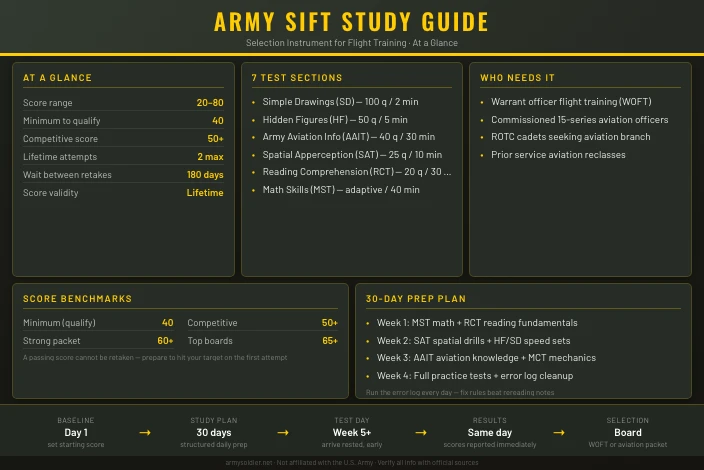
Start here (the 3-step path)
- Take a baseline practice set in the areas that drive your score: math, reading, mechanical, and spatial reasoning.
- Confirm your aviation path with your recruiter – WOFT (warrant officer), commissioned 15-series, or ROTC – and set a realistic target score.
- Follow the study plan in this guide. Protect your limited attempts by retesting only when your practice results show a real jump.
SIFT basics you must understand before studying
What the SIFT is
The SIFT (Selection Instrument for Flight Training) is the Army’s aviation aptitude test. It replaced the AFAST (Alternate Flight Aptitude Selection Test) and is now required for anyone applying to Army flight school – warrant officer candidates through WOFT, commissioned officers seeking an aviation branch, and ROTC cadets pursuing 15-series assignments.
The test measures skills tied to aviation training performance: perceptual speed, spatial awareness, mechanical reasoning, reading comprehension, math, and aviation knowledge. You cannot fake preparation for this test. The best approach is systematic study with a dedicated SIFT prep course several weeks before your attempt.
Who must take it
- Warrant officer flight training (WOFT) applicants – the most common path
- Commissioned officers seeking aviation branch assignments
- ROTC cadets pursuing 15-series aviation
- Prior-service soldiers reclassifying into aviation MOS
Where you take it
The SIFT is administered at MEPS (Military Entrance Processing Stations) and authorized Army testing centers. Your recruiter will schedule the test once your packet is ready. Scores are reported the same day.
Retakes and lifetime limits
This is the part most applicants underestimate. The SIFT has strict attempt limits. You get 2 attempts total. A passing score (40 or above) is permanent – you cannot retest to improve a passing score. If you fail both attempts, you are disqualified from Army aviation.
That means your first attempt matters enormously. Do not show up cold.
A 180-day wait period applies between attempts. Plan your study timeline around this constraint. If your target score is competitive rather than just passing, your first attempt should already be close to that target.
Score validity
SIFT scores do not expire. A score you earn today remains valid for the life of your military service.
You get two attempts. A structured SIFT Online Course with timed practice and progress tracking is the most reliable way to make your first attempt count. If you prefer to self-study, the SIFT Study Guide covers all seven subtests with full-length practice tests.
When you purchase through links on our site, we may receive compensation at no extra cost to you.
How the Army uses SIFT scores
The score range and what the numbers mean
The SIFT produces a single composite score on a 20 to 80 scale. The score is not a raw point total – it is a standardized composite that combines all seven subtest results.
Here is what the benchmarks mean in practice:
| Score | Status |
|---|---|
| Below 40 | Failing – not eligible for flight training |
| 40 | Minimum passing score |
| 50+ | Competitive – around the national average |
| 60+ | Strong candidate packet |
| 65+ | Top-tier for most selection boards |
The minimum score of 40 gets you eligible. It does not get you selected. WOFT selection boards are competitive and they see full scores. A score of 50 to 55 gives you a realistic shot. Above 60 puts your packet in a stronger position.
How boards use SIFT scores
Selection boards for WOFT and aviation commissioning do not look at just one number. They see your full packet: SIFT score, GT score (minimum 110 for WOCS), physical fitness, flight physical results, letters of recommendation, and Army Record Brief if you are prior service.
Your SIFT score is one of the few items in that packet you can improve before you apply. That is why it is worth preparing seriously.
The 7 subtests explained
The SIFT has seven sections. Each measures something different, and each responds to different preparation.
Simple Drawings (SD)
100 questions in 2 minutes. You identify which answer image matches a target image as fast as possible. This is a pure perceptual speed test. You cannot study content for this section – but you can improve your performance by practicing rapid pattern recognition exercises. Timed drills that push your pace without sacrificing accuracy are the right prep approach.
The SD section penalizes wrong answers. Do not randomly guess when time runs out.
Hidden Figures (HF)
50 questions in 5 minutes. You identify which simple figure is hidden within a more complex pattern. This tests visual discrimination and the ability to maintain mental focus under time pressure.
Like SD, HF penalizes wrong answers. Work with speed and accuracy together. Timed practice on hidden figure puzzles is the best preparation – the skill is trainable but requires repetition.
Army Aviation Information Test (AAIT)
40 questions in 30 minutes. This section tests knowledge of Army aviation: rotary-wing aerodynamics, helicopter components, aviation terminology, instruments, weather patterns, and basic flight principles.
The AAIT is one of the most knowledge-dependent sections. You can study a lot here. Focus on:
- How helicopters generate lift (rotor disc, collective, cyclic controls)
- Aerodynamic principles (translational lift, retreating blade stall, vortex ring state)
- Army aircraft types (UH-60, CH-47, AH-64, UH-72)
- Aviation weather basics (density altitude, ceiling, visibility, IFR conditions)
- Basic instrument functions (altimeter, airspeed indicator, attitude indicator)
- Aviation phonetic alphabet, communication procedures
The Federal Aviation Administration Pilot’s Handbook of Aeronautical Knowledge (free at faa.gov) and the Army’s Operator’s Manual for each major aircraft give you a solid foundation.
Spatial Apperception Test (SAT)
25 questions in 10 minutes. You look at a view of coastline, water, or terrain seen from an aircraft and select which flight orientation (attitude, heading, altitude change) matches what the pilot would be seeing.
This is a spatial reasoning section. The key skill is translating a ground view into a mental model of aircraft orientation: is the aircraft banking, climbing, diving, or flying level? Is the nose pointing toward water or land?
Preparation: study diagrams of aircraft attitudes (nose up/down, banked left/right, wings level) and practice matching ground scenes to those attitudes. A dedicated SIFT study guide includes drills for this section.
Reading Comprehension Test (RCT)
20 questions in 30 minutes. Standard reading comprehension: you read a passage and answer questions based on what the text says. The questions test main idea, best-supported conclusions, and inferences that stay within the passage.
You have more time per question here than in most reading sections. Use it. Read carefully, eliminate answers you cannot support from the text, and do not infer beyond what is written.
Math Skills Test (MST)
Adaptive format, approximately 40 minutes. The MST covers arithmetic, algebra, geometry, and word problems. It adapts based on your answers – if you answer correctly, the next question is harder; if you miss one, it adjusts down.
Key topics:
- Fractions, decimals, percentages, percent change
- Ratios, proportions, rates, unit conversion
- Basic algebra (solve for x, simplify expressions, substitute values)
- Exponents, roots, and order of operations
- Geometry essentials (area, perimeter, volume, angle relationships, Pythagorean theorem)
- Multi-step word problems
The adaptive format rewards a clean, systematic approach. Work each problem step by step and double-check units and signs. Rushing causes compounding errors that the adaptive system will follow you down from.
Mechanical Comprehension Test (MCT)
Adaptive format, approximately 15 minutes. The MCT tests your ability to understand mechanical systems: levers, pulleys, gears, forces, pressure, and basic physics.
Key topics:
- Levers and torque (direction of rotation, mechanical advantage)
- Pulley systems (force direction, number of supporting strands)
- Gears (rotation direction, gear ratio, speed changes)
- Forces (gravity, friction, tension, equilibrium)
- Basic fluid pressure (Pascal’s principle, pressure in containers)
Preparation: sketch diagrams before choosing answers. Track force directions step by step. Do not guess at mechanical intuition – draw it out.
The fastest way to raise your score
Most SIFT score gains come from two moves: fix your weakest section first, and turn every missed practice question into a rule you do not repeat. This is the same method that works on any standardized test.
Fix your weakest section first
Do not spread study time evenly across all seven sections. Spread it based on where you have the most room to improve.
After your baseline practice sets, rank your sections by pain level. Pick the one that felt slowest or most full of errors. Spend 5 straight study days attacking only that section. Then retest it with a timed set on day 6. If the score improves, move it to maintenance mode and start the next weakness.
This approach works because steady focus builds a skill stack. Scattered studying builds stress and surface familiarity without real improvement.
The error log method
Your error log is not a list of wrong answers. It is a list of patterns.
For every missed practice question, record:
- Section: SD, HF, AAIT, SAT, RCT, MST, or MCT
- Mistake type: concept gap, misread, rushed, weak method, ran out of time
- Fix rule: one short rule that prevents the miss next time
- Redo: solve or answer the question again correctly, without help
Examples of strong fix rules:
- “Estimate first, then solve. Check the magnitude.”
- “Underline what the question asks before I compute.”
- “Sketch the gear or pulley before choosing a direction.”
- “I choose RCT answers I can point to in the passage.”
- “Track the aircraft nose separately from the wings.”
A weak fix rule sounds like motivation. A strong fix rule sounds like a procedure. Procedures are what you apply under time pressure.
When reviewing, redo the question – do not just reread your notes. The redo is where the learning sticks.
Your SIFT study plan
A good plan builds both skill and timed performance. The SIFT includes sections that are purely speed-based (SD, HF) alongside knowledge and reasoning sections. You need to prepare for both.
Pick a timeline based on your baseline and your test date, then follow one routine until test day.
Pick your timeline
- 7 days: You are already close to your target and need final polish on timing and consistency. Plan 60 to 90 minutes a day.
- 14 days: You are close, but one area is dragging your composite down. Plan 75 to 105 minutes a day.
- 30 days (best default for most candidates): You want a real score improvement without burning out. Plan 60 to 90 minutes a day, 5 to 6 days a week.
- 60 days: You are rebuilding fundamentals, you have little aviation background, or you want to maximize your first attempt. Plan 45 to 75 minutes a day, 5 to 6 days a week.
If your test date is already set, shorten sessions rather than skipping days. Consistency beats cramming.
The daily study routine
Each study day follows the same loop:
- Learn one skill (15 to 25 min) – One topic only. Not a whole chapter.
- Timed practice set (20 to 30 min) – Small sets, strict on time. Mirror the actual section pace.
- Error log review (15 to 25 min) – Fix rules first, then redo missed questions correctly.
- Quick retention (5 min) – Aviation vocabulary or formula cards, reviewed quickly.
The 30-day plan
| Week | Main goal | Daily focus | Checkpoint |
|---|---|---|---|
| Week 1 | Build clean fundamentals | MST math essentials + RCT reading strategy. Short timed sets. Start error log. | Mini-test: MST + RCT. Review every miss. |
| Week 2 | Spatial and speed sections | SAT attitude drills + HF/SD timed sets. Identify your spatial weak point. | Timed SAT set + HF/SD drill session. Update weak-topic list. |
| Week 3 | Aviation knowledge and mechanical | AAIT study blocks (aerodynamics, aircraft, weather) + MCT mechanical patterns. | AAIT quiz + MCT timed set. Deep error log review. |
| Week 4 | Perform under pressure | Full practice run across all sections. Fewer new lessons. More timed sets and review. | Full SIFT practice test. Score it. Build a final 7-day tune-up list. |
Track each day:
- Total timed questions completed
- Accuracy percentage by section
- Top 3 mistake patterns from the error log
- One fix rule you will apply tomorrow
This tracking keeps the plan honest. You will see whether you are improving or just staying busy.
The 7-day plan (final polish only)
Use this only when your baseline is already close to your goal.
- Day 1: Baseline test across all sections. Start error log.
- Day 2: MST high-frequency math topics + timed set.
- Day 3: RCT elimination practice + SAT attitude drills.
- Day 4: AAIT high-yield aviation knowledge + MCT patterns.
- Day 5: Weakest section day. Redo all error log misses.
- Day 6: Full practice test + deep review.
- Day 7: Light review + sleep plan + logistics for test day.
Protect your sleep the last two nights. Do not cram new topics after day 5.
The 14-day plan (tight improvement)
Two focused cycles:
- Days 1 to 6: MST, RCT, and MCT fundamentals. One section per day, timed sets, heavy error log.
- Day 7: Full practice test + review session.
- Days 8 to 13: AAIT aviation knowledge, SAT spatial drills, and your two weakest sections.
- Day 14: Full practice test + final fix list.
Section-by-section game plan
Math Skills Test (MST)
The MST rewards systematic execution over raw speed. The adaptive format means one careless miss can pull your question difficulty lower and drag your composite down.
What to study first:
- Percent and percent change (the most tested topic)
- Ratios and proportions with unit conversion
- Linear equations and basic algebra
- Exponents and roots (simple rules only)
- Area, perimeter, and angle relationships
The 5-step method for each problem:
- Underline what the question asks. Circle the unit if there is one.
- List the given numbers with their units in a column.
- Choose the operation: add, subtract, multiply, divide, or a combination.
- Compute one step per line. No shortcutting in your head.
- Sanity-check the result. Does the size make sense? Are the units right?
Reading Comprehension Test (RCT)
You have 30 minutes for 20 questions – more time per question than most reading sections. Use it.
What to practice:
- Main idea and purpose questions
- Inference that stays inside the passage
- Best-supported answer (eliminate what you cannot point to in the text)
High-yield habits:
- Read the question before the passage when the question is specific
- Eliminate extreme answers first (“always,” “never,” “completely”)
- Never choose an answer you cannot quote or paraphrase from the passage
Army Aviation Information Test (AAIT)
This section rewards deliberate knowledge building. It is one of the most improvable parts of the SIFT with dedicated study.
Build a short daily list of aviation facts and review it every morning. Focus these topics:
- Helicopter flight controls: collective (up/down), cyclic (direction), tail rotor (anti-torque)
- Lift concepts: translational lift, effective translational lift, translating tendency
- Hazards: vortex ring state (settling with power), dynamic rollover, retreating blade stall
- Army aircraft: UH-60 Black Hawk, CH-47 Chinook, AH-64 Apache, UH-72 Lakota
- Instruments: altimeter, airspeed indicator, attitude indicator, vertical speed indicator
- Weather: density altitude, ceiling, visibility minimums, VFR vs IFR
Study in short daily blocks rather than long sessions. Aviation vocabulary is easier to retain when reviewed with flashcards or a study guide daily.
Spatial Apperception Test (SAT)
The SAT asks you to look at a scene from a cockpit perspective and determine the aircraft’s orientation.
How to approach it:
- Identify what is water and what is land in the image.
- Determine which direction the nose is pointing (toward water or land, horizon angle).
- Check the horizon line – is it tilted left or right? That tells you bank angle.
- Look at the horizon height – above center means nose down, below center means nose up.
Sketch the four basic attitudes (wings level/nose up, wings level/nose down, banked left, banked right) on a card and refer to it while practicing. The section becomes much easier once you internalize the relationship between what you see and what the aircraft is doing.
Mechanical Comprehension Test (MCT)
The MCT tests whether you can reason through mechanical systems, not whether you memorize formulas.
What to study:
- Levers: identify the fulcrum, load, and effort. The longer the effort arm, the less force needed.
- Pulleys: count the strands supporting the load to find mechanical advantage. Direction reverses with each pulley.
- Gears: when two gears mesh, they rotate in opposite directions. A smaller gear turns faster.
- Forces: balance, equilibrium, and direction before magnitude.
High-yield habit: sketch arrows on every diagram before choosing an answer. Do not trust your intuition on direction questions – draw it out.
Simple Drawings (SD) and Hidden Figures (HF)
Both sections penalize wrong answers. For SD, practice rapid matching exercises online and time yourself. The goal is to process images faster without losing accuracy. For HF, practice hidden figure puzzle books or apps. The pattern becomes more recognizable with repetition.
Do not spend a lot of total study time on these two sections – they have limited improvability compared to the knowledge sections. Sharpen them with regular short timed drills, then focus the bulk of your study time elsewhere.
More information
Verify current requirements with your recruiter or the U.S. Army Recruiting Command at recruiting.army.mil. The WOFT application process and aviation branch requirements are confirmed through your specific commissioning or warrant officer pathway.
Explore more Army test prep guides including the Army ASVAB Study Guide for applicants who also need to meet GT score requirements before applying to aviation.
This site is not affiliated with the U.S. Army or any government agency. Verify all information with official Army sources before making enlistment or career decisions.